


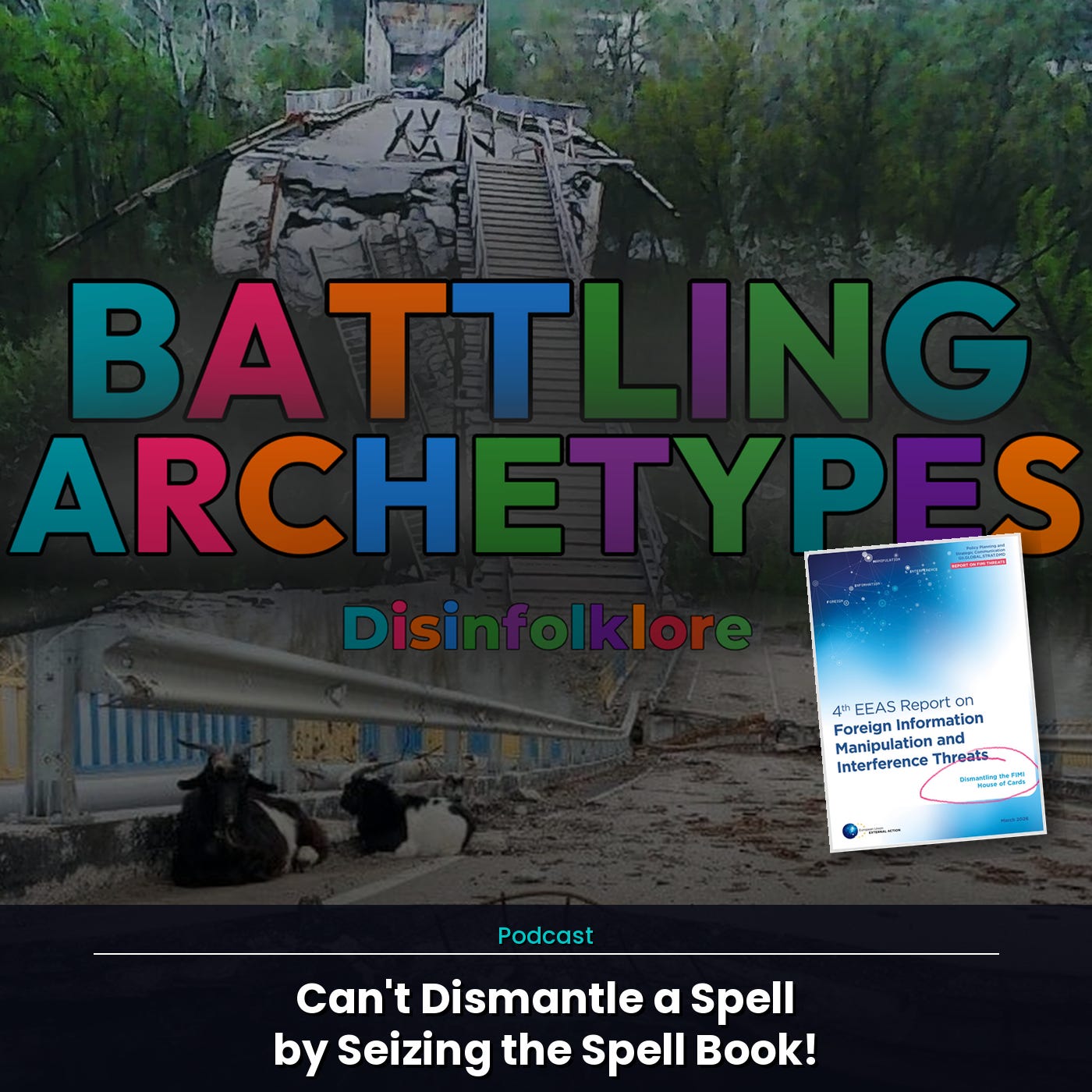
The European Union today released its highly anticipated — well, highly anticipated by the likes of me — fourth report on threats on what it calls FIMI, which is a rather unwieldy phrase. It’s not unanalogous to Disinfolklore, but FIMI stands for Foreign Information Manipulation and Interference. The “foreign” in this context means the threat is coming from outside the European Union, which for good, understandable political reasons and constitutional and mandate reasons, the European Union of course doesn’t want to get involved in intra-European Union created Disinfolklore or disinformation.
The fourth report which came out today — I just wanted to talk about it in the context of the Disinfolklore analytical method. I’ve talked before about the three previous reports. The first report was published three years ago and it provided a brand new analytical framework and common language through which European Union and non-European Union states could speak about the threat to their national security which Russia, China, and indeed Iran — those three are the main foreign forces that these reports are dealing with — pose.
It provided a common framework and a common language to talk about something which was new. From outside of the structure, the word “disinformation” was really operationalised from inside Russia. We have evidence from KGB manuals from the 1960s and 1970s of them using the term disinformation. Therefore, if you’re trying to solve a problem or talk about a problem or come up with tools to deal with a problem that has been created by the Russians, then if you subject yourselves to using the vocabulary and language and tools which the Russians themselves have forged, there is only a limited area for you to operate within.
By contrast, if — as I have done with Disinfolklore — you invent a new portmanteau and you elaborate a whole set and analytical method, as I have done through the Twelve Tool Way on disinfolklore.eu, and through my writings, which many of you have been thankfully reading and interacting with since I created the portmanteau in February 2023 — but after thinking and thinking about what Disinfolklore means as an analytical method and also as a narrative form that I first noticed in Russia-occupied Ukraine between 2015 and 2018.
It’s now ten years I’ve been thinking and elaborating and writing about this problem, but I’ve only had the term Disinfolklore for the past three years. It was quite liberating to come up with this word. I had from time to time tried to look for a new language in new terms because I recognised from early on in 2015 that what I was witnessing inside Russia-occupied Luhansk was something new and therefore it required a new vocabulary to describe the whole system of information fields, matrices, thick enmeshing matrices — the kind which we’re now experiencing, for instance, in relation to this Iran war.
The Colonisation of Thought
Even people who haven’t paid much attention to MAGA and who have no idea really of QAnon and what MAGA has been doing since 2015 to create this enmeshing, identity-creating mess inside people’s minds — now, if you are contemplating whether to fill your car with petrol or diesel, or you’re thinking, gosh, am I going to have gas? All the gas in my country comes from Qatar and they’re not going to be able to get this gas to the island of Britain or wherever else you might live. Where am I going to get my hot water? How am I going to drive my factory?
That kind of colonisation of our thoughts is a direct line from Donald’s — on the one hand, the war is over; on the other hand, I’m having fun, I’m blowing things up. He is projecting outwards through the medium of Disinfolklore into our minds, into humanity’s minds, this completely enmeshing, confusing mess of nightmarish rhetoric.
That is precisely what I had noticed the Russians were doing inside Russia-occupied Ukraine. I didn’t know at the time what they were up to. Only after the full-scale invasion began, I realised — oh my God, this is what they were doing. I was inside what I call a stealth attack. A stealth genocide.
The EU’s Parallel Journey
The European Union has structures where it has been investing its energy into coming up with a new framework. It’s done this very successfully in these four FIMI threat reports. This fourth report, which is out today, is what I was going to talk about.
When I was standing on the bridge at Stanytsia Luhanska 2015 to 2018, watching Russian disinformation unfold in real time among real people — soldiers, civilians, spies, traders, all archetypes — the European Union was at the same time beginning to build its strategic communications apparatus from Brussels. Both of us were looking at the same phenomenon. We saw folklore. We saw an infrastructure.
The fourth EEAS FIMI report, published today, is the most comprehensive institutional mapping of foreign information manipulation ever produced. It documents 540 incidents. This is the meat and veg, as it were — or the lentil strudel — of what makes the European Union’s operation unique: it has the resources and now the methodology to document tens of thousands of instances of Russian disinformation, and Chinese and Iranian to a lesser extent. We see this sometimes on our Twitter feed as the excellent EU vs Disinfo, which is just one emanation of this whole system, this whole operation.
Donald and Cuba: Disinfolklore in Real Time
From my perspective, the engine of the operation is to collect instances of FIMI and try to determine the sources of them. I, as a lowly sole operator, use my method — the Disinfolklore analytical method. If I see coercive control immanent in a meme, if I hear, for instance, as I did today, Donald talk about Cuba as if it’s a woman —
Today Donald was referring to Cuba as a woman. It’s the same energy that Putler used just before the outbreak of the war. Donald grabs at Cuba the way he and Putler grab women — an archetype of women. This is Donald:
“It’s a beautiful island, great weather. They’re not in a hurricane zone, which is nice for a change. You know, they won’t be asking us for money for hurricanes every week.”
The first element of the Code of Positive Trolls is generosity. This is ungenerosity, therefore it is Disinfolklore. “They won’t be asking us for money for hurricanes every week.” I’m not sure Cuba has ever asked America for money for hurricanes. But obviously it hasn’t, because according to Donald — and I wouldn’t trust him on this — they have no hurricanes. I’m sure they have hurricanes. It probably breaches the second element of the Code of Positive Trolls — this is probably just totally untrue.
Back to Donald:
“But I think Cuba’s seen the end. You know, all my life, I’ve been hearing about the United States and Cuba.”
This is one of my pet theories about Donald. A lot of what he does goes back to the early 60s, a formative time when everyone was talking about Kennedy. What does he do? He wants to annihilate Kennedy by hiring this Epstein-connected Kennedy guy who wants everyone in America to become really sick. That will destroy this archetype of the good president in his early time. Obviously the Cuban Missile Crisis is part of that.
“All my life I’ve been hearing about Cuba and the United States. When will the United States do it? I do believe I’ll do the honour of having the honour of taking Cuba.”
This is where the language that we know through the legal cases — that E. Jean Carroll took against him, where he was adjudicated by the judge to be an adjudicated rapist, and two grand juries found that he had in fact assaulted E. Jean Carroll in, I think, Saks Fifth Avenue. We also have the footage we heard in 2016 from the outtake. We understand that this archetype in Donald’s mind is how he treats women.
“That’ll be good. It’ll be a big honour. Taking Cuba. Taking Cuba in some form. Yeah, taking Cuba. I mean, whether I free it, take it. I think I could do anything I want with it.”
This is the Epstein class. This is what they did to women entrapped on the island at every level. We’ve seen this week women who had jobs as assistants to Epstein, some of whom may well have been complicit in the crimes and in this entire coercive control network which entrapped the most powerful and richest people in the world as well as some of the weakest — women and children. As far as we can see, this is still entrapping people.
Putler’s Parallel: “Like It or Not, Take It, My Beauty”
I often cite how Putler made his speech to the Russian people on the 20th of February, four days before the full-scale invasion, where he said: “Like it or not, take it, my beauty.” International lawyers in the first New Lines Institute report on genocide in Ukraine cite this as evidence of genocidal intent because what Putler was doing there was using a vulgar Russian rhyme — it’s from a Soviet-era hard rock song from a band called Red Mold, and the song is called “Sleeping Beauty in a Coffin.”
Again, Disinfolklore — Sleeping Beauty, one of the core archetypes in European, Indo-European folklore, Indo-European culture. Putler was likening Ukraine to a dead woman, to a corpse, and saying to it: “Like it or not, take it, my beauty.” We see the same spirit, the same energy in the way Donald talks about Cuba today as he contemplates one of his other operations.
540 Incidents: The Scale of the EU Operation
The European Union, like me, is collecting incidents of this, but it’s obviously doing it on a much bigger scale. The report documents 540 incidents, 10,500 channels of Disinfolklore, 43,000 pieces of content across 19 platforms.
The report introduces a FIMI framework. Even for people like me who spend all day every day in this area, FIMI is still quite an awkward concept. What I’m trying to do with Disinfolklore is provide tools for ordinary people like you and me that we can use and integrate into our daily life as we’re dealing with lots of timelines, rather than provide a framework for nation states. The European Union has a much bigger mandate and a bigger scope than me. I’m merely trying to inject an algorithm into humanity’s minds that’s more easily memorable. I’m hoping Disinfolklore will work a little bit better than its analogue FIMI.
What the FIMI report does today — it maps a galaxy of interconnected FIMI operations. It’s without question an impressive institutional achievement. One of the main goals of this operation in the European Union is to ensure it’s not dealing with what I might call DMI, which is Domestic Information Manipulation and Interference. For good constitutional mandate-related reasons, it wants to ensure that the units of information it’s dealing with do emanate from outside the European Union and specifically from Russia and China, and to a lesser extent, Iran. That’s within its mandate.
My Analytical Framework for This Report
I read these reports through the lens of the Disinfolklore analytical method, which I elaborate in these podcasts once a week and also on the disinfolklore.eu website. I wanted to look at: what does this report see clearly? What does it miss? What might each of our different approaches perhaps learn from one another?
I’m going to talk about: one, what the EEAS European Union framework is and what it does well; two, what Disinfolklore is and does differently; three, the critical gaps in the European Union approach that Disinfolklore fills — that is not to denigrate the European Union framework, as I’ve mentioned, it’s trying to do a different thing than Disinfolklore is doing, but we are in the same sphere and in a way I’m using it as a foil to elaborate more on the Disinfolklore analytical method and to think it through myself; four, the institutional strengths of the EU that Disinfolklore needs; and five, a synthesis towards a combined approach.
Because one of the things I really have is — to quote Bono — three chords and the truth. I’ve got my Twitter account and various outlets. The European Union has the European Court of Justice. It has a sanctions framework. It has 27 of the most powerful economies in the world. It has all of these different institutional mechanisms which it can use and it has been using amazingly and in a really innovative way to sanction individuals who are found guilty of speech crimes. This is something which the owner of this platform is not very happy about. That is also perhaps what is motivating part, at least part, of Donald’s war against Europe.
Part One: What the EU Report Does Well
The report uses a metaphor from military doctrine because, as with Disinfolklore, FIMI is about national security. This isn’t a kind of add-on or cultural nicety. The same with Disinfolklore — for me, it was born in a war zone, born in eastern Ukraine, born on this bridge, in this liminal territory between the Russian occupiers and the Ukrainian military. This is a question of national security, whether we remain sovereign democratic countries and states.
Yes, it’s great to have a bit of media literacy and informed political debate and ways of building and consolidating our mental hygiene. But ultimately, from my perspective and also from the European Union’s perspective, this is about national security.
The report borrows the kill chain concept from cybersecurity and applies it to information operations. FIMI operations are mapped from planning and financing through production and amplification. I should say at this point, one of the big differences between the Disinfolklore analytical method and FIMI, and in fact most disinformation work, is that I see — and I’ve seen this since being in eastern Ukraine — the continuity between the online and offline worlds. For me, there’s no distinction between the methods Donald will use when he is in private trying to convince somebody to do his bidding, and the method he will use on Twitter to try and troll the United Kingdom into sending its aircraft carrier into the Strait of Hormuz. It’s the same structure — the rhetoric of hostage-taking, provocation logic, coercive control, this swinging of one minute I’m your friend, one minute I’m your enemy. It’s the same method Donald uses, the same method all wife beaters and coercive control addicts use, the same method that Epstein used, the same method that every Russian commander on the front uses to persuade their people to go to their deaths in a meat assault, all the way up the chain of command to Putler.
While for obvious reasons the European Union is dealing just with the online sphere and looking at kill chains and cybersecurity, the Disinfolklore analytical method and its value should be to provide a set of tools that work in the offline world just as well.
The Kill Chain and FIMI as a Service
Each stage in a FIMI incident is mapped from planning and financing — through, for instance, the chef sorcerer Prigozhin and his Internet Research Agency who got Brexit done and Donald elected the first time. We’ve got lots of first-hand testimony from inside the troll factories: the way they’re structured and organised, people have quotas, they’re given temnyky — which is the Ukrainian word for themes. “Your job this morning is 30 tweets attacking European leaders.” They go off and then they have their lunch hour, just like normal people with normal jobs, but their job is to pollute our minds with Disinfolklore.
FIMI operations are mapped with planning and financing through to production and amplification. Each stage becomes an intervention point. This is genuinely useful. It transforms FIMI from an amorphous problem that we see in our information space or through the words of a friend into a set of discrete, targetable phases.
The key insight is that the European Union has correctly identified that FIMI operates as an industry — what they call “FIMI as a Service.” Some of you might remember I wrote my piece “Genocide as a Service” about the Wagner military wing in Africa, where they move in and first provide some hardware — maybe a couple of planes, some tanks — and then they start providing what I call governance services.
The Galaxy Metaphor
At the Munich Security Conference, in which I declared the Disinfolklore Universe, I set out that we’re susceptible to being caught up in a concatenating series of Disinfolklore galaxies — like MAGA, like Russia-occupied Ukraine, like the Disinfolklore galaxy inside Russia. The European Union then a few weeks later — nothing to do with my speech — used the galaxy metaphor, but in a more concrete way, because what I’m always talking about is the system-wide effects of what I call Disinfolklore.
When Donald says what he says about Cuba being a woman ready, a weak woman ready to be taken — these are particular instances. It’s all very well dealing with them and looking at them as particular instances of Disinfolklore. But from my perspective, it’s the accumulation of billions of these incidences every day. Donald’s particular power is to, in the context of the Iran war, talk about 50 different things from 50 different perspectives. If you’re MAGA, you think the war is over. If you’re Iran, you just think it’s ridiculous. If you’re me, you’re just confused. There’s this whole system, the concatenating effects of individual instances of Disinfolklore.
That’s why for me, declaring the Disinfolklore Universe — where every aspect of our reality from the first moment we wake up each day is determined by Donald or Russia or a whole coalition — when you go to fill your car up at the petrol station, you’re worried about the price of fuel, or you have to make choices about food because you can’t afford fuel to get to your job. This is how the information space interacts with the inside of our minds.
The European Union uses a network graph to map approximately 3,000 core channels in a remarkable piece of infrastructure analysis. It reveals a central operational backbone of Russian-attributed channels surrounded by regional hubs targeting Moldova, Sub-Saharan Africa, and the MENA region. The identification of bridging nodes that connect the central infrastructure to regional clusters is operationally valuable.
Useful detail: only 9.5% of the channels are directly attributable to state actors. The remaining 90.5% are covert, state-linked, state-aligned, or unattributed. The iceberg metaphor is apt and important for policy audiences.
Disinfolklore’s Different Approach to Attribution
What I do in the Disinfolklore analytical method — I don’t care so much whether I can directly link a particular meme to a Russian state actor. If the energy in a meme is coercive control, for example, or is to destroy the post-World War II legal and social order, then I don’t care whether that’s coming from a domestic actor directly or from Russia or from MAGA. That is what, for me, marks it like a fluorescent dye as Disinfolklore.
From my perspective, the second element in the Code of Positive Trolls, which I use to determine whether a unit of information is folklore or Disinfolklore, is right or ethical discipline. That standard is set by the post-World War II legal and social order: the Genocide Convention, the UN Charter, the European Convention on Human Rights, the UN Declaration on Human Rights, and a whole plethora of treaties between states and the post-World War II Geneva Conventions.
If the particular meme is trying to denigrate international law — like practically everything that Donald does or anything that comes out of Russia — if I see that energy in a meme, that then becomes my point of operation. I’ll characterise that as being Disinfolklore. The European Union obviously has a different perspective and has to make sure it’s only dealing with material emanating from outside the European Union. But I think that if it developed an idea of what I call the mana in the meme — looking for the energy in particular memes — it would make their lives a lot easier.
Doppelganger and Information Manipulation Sets
The report’s tracking of specific information manipulation sets — Doppelganger, again, this comes from folklore. The term “Doppelganger” was used first by a European Union official when they discovered a network and particular disinformation modus operandi emanating from Russia, where they would fake pretend to be the Guardian — take a Guardian article, and then I might read and go, “Gosh, the Guardian saying this,” share it, and it gets shared on. Someone said, “This is a bit like the Doppelganger,” which is from Germanic folklore. This is part of my insight, my realisation since Disinfolklore, that we perceive so much of our reality, but especially stories and disinformation, through these lenses of folklore and what I call Disinfolklore.
Then the Russians saw that the European Union was calling these networks Doppelganger. In documents we’ve seen since, where these private entities in Russia are pitching for funding from the defence ministry or different ministries, they then use these European Union reports as evidence that they’re getting traction and that therefore they should be invested in. One of the really positive things you glean from reading these internal documents — when from time to time InformNapalm or other intelligence collectives manage to get their hands on them — is all of the lies the Russians are using inside their own institutions to try and get more funding. They are very bureaucratic.
Then they take on the mantle — Doppelganger. The Doppelganger’s Doppelganger, and it goes on. Like in a Mirror, Storm 1516, Operation Overload, Portal Combat, Spamouflage, Paperwall. These provide granular operational intelligence about how they work. The distinction between these different information manipulation sets, their behavioural signatures and their relative effectiveness, is excellent.
Storm 1516: The Exception That Proves the Rule
Storm 1516 stands out as the only information manipulation set generating genuine organic engagement, which is a critical finding. Really interesting — that so much of the effect of Russian disinformation can now be empirically demonstrated to be itself evidence of misinformation. Because when you look at it empirically, it’s only Storm 1516 which genuinely generates organic engagement. I, for one, will be looking more closely at their kind of content and what they’re doing.
The first European Union threats report rather oddly said that AI wasn’t anticipated to have any effect on disinformation. My eyebrows and others’ were raised at the time, but they’ve now recanted on that because in this fourth report, there’s a 259% increase in AI-related TTPs — that’s from cybersecurity and military speak: Tactics, Techniques, and Procedures.
The Mana in the Meme vs TTPs
When I talk about the mana in the meme, I’m talking about whether you can see the energy of ungenerosity — as we saw with Donald talking about how, if a country’s hit with a hurricane, he’s really quite tight-fisted, doesn’t want to give them any money to save their lives. If you see the mana against the post-World War II legal order, then you know prima facie it’s probably Disinfolklore — don’t let it into your inner mind, don’t repeat it, don’t let it affect you. Just move past it.
What the European Union looks at is TTPs: techniques, tactics, and procedures. You can see in the signature of certain ways in which disinformation is broadcast. For instance, if it’s using fake websites under the name of genuine publications and you don’t know anything else about it, then you know it’s probably Russian because it’s the same technique, tactic, and procedure they’re using — they’ve registered a domain name, and on the balance of probabilities you can tell it’s Russian.
The report identifies three AI challenges. LLM grooming — Portal Combat is this large language model grooming. The Russians are using AI to create content which is then used to skew the weightings inside large language models, so that when you put in a question — “Who’s the fairest country of them all?” — you get, “Russia, the big bear is.” Portal Combat: flooding the information space to contaminate training data. Cognitive chaos: erosion of trust through synthetic content saturation — that’s Donald’s main tool as well. Algorithm influence: volume-driven feed manipulation. This is what we’re dealing with every day on this app.
This tracks directly into my concerns about AI companions affecting mind streams. I’ve talked recently about how the Code of Positive Trolls can also mediate our relationship with AI chatbots, just as it can mediate our relationship with our social media feeds or with people in our lives who cause chaos in our minds or in our communities.
Part Two: What Disinfolklore Sees That the EU Doesn’t
This is my central critique — which is, again, not to denigrate but really just to illustrate what I do by comparison to the European Union. I’m just one person with an idea and a lot of energy to try and operationalise it, whereas of course it’s a huge institution.
The EEAS report is extraordinarily sophisticated about infrastructure, channels, organisational structures. It’s remarkably thin on actual content — the narratives, the archetypal structures, the psychological mechanisms through which disinformation actually works on human minds.
The report’s analytical framework has three layers: the who (organisational structures), the how (digital infrastructure), and the what (FIMI activities and contents). But the “what” layer is the least developed — yet probably the most developed for me.
The deterrence playbook has detailed triggers and effects for sanctions and law enforcement targeting the who and how layers. For the content layer, the tools are limited to content removal and amplification disruption. There’s no framework for understanding why certain content works, why certain narratives penetrate authentic discourse while others fail. My answer to that is my discovery that the Russians were using archetypal Disinfolklore.
The EEAS can tell you that Storm 1516 has generated four million views on a particular video. It cannot tell you why that video resonated, what archetypal structures it activated, what emotional journey it induced in the viewer, or how to inoculate populations against that specific form of narrative sorcery. Disinfolklore can.
The 5Ds vs the Twelve Tools
The EU uses the 5Ds framework — dismiss, distract, distort, dismay, divide — from the Disarm Foundation to categorise Russia’s and China’s strategic objectives. Let me say, I would love to see the European Court of Justice — and I will campaign for this over the next few decades — adopt the Code of Positive Trolls. I used the term “code” originally as a lawyer because it does operate as a test, the kind of six-limb test introduced in many different areas of European Union law and our domestic jurisdictions.
The 5Ds are a useful typology of intent, but they operate entirely at the level of the operator’s purpose. They say nothing about the recipient’s experience. My twelve-tool framework at disinfolklore.eu operates at both ends of the transmission.
The first six are detection tools: archetypal Disinfolklore literacy; incoming and outgoing troll radars; look for the mana in the meme; the four dimensions — moods, attitudes, intentions, motivations. Sometimes the first feeling you get that you are being manipulated — and this is what I try to imbue myself with when I find myself really confused, as I have since the beginning of these attacks on Iran — is if my incoming troll radar is activated and I’m detecting my mood, my attitude, my intention, my motivations being changed by information coming into my mind. That sometimes is the first clue I get that someone is trying to manipulate me. That allows me to triage — like when you go into a hospital — triage certain informational units in a particular container in my outer mind for closer examination. Or if I’m in a rush and just don’t have headspace to deal with stuff, I just dismiss it. If it’s ungenerous, like anything coming from Donald at this point, I just dismiss, except for pedagogical purposes because he’s such a great example. I designed the Code of Positive Trolls to try and understand and confront and counter what Donald was doing in 2019, back in those ancient days. Now we see he’s wrapping humanity up inside this craziness.
Then the other detection tools: the trigger-experience-reaction model, which I take from Paul Ekman and the Dalai Lama. I’ve done podcasts on that before — it’s up on the disinfolklore.eu website. Understanding how Disinfolklorists construct their output.
The second six — which is the Code of Positive Trolls: generosity; ethical discipline or right; patience (if someone’s trying to get you to be urgent, to make you make a decision right now, then you know someone is trying to manipulate you — just somehow get out of that moment); energy/mana is the fourth element; focus/mindfulness, which is necessary to maintain — by mindfulness I mean being mindful of what you allow into your mind; and the final is insight/wisdom.
These are the response tools that address our individual capacity to resist Disinfolklore. The structural difference: the European Union’s 5Ds classify what the attacker is trying to do. The twelve tools equip the defender to understand what is happening to them, to us, and how to respond. One is a taxonomy of offence; the other is a practice of defence. The European Union has the taxonomy of offence. It does not have the practice of defence.
Archetypal Depth: 6,000 Years of Indo-European Culture
The European Union acknowledges that FIMI narratives are repetitive and predictable. It documents the three-phase Russian election interference playbook: delegitimise leadership, weaponise divisions, undermine electoral integrity. But it treats this repetitiveness as a feature of Russian operational doctrine. Disinfolklore goes deeper.
My framework traces these narrative structures, these archetypes, back through 6,000 years of Indo-European culture. The inner-outer realm switching that I documented at Stanytsia Luhanska, where Russian-speaking Mariupol mothers were instantaneously re-archetyped as dead Ukrainian Nazis — that is not a Russian TTP, not a Russian tactic, technique, or procedure. It’s an ancient mechanism of exclusion and dehumanisation that Russia has weaponised. The Trito myth, the wolf in sheep’s clothing, the trickster tale — which the Middle Eastern countries are living right now. You give Donald a gold-plated Boeing 747 and all you get in return is 100 Shahed drones attacking your infrastructure. When you say to Donald, “But you said you’d protect us,” all you get is, “How about another jet?”
The trickster tale. We learned these when we were children and these have been passed on and on, whether in the Arabian Nights or Chaucer’s tales or folk tales collected by the Brothers Grimm, or indeed in the folklore which Mockers reads on Volya Radio each morning. These are structural patterns that predate any state actor. That’s the depth I help provide.
Why this matters operationally: if you only understand FIMI as Russian or Chinese state behaviour, your response is limited to targeting those states. If you understand it as a weaponisation of deep archetypal structures that are hardwired into Indo-European cognition, you can build genuine cognitive immunity because you can teach people to recognise this pattern regardless of who deploys it — whether it’s in your own household or in your own community or from Russia.
The Missing Mana Dimension
The European Union report exhaustively catalogues channels and observables. It counts, it maps, it attributes. But nowhere does it ask: what is the energy inside the meme? What is the affective charge that makes one piece of content resonate and another fall flat?
My concept of mana — the energy embedded in informational units that impacts moods, attitudes, intentions, and motivations — is precisely what the EEAS framework lacks. The report notes that most AI-generated FIMI content is low quality and generates limited organic engagement. It notes that Storm 1516 is the exception, but there’s no framework for explaining why. In my terms: most FIMI content carries weak or misaligned mana. Storm 1516 succeeds because it plugs into authentic fears and archetypal structures that carry real affective charge.
My Finding Manuland research — you’ll see the Manuland section on disinfolklore.eu — traces the etymological and semantic and hermeneutical link between the mana energy, the M-N in mana and energy, and money — it’s in M-money as well — through 6,000 years of M-N sound patterns. The EEAS report documents Russia’s 146.3 billion rouble media budget, about 1.56 billion euros. The linguistic archaeology tells us something the budget line does not: money and mana are cognates. The resources flow where the energy is. Understanding the energy is understanding the resource allocation.
The Sympathetic Magic Lens
The sympathetic magic lens, which is a relatively new lens I’ve introduced alongside war magic, propagation apparatus, folklore-like archetypes, and gender lenses — that offers analytical depth which the European Union framework entirely lacks.
The European Union report documents that during the German elections, Russian accounts shared AI-generated images of apocalyptic versions of German landscapes engulfed in chaos and crime. In the European Union framework, this is categorised as a technique within the “distort” strategic objective. In my framework, this is sympathetic magic — the creation of images (image, mage — it’s that sound, from early Indo-European languages). The creation of images intended to bring about the reality they depict. It’s contagion — I use the word mana, which is contagion energy — in the Frazerian sense. James George Frazer, who first set out the laws of sympathetic magic: law of opposites, law of similarity. The image infects the viewer’s inner mind with a vision that then shapes perception of the real world.
The practical difference: understanding this as sympathetic magic immediately suggests countermeasures that content removal cannot. You cannot remove images from minds. You can teach people to recognise the magical mechanism. This is what archetypal Disinfolklore literacy does.
The Individual Mind
The European Union report is almost entirely systemic. It addresses states, institutions, platforms, regulations, and sanctions. That’s why I say it is doing a different thing than I’m doing, and I’m not criticising it in a negative sense. Its resilience-building pillar mentions media literacy and capacity building across institutions and civil society, but it never descends to the level of the individual mind — whereas that’s my primary interest.
Disinfolklore is fundamentally a practice for the individual. Trigger, experience, reaction — that’s the model I take from Paul Ekman, who died recently but is the genius who basically established the whole area of micro-expressions revealing true intentions and feelings, which is of great interest to computer vision specialists. He and the Dalai Lama developed the Timeline of Emotions model: trigger, experience, reaction — which I apply to our timelines where you’re triggered by something, you experience a feeling (one of the five primary feelings of disgust, sadness, and others that Ekman set out), and then the space between our experience of the feeling and how we react to it — that’s the space we can control if we have our incoming troll radar actualised and we’re mindful of what’s coming into our mind.
If, for instance, we scan for ungenerosity and use that as a proxy for an informational unit or meme that we should not share — because we’re just passing on negative energy — and if we’re particularly disgusted by something, it may be that it is targeted at our vulnerability. This is what ISIS was able to amazingly do with all of its horrid Disinfolklore ten or fifteen years ago, like a world before.
The Code of Positive Trolls provides a personal ethical framework for navigating information warfare. “Is there generosity in this message?” is a question any one of us can ask. “Does this violate the Digital Services Act?” — well, not really, not unless you’re a very clever lawyer, because it’s an amazing piece of legislation but it’s pretty complicated.
The Post-World War II Legal Order
Both frameworks share a normative foundation in defending the post-World War II legal order. But the European Union locates this defence in institutional mechanisms — sanctions, regulation, law enforcement. I locate it additionally in individual moral agency: our capacity to refuse to be trolled, to refuse to share the Disinfolklore, to refuse to participate in the destruction of our own civilisation. Both are necessary. Neither alone is sufficient.
Part Three: What the EU Has That Disinfolklore Needs
The European Union has — since I’m just one person, really — institutional scale and data: 540 encoded incidents last year, 10,500 channels mapped, 43,000 observables, a network analysis capability, a STIX-encoded threat intelligence sharing system, and the backing of 27 member states. Disinfolklore has a one-million-word corpus and a single analytical mind. The European Union can scan the entire FIMI ecosystem. I can go deep — archaeological excavation over 6,000 years of history for individual archetypes. Both are needed.
The deterrence playbook is something Disinfolklore does not yet have the equivalent for. My framework tells us how to see and resist Disinfolklore. It does not yet systematically address how to raise costs for the producers of Disinfolklore. The European Union’s integration of sanctions, law enforcement, digital regulation, and resilience building into a single kill chain framework is a genuine institutional innovation. It’s a concept that you can make FIMI a losing proposition through cumulative cost imposition. That’s powerful.
Forward-looking capability: the EEAS’s ability to predict, say, that the Moldova playbook could be redeployed elsewhere is derived from systematic infrastructure monitoring. The report identifies upcoming elections in Slovenia, Hungary, Bulgaria, Cyprus, Estonia, Sweden, Latvia, and Denmark as potential targets. This kind of early warning system requires institutional resources that individual practitioners do not have. If you’re trying to persuade a government like Bulgaria or Latvia or Sweden to take preventative measures, then the European Union’s approach is what’s required.
The distinction between overt channels — 2.5% official state, 7% state-controlled — and covert channels — state-linked, and 86% state-aligned — and the rigorous methodology for moving between these categories is essential for legal and diplomatic responses. Disinfolklore’s analytical power does not depend on attribution, which is both a strength (it works regardless of who is doing it) and a limitation (it cannot directly feed into sanctions designations). Not yet — but I think a lot about that point.
Part Four: Towards a Synthesis
The fundamental complementarity: the European Union sees the plumbing. Disinfolklore sees the poison. The EEAS maps the pipes, identifies the pumping stations, and proposes blocking the flow. Disinfolklore analyses the composition of what’s flowing through the pipes, explains why it is toxic, and teaches people to recognise and resist it. Neither approach alone can win the information war.
Where both frameworks converge: both recognise that FIMI/Disinfolklore is deliberate and strategic, not random. Both identify repetitive patterns that can be anticipated. Both understand that Ukraine is the central battleground. Both locate the normative stakes in the defence of democratic systems and the post-World War II legal order. Both recognise that AI is transforming the threat. Both understand that resilience is ultimately the most sustainable defence. The EEAS’s observation that most FIMI content fails to generate organic engagement validates the Disinfolklore insight that weak mana does not penetrate authentic discourse.
Where They Diverge and Why It Matters
The European Union framework is horizontal and systemic — it scans across the entire threat landscape simultaneously. Disinfolklore is vertical and archaeological — it digs deep into individual archetypal narratives, tracing their structures back millennia. The EEAS treats content as the output of a supply chain. Disinfolklore treats content as the deployment of ancient cognitive weaponry. The EEAS framework targets the producer. Disinfolklore’s response framework empowers the consumer.
The Automation Bridge
Here is where the two frameworks could converge operationally. I mentioned this last week — I’m working on automating the Disinfolklore analytical method via neural network training, using my one-million-word corpus on disinfolklore.eu as training data, with autoresearch and BitNet as target architectures.
The European Union already encodes its incidents in STIX format. If the twelve tools could be operationalised as classifiers trained on my corpus, they could be applied at scale to the EEAS’s 43,000 observables.
Imagine: each detected FIMI incident not only categorised by its 5D strategic objective, but also analysed for its archetypal structure, its mana charge, its sympathetic magic mechanisms, and its trigger-experience-reaction pathway. That would be a merger of institutional scale and analytical depth. We now have the models — which I’m experimenting with — that can do this, that have the kind of semantic depth to do this.
Anthropic’s Claude — Claude Code, for instance — was able to find premonitions of my insight about archetypal Disinfolklore, which I first wrote explicitly about in December 2024, when I first used the term in reference to Syria — the Potemkin state archetypal Disinfolklore of data-resistant archetypes of a Potemkin state. Claude Code was able to find premonitions of this going back years into my work, and some really interesting ones that I hadn’t seen. You could see these ghosts and premonitions of what I had thought. This is very personally gratifying and fascinating, but it also demonstrates the power of these tools to find examples of sympathetic magic, for instance.
Three Proposals
My three proposals to end with:
Proposal One: An Archetypal Layer for the FIMI Toolbox.
The EEAS deterrence playbook has four instruments: sanctions, law enforcement, digital regulation, resilience building. A fifth instrument should be added: archetypal literacy. This would sit within the resilience-building pillar but go beyond generic media literacy. It would teach specific recognition of the folkloric, folklore-like, and mythological structures that Disinfolklorists consciously and unconsciously weaponise: inner-outer realm switching, trickster tales, sympathetic magic, dehumanisation archetypes. My twelve tools, packaged for institutional educational deployment, could form the curriculum.
Proposal Two: A Mana Index for FIMI Incidents.
The EEAS currently categorises incidents by attribution, platform, geography, and 5D objective. A mana index — a measure of the affective charge and psychological penetration potential of content — would help prioritise response. Storm 1516 succeeds where Doppelganger and Overload fail precisely because its content carries higher mana, higher manipulative energy. It pulsates, it vibrates our mana. Quantifying this would be a significant analytical advance. We now have the neural network algorithms that are able to do this.
Proposal Three: The Counter-Archetyping Dimension.
The European Union report mentions strategic communication as a component of resilience building, but has no framework for counter-archetyping — the act of creating alternative narrative structures that displace Disinfolklore. NAFO is the best organic example of counter-archetyping in world history: individuals re-archetyping themselves with avatars that are charming, beautiful, lovely, agreeable, kind, not egotistical, humbly joyous. With these avatars, they re-archetype information in the information space and undermine and destroy the power of Russian Disinfolklore. This is narrative and archetypal warfare conducted with positive mana. A systematic counter-archetyping capability informed by 6,000 years of Indo-European narrative knowledge would be a powerful addition to the FIMI toolbox.
Conclusion: Dismantling the House of Cards, Breaking the Spell
The European Union report has a subtitle: “Dismantling the FIMI House of Cards.” Again, using this image from folklore — House of Cards. It is the right metaphor for the infrastructure. Pull out the right card — a sanctioned entity, a seized server, a deplatformed network — and the structure collapses.
But the narratives are not cards. They’re spells. They’re ancient patterns of meaning-making that have been weaponised. You cannot dismantle a spell by seizing the spell book. You dismantle it by teaching people to see the sorcery for what it is.
The EEAS gives us the capacity to dismantle the house of cards. Disinfolklore gives us the capacity to break the spell. We need both. The house of cards is the delivery mechanism. The spell is the payload. Kill the delivery mechanism and the operators will rebuild it. Break the spell and the payload loses its power regardless of how it is delivered.
This is the conversation I want us to have.


