


New Second Series and the Starting Point
I have been thinking about some of the archetypes and seeing their application. Frankly, I have been hearing more people say the method is useful for figuring out what is going on in the world. I am glad this is something that is catching on with some important people, the people I work with. It matters. It really is helpful to understand how Russia thinks and how we can use this against them.
My vision is that we will have two series going on together at the same time, one week on, one week off. The other series, which I started a few weeks ago, is looking at this well of data that I collected between 2015 and 2018 in Luhansk from the Russian occupier media, broken down into the various archetypes. I have been going through that.
This series I wanted to start was to look at trolling and the emotion-moving activity of body, speech, and mind. I have spoken about this before. I did a lot of work on this from the autumn, from the fall of 2019 onwards, and particularly from March 2020 onwards. I went through 60,000 or 70,000 entries under the terms trolling and trolls in the Dow Jones Factiva database of 33,000 sources. That is the largest media source database on planet Earth.
What I wanted to look at was how the terms trolling and trolls are used in the modern era, as evidenced by these 60,000 or 70,000 entries in the database. Recently, I have been able to analyse the results in a way that I had not had the space and the time to do before. In some ways, you have seen the results of it, which is Decoding Trolls and all of my work, the Code of Positive Trolls, and things I have talked about in Disinfolklore.
The Insight from Eastern Ukraine: Artillery and Emotions
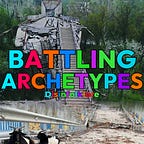
I am going to start with the insight which I had in eastern Ukraine, which was the continuity between, for example, artillery strikes on the bridge at Stanytsia Luhanska — the continuity between that and the emotions you feel when you see them or feel them or hear them — and the emotions you feel when you read articles written about them.
I had this insight, this vision, that actually there is no real difference in terms of quality, the content of trolling through artillery strikes, for example, and using Twitter to troll. The same effect on people’s emotions comes from these two different examples.
I had started off on this journey because I wanted to understand how Donald Trump was able to use Twitter to provoke people’s emotions. That is essentially why trolling seemed to me important as a concept. It is my luck — I use that in a very classic sense — it is my luck that Donald was re-elected and we have seen his self-realisation move towards this apex.
The White House Meme Apparatus in the Iran War
My starting point really is the White House meme apparatus in the Iran war. Between the 28th of February 2026 and the launch of Operation so-called Epic Fury and the two-week Hormuz Strait ceasefire — or if it was a ceasefire, which has supposedly been extended today — the Trump White House ran the most aggressive presidential office social media war propaganda campaign in American history.
What had been in the first Trump term a hobbyist’s Twitter feed has been fully institutionalised. The White House X, TikTok, and Untruth Social accounts, together with the Rapid Response 47 feed, have posted over 100 short-form videos mashing up real Iran strike footage with Grand Theft Auto: San Andreas, Mortal Kombat, Halo 2, Call of Duty, Wii Sports, Top Gun: Maverick, Gladiator, John Wick, Transformers, Deadpool, Star Wars, Iron Man, Breaking Bad, Better Call Saul, Yu-Gi-Oh, and SpongeBob SquarePants.
This is clearly within my jurisdiction. This is all Disinfolklore. This is the use of contemporary folkloric tropes and memes to communicate national policy.
Six Archetypal Moves Inside the Iran Theatre
There are six archetypal moves I have managed to trace inside this, all running simultaneously.
The first is drama as war. Real killings are edited into video games. Ludic frames — wasted, flawless victory — close the Epic Fury montage after Iranian trucks and ships are blown up. This is Surkov-style dramaturgy imported into the world’s largest military. For those of us who are Americans, it is a moment of epic shame.
The second archetype is accusation in a mirror, Minab edition. The Shajira Tayeba school was destroyed by a US Tomahawk on the first day of the war. Bellingcat, BBC Verify, the New York Times, and preliminary Pentagon findings all attributed responsibility to the United States. Donald, on the 7th of March, said the strike was done by Iran because Iranians are very inaccurate with their munitions. Leavitt, at the 4th of March podium, said “not that we know of” when asked if the US had killed the girls, and called the reporting propaganda.
The third archetype is war magic by repetition and opposites. The White House reframed a war of choice, unsupported by a UN Security Council mandate and unsupported by any armed attack on the United States, as “peace through strength” — another archetype, the exact phrase that Reagan coined and that Leavitt in November 2025 attributed to Donald. The words crushes, decisive, overwhelming strength, lethal precision recur verbatim across the White House Epic Fury page, the CENTCOM press release, the DOD fact sheets, and the Rapid Response 47 feed.
Just to remind people: in the past, wars were fought — sure, we had CNN in the first Gulf War, and Baudrillard famously wrote about how the Gulf War only happened on TV. At that time, there were also diplomatic channels, the UN Security Council, meetings between allies. The war itself was separate in some sense that it is no longer separate from this meme war.
The fourth archetype is the provocation logic cycle, which I did that series of five on — reflexive control. Donald’s Truth Social cycle — open the Strait, you crazy bastards, or you will be living in hell — his Easter week threats to bomb every bridge, every power plant, every desalination plant, all AI-generated — exactly the escalation ladder that let him claim victory by ceasefire hours before his own deadline expired. Iran’s forced reopening of the strait under threat was branded a diplomatic win. The test was invented to produce the outcome.
The fifth archetype is the foreign scapegoat switch. Iran was slotted into the same scapegoat rotation machine that has cycled through trans service members, Haitian immigrants, Venezuelan gang members, universities, law firms, trans athletes — Donald is on about athletes again today, university athletes — and the press corps. The Iran theatre gives the administration what domestic scapegoats cannot: kinetic footage. That footage feeds the meme engine, which feeds the ratings, which feed the podium.
The sixth archetype is stealth via AI targeting. The Maven — again, a Disinfolklore moniker — the Maven so-called smart system from Palantir — again, a Disinfolklore moniker, the magic stones from Lord of the Rings. Palantir is a $1.3 billion Pentagon programme of record, with Anthropic’s Claude embedded to rank targets and draft legal justifications.
Palantir has been around for about ten or twelve years. Many people have said it is basically just a shell; they have nothing, there are no magic stones underneath it. Here we find out that basically — because it was Palantir’s magic stones which were involved in the targeting of this school — Palantir is using Claude. It is using Anthropic’s systems. Anthropic was a company begun four years ago. From my experience, it does have the most powerful available AI engine ever created.
Here we have Palantir. They are just basically trying to scapegoat Claude. By scapegoating Anthropic’s Claude for the mis-targeting, they are admitting that they have nothing. It is just like a holding company. Even though they have had access to so many governments’ records — the National Health Service in the UK handed over the entire database to Palantir under the last government, continued by this government — yet, despite having all this massive amount of data, Palantir never seemed to build any AI engine capable of properly processing these data into actionable predictions.
We know what Ukraine has done with the Delta battlefield system. One of Palantir’s great products was to sell NATO their real-time battlefield intelligence system. Ukraine has just built its Delta system from the ground up, which is, as far as we were aware, better than anything NATO or Palantir could come up with.
Palantir used Anthropic’s Claude to rank targets and draft legal justifications. This compressed what had been days of human analysis into minutes. The Minab school was hit because DIA-supplied coordinates were outdated. As we now know, you could have looked on Google Maps and seen it was a school, but six years ago it was not a school. The system did not catch that the school had been fenced off from the IRGC compound. Between 2013 and 2016, the kill chain accelerated faster than the error-correction loop.
When the atrocity surfaced, the administration’s first move was denial through social media. Second was propagandising the denial. Third was the meme.
In my Disinfolklore framework, this is what I call a negative chain: coercive control, war magic, stealth, and drama, all running on full throttle in the Iran theatre. The meme apparatus is the drama. The archetypal insurance the administration is taking out — through Leavitt’s podium denials, Trump’s Old Testament Hormuz thunder, Hegseth’s no-quarter pledge, and the White House’s cartoons — is the war magic that legitimises the stealth and re-archetypes a war of choice as an existential one.
The Code of Positive Trolls — the six-element code which I came up with in February 2020 — has never been more clearly needed and more clearly absent.
A Confession About the Word Trolling
I want to begin with that, but also then focus on what runs through all of it: trolls and trolling.
For almost a decade, I defended a definition of trolling that no one else was willing to defend. I told everyone who would listen, and many who would not, that trolling is any action, any activity of body, speech, or mind that moves another’s emotions. I said it on bridges in eastern Ukraine. I said it to diplomats. I said it to my students. I said it to agents.
The definition was not invented. I had lifted this definition — any emotion-moving activity of body, speech, and mind — from the word itself. The idea of movement is embedded in it: motion, emotion, motion. I had spent the better part of two years reading every sense the Oxford English Dictionary gave for the verb to troll and all the data which it referenced. What I found was a word that refused to stand still. I found a word that over 650 years kept escaping the narrow room dictionary-makers tried to lock it into. Here was I, trying to lock it into another narrow room: an emotion-moving activity of body, speech, and mind.
Tonight I want to walk you through what the OED, the Oxford English Dictionary — the definitive statement of the state of the English language — actually says about this verb, because the shape of the entry is the shape of my problem, and I will argue by the end the shape of an answer.
The OED Entry: Forms, Etymology, and the Warning Label
I have started with Iran to remind us of where we are with trolling and how trolling has migrated: from the hobbyist using page eight to big himself up in the 1980s New York real estate high-society world, through the first presidency, through to the use of Twitter to mobilise and execute an insurrection against the United States on January 6th — as those of us who have read the January 6th federal indictment will remember how Jack Smith begins the indictment on election night, when Donald first starts tweeting that the election was stolen, and then catalogues the use of Twitter all the way through those months to summon the mob over the course of months. That version of trolling: moving people’s emotions so that they felt their highly valued democracy was in doubt, mobilising them, getting them to perform and conduct and engage in an insurrection against the United States. Then all the way up to where we are now.
The OED lists the forms before it lists the senses. Troll has gone under the shapes — it has different spellings: two Ls, one L, an E following the L, a W; trowle, trowle with an E, trolle — like French; trull, trull with an E. In Scottish dialect through the 18th century, the word was trowl.
The etymology is candid about its own uncertainty. The editors write that the verb is “a word or series of words of uncertain origin and of which all the senses do not go closely together.” That single line is the archaeologist’s warning label, and it is what I thought I had solved.
The sense I used troll in, after conducting this very long survey through Factiva and also through ProQuest — which has basically every pamphlet and article, everything you can imagine from the 16th century produced in England, scanned and now searchable — the emotion-moving activity of body, speech, and mind, for me, was something that crossed all of these boundaries.
To use a metaphor I take from Dnipro, which was another starting point for me — looking into a burial mound on the outskirts of Dnipro in May 2021 — we are digging into a mound that may contain more than one burial.
The dictionary’s best guess is that the word comes from Old French trolle, a hunting term meaning to quest, to go in quest of game without purpose. That is a sense which any police officers listening from America will understand — trolling for criminals. The companion guess is German trollen, to roll. Both senses are present in English, and the editors note that English has acquired further senses not found in either parent tongue.
One of the things I learned from looking at the OED at this time was that most English words are cited as beginning around the 12th or 11th century and came in from French or from German. The proto-Indo-European element, where many of our words come from proto-Indo-European roots, from the earliest Indo-European languages, is somewhat blind. I just make that health warning.
The Common Denominator: Emotion-Moving Motion
If I want to claim that trolling is any action of body, speech, or mind that moves another’s emotions, then Langland’s trolling pilgrim and Shakespeare’s trolled catch, Dekker’s trolled bowl and the psalm troller of the Reformation, and the Tudor angler with his running line must all be doing the same thing at the level of structure.
In a certain Buddhist way, they are. Each one sets something in motion that moves another person. The pilgrim who approaches. The singer who passes the melody. The host who passes the bowl. The minister who trolls the soul towards God. The angler who trolls the bait towards the pike. Movement of body, speech, or mind directed at another. That is the shape. I was not making the definition up. I was reading it off the page, although I am the first person to put it in that way.
The common denominator of the five OED families is emotion-moving motion: literal motion in family one, articulated motion in family two, social motion in family three, musical motion in family four, predatory motion in family five. The T-R sound itself, as I will argue in a future episode and have argued before, carries the semantic charge of transport, traverse, transition, trajectory, trans. Every living Indo-European language builds its verbs of motion out of that consonant pair. That definition is in the phoneme of trolling.
Remember, for me, I did not know anything about Indo-European studies when I started this journey. This was my porthole. I opened the window and started looking at this.
I said: if the word is this capacious, why not rescue it? Why not let the Christmas bowl and the pedagogical Usenet newbie trap and the pilgrim on the road all sit together? Why not build a discipline — the Code of Positive Trolls — that asks us to troll well, to troll positively in the old merry sense, rather than to troll viciously in the new sense? I spent nine years on that answer.
The Four Words That Stopped Me
Then one morning I opened the OED to the bottom of the troll verb entry and I read the four words that stopped me. The OED had added them in a box headed “Draft Additions, March 2006.” The words: intransitive, computer slang — to post a deliberately erroneous or antagonistic message on a newsgroup or similar forum with the intention of eliciting a hostile or corrective response.
I began with Iran. Trolling in the computing slang is now the main means of the United States of America — the greatest community of people that has ever lived and gathered, together with the greatest army that has ever been assembled — now being run through social media accounts and memes.
It began, according to the Oxford English Dictionary, as recently as March 2006, when they entered it as computing slang: to post a deliberately erroneous or antagonistic message on a newsgroup — not on Twitter, not to the Iranian government — with the intention of eliciting a hostile or corrective response. The earliest citation they use is October 1992, the Usenet group alt.folklore.urban. The message is: “Maybe after I post it, we could go trolling some more and see what happens.”
The OED is the most cautious lexicographic institution in the English-speaking world. It does not redraft an entry lightly, and it does not add a computing sense to a 14th-century verb unless its evidence base is overwhelming. Between 1992 and 2006, a 14-year window, the Usenet sense accumulated enough citational weight that the dictionary had to concede: troll now means also to post provocative content to elicit reaction. The gloss is narrow, clinical, and pejorative. It does not describe the bowl. It does not describe the psalm. It does not describe the pilgrim.
I emphasise that this work is mine. As far as I know, no one has ever really looked into this word in this detail. There are a lot of books on trolls — folklore trolls and other aspects — but to look at it from a geopolitical, political discourse point of view, as far as I know, no one else has really looked into it in this detail.
I will take you all the way back to this morning, where the President of the United States has told a White House adviser that he wants to appear on social media as unstable and insulting as possible, because “instability is a language the Iranians would understand.” That is a very important aspect of what Donald is doing. He is using trolling because he wants to appear as unstable and insulting as possible. It is a direct quote — I think it was in the New York Times — by advisers to Donald.
The only way to serve this word, this verb trolling that will not stay still, is to stop trying to hold it in one place and to build instead a code — a set of six practices that can be applied whenever the verb happens to mean next. That code is the subject of this series. Tonight I just wanted to show you the verb in all its seven families, so that when you hear me argue later that troll is the phonological mirror of truth, you will know that I did not arrive at that argument lightly. I arrived at it after 650 years of motion refused to stop — and in the end, after the motion killed 49 people on a Tuesday night in April because the wrong man was holding the bait.
The Fishing Stream: The Angler’s Running Line
There are two discourses which trolling comes from, really, in a nutshell: fishing and folklore. Let me look at fishing.
Fishing is the older of the two streams that fed the word troll. The angler’s running line. The OED theorised that it may have come from trolle, early French for hunting, which is obviously quite close to fishing. The angler’s verb, the running line, and the clergyman of 1606 who said God trolls for souls.
I told you that the verb to troll belongs to several families of meanings in the OED, in parallel columns, and that the dictionary itself admits the families do not go closely together. I want to take you to the older of the two streams that fed the word. On the literal-motion side, it is the stream that was already there when the Scandinavian folk creature walked down the hill and met the English verb at the bottom. It is the stream of fishing.
I am going to spend a few minutes on the angler, because the angler is where the word was first weighted with moral content. The folklore stream will get its own episode.
Consider what fishing is structurally. You stand at the edge of a moving body of water. You cannot see into it. You know there is life beneath the surface and you cannot address that life directly. You construct an elaborate indirection. You take a line. To the end of the line you attach a piece of bait. The bait is chosen because it resembles what the fish you want would eat if the fish were doing what the fish do when you are not there. Then you place the bait in the water and you cause the bait to move — by casting, by drawing, by rowing forward with the line trailing behind. The fish, not seeing you, sees the bait. It mistakes the bait for the real prey. It strikes. You have caught it.
Fishing is a lesson in the manipulation of another mind across a medium that makes direct communication impossible. The fish lives in a world you cannot enter. You reach into its world with an object that is not what it seems. You shape the object’s motion. You make it more persuasive. You wait for the target to project onto the object the identity you have designed for it. When the projection is complete, you set the hook.
This is not a small thing. This is a model of how one mind can move another mind by constructing a lure, placing it at the boundary of another’s world, and making the lure move in a way that mimics the real thing. Every advertising campaign from 1890 forward is an application of this model. Every disinformation operation is an application of this model. What Surkov calls non-linear politics is an application of this model. What Steven Cheung does at the White House, with the Grand Theft Auto cheat code layered over real Iranian strike footage, is an application of this model. The fisherman was there first.
God Trolleth for Thee: 1606
When did the English language acquire a verb for the activity I just described? The OED’s earliest citation for the angling sense is 1606. The source is Samuel Gardiner’s Book of Angling. The line reads: “Consider how God, by his preachers, trolleth for thee.”
I want you to sit with that sentence for a moment, because it is where the word carries its highest moral charge. We are in a week where Donald is trying to distract by trolling as the Antichrist, by trolling the Pope, and modelling as the Antichrist, then trolling the Prime Minister of Italy when she defends the American Pope.
Consider how God, by his preachers, trolleth for thee. I want you to sit with that sentence because it is where the word carries its highest moral charge in the entire history of the English language. Gardiner is not writing a manual of rod and line. He is writing a devotional treatise that uses fishing as an extended allegory for the work of salvation. The preacher in this image is the angler. The sinner is the fish. The gospel is the bait. The church is the bank of the river. God — note the grammatical position — is the one who trolls.
God trolls through the preacher. The preacher is the instrument. God is the verb’s subject. What God does to you through the voice of the man in the pulpit in 1606 is troll. God trolls for your soul. Today, Donald says he is enacting God’s will — and he says that while trolling.
You cannot read that sentence without seeing the kind of moral work the verb could once do. This is the verb at its most positively charged. It describes the activity by which divine love approaches a human being who cannot, in its unregenerate state, see the divinity directly. The lure is the gospel. The motion is the preaching — not Grand Theft Auto. It is the gospel. The strike is the sinner’s acknowledgement of grace. The word troll here means to save.
From Gardner to the Present: How the Moral Charge Drifted
How did we get from there to here? The short answer is that the verb was already older than Gardiner’s 1606 citation. What Gardiner did was apply an existing verb, used mostly for convivial motion — the passing of a bowl, the singing of a round, the trolling of bowls on a green — to a specific angling technique that involved a running line. The technique existed before the verb named it. There had been Tudor fishermen who trailed a baited line behind a rowboat or who spun a minnow on a winch for centuries.
The word exists in American English in a way it does not exist in British English today — trolling, where you are hanging the line behind the boat, which works in America. Trawling is a different kettle of fish to trolling. In case English listeners think trawling and the use of trawls, where you put massive nets in the water — that is a different art to the art of trolling, which people who speak American English will understand but people who speak British English probably will not.
What Gardiner does is take the verb that describes the bowls, the songs, the psalms, and lower it into the water. The fishing sense stuck. From 1606 onward, the OED citations proliferate in the angling register. By 1653, Thomas Barker in The Art of Angling writes: “The manner of his trolling with a hazel rod.” By 1682, Robert Nobbes publishes The Compleat Troller, an entire treatise devoted to the art. By 1720, John Gay writes, in Rural Sports: “Nor troll for pikes, despoilers of the lake.” By 1824, the British sporting press has refined the term: “Trolling or spinning a minnow is the other most general mode of trout fishing.” By 1891, Andrew Lang — the same Andrew Lang who edited the fairy books and who took an active interest in folklore — writes in Angling Sketches that “trolling a minnow from a boat in Loch Leven is probably the lowest possible form of angling.”
Three centuries of angling use, stretching from a Jacobean devotional writer to a late Victorian folklore editor. Note what has not happened in those three centuries. The verb has not yet acquired the pejorative sense it will acquire in the 1990s and 2000s. The verb has not yet been used in any widespread way to describe the deliberate provocation of a human audience. The verb is still, for three centuries, doing what it did for Gardiner: describing the patient, motion-based, indirect approach of an angler to a quarry that cannot see the angler directly.
All through those three centuries, the verb’s moral charge drifts. Gardiner’s “God trolleth for thee” is already slightly archaic by 1682, when Nobbes is writing a technical manual. By Gay’s 1720 Rural Sports, the verb is entirely secular. By Lang’s 1891 “lowest form of angling,” the verb has acquired a mild snobbery — trolling is what you do when you cannot fly-fish. The moral charge has left the word and gone into a different register. The word is now just a verb for a kind of fishing.
Notice what remains: the structural meaning. One mind setting a lure at the boundary of another mind’s world and moving the lure through the water to make the other mind project onto it — that is constant across all three centuries. The angler in 1606 and the angler in 1891 are doing the same thing. What changes is what you are permitted to say about whether you are doing it virtuously.
From Vietnam to Usenet to the Minab School
The first modern migration of the fishing verb into the non-fishing context happens in the United States military in the 1960s. US Navy pilots in Vietnam used the phrase “trolling for MiGs” to describe an unauthorised but apparently widespread practice: flying in patterns that would lure Vietnamese aircraft into an engagement so the American pilots could evaluate their opponents’ capabilities. The practice was not sanctioned; the term was. The term moved from the river to the sky, and with it moved the structural meaning: laying a bait, making the bait move, waiting for the strike.
This is an important moment. In the 1960s, in a cockpit over North Vietnam, the fishing verb acquires its first application to a human enemy. The fish and the MiG are both quarries. Both are lured by motion. Both strike when the lure moves in a pattern that mimics what they expected to hunt. With the MiG, the quarry is a person, and the person dies.
From Vietnam, the term does not travel widely in the 1970s or 1980s. I told you before about the Factiva corpus. It runs from 1970 to 1991, and it shows the word trolling meaning principally the Norwegian gas field, with a secondary sense of fishing, with a vanishingly small residue of figurative uses. I found the first use of trolling in the context of Donald Trump: “Donald Trump trolling for a buyer for his yacht” — in 1990, in the Boston Globe, 31st of March 1990. Interestingly, in that article itself, it talks about how Donald Trump, having criticised the Japanese, is now trolling for a buyer for his yacht among the Japanese. For those who are old enough to remember 1990, the Japanese were very rich then, until their crash.
He was trolling for a buyer. He was trolling for votes in 1992 political contexts. Trolling for customers in early 1990s tort reform rhetoric — tort, the law of wrong. In every one of these uses, the referent of troll is structurally identical to Gardiner’s 1606 angler. You are setting a lure and moving it to attract a quarry. There, Donald was using the Boston Globe to attract a quarry. Mitsubishi, I think, in the end bought his yacht.
The virtue or vice of the activity depends on what you are hunting: a fish, a MiG, a yacht buyer, a vote, a customer, a soul.
The next migration is the one that matters most for this series, and I will give it a whole episode on its own next time — on a Usenet newsgroup called alt.folklore.urban. In October 1992, a user writes: “Maybe after I post it, we could go trolling for some more and see what happens.” This is the OED’s earliest citation for the computing sense. The thing the computing sense borrows from the fishing sense is exactly, word for word, the structure I have described. A lure is placed in the water — the post. The lure is made to move — the provocation. The quarry, the newbie, strikes. The angler has caught something.
Everything that happens after 1992 — all the way to the troll face image created on 4chan’s /b/ board on the 19th of September 2008, all the way to the Minab strike of the 28th of February 2026, all the way to the Slate headline “Iran Is Relentlessly Trolling Trump” — is the angling verb doing its structural work. Whatever the medium, whatever the quarry, whatever the moral register, trolling is still what the Book of Angling in 1606 said it was: the patient setting and motion of a lure, to attract, to elicit a projection, and to catch what strikes.
From God Trolleth to the Minab School: A Moral Collapse
I want to close by going back to Gardiner. The verb that in 1606 could describe God saving a sinner has by 2026 become the verb that describes a president killing 120 children because a cruise missile targeting system did not know the school had been fenced off from a naval base. This is not a change in the verb’s structure. The structure — set a lure, make it move, wait for the strike, catch what responds — is identical. What has changed is what the verb is permitted to describe, and what humans are willing to call their activity in those terms.
The fisherman’s model of mind manipulation is morally neutral in the abstract — unless, like me, you are a vegetarian. It is good when God is the angler and the sinner’s soul is the fish. It is neutral when the angler is a man in a boat on Loch Leven and the fish is a trout — though I would slightly dispute that. It is bad when the angler is Steven Cheung and the fish is an audience of Gen Z TikTok users about to view Grand Theft Auto footage layered over real Iranian civilian deaths.
The verb did not judge. The angler did, or did not. This is what my original definition — trolling as an emotion-moving activity of body, speech, and mind — was never arbitrary. It was the structural content of the fishing verb going back to 1606, translated out of angling into psychology. What I failed to see until recently was that the verb, while it kept its structure, had stopped carrying the 1606 moral charge. Gardiner’s “God trolleth for thee” is not available to us in English any longer. It is gone. The verb has moved, and when it moved, it took some of its positive resonance with it and left the rest behind.
Arta — meaning the truth, the truth of the sovereign, as distinct from the usurper who practises druj, which also has a kind of T-R in it. Then into the Vedic, where the word is ṛta — right, truth. This will remind you of all the times I have spoken about the T-R sound.
This is the journey I went on. I started by looking at Shakespeare and all these old English pamphlets. I was chasing this T-R sound backwards, just to see if I would get some insight into the present, because that is the point. The point is to understand what Donald Trump is doing when he is trolling. Of what does it consist? How is it moving people? How does it roil people? How does it affect eight billion minds in an hour?
Going through the language, at each step of the way I found really interesting and insightful material. Here we are again, back in Iran, where you have Darius and the Behistun inscriptions, up there on the rocks, where he is talking about his different military victories. He characterises the reason he went to war as: so-and-so started practising druj, the lie. The lie — they are a usurper, like Donald. They engaged in an insurrection against the United States by lying. Darius cites his victories because he was practising arta, the truth. He is the truth, the truth of the sovereign. When the sovereign is truth and practises truth, he rules magnificently and there is no wasteland.
That was the journey I went on. I will not spoil the rest of where we are going. It is just a coincidence we are in Iran. It all begins in Ukraine. This is the connection to Ukraine, because these languages began in Ukraine and they travelled to Trita. Trita — again, T-R — which is the most attested story in Indo-European culture, the Trita myth. The snake, the serpent, or the dragon, depending on the iteration, comes and steals the cattle. Trita is the third man, the third human after Manu and Yama. This is in the Iranian tradition, the Vedic, the Irish, Baltic, Slavic, the Albanian. It is in almost every Indo-European tradition. The serpent or the dragon steals Trita’s cattle — and then, in Ukraine’s case, sovereignty, security, prosperity — and then Trita, who could also be a troll on the bridge protecting his kingdom, gets his cattle back and makes the first sacrifice of the cattle. That establishes human culture. That is the foundation myth at the bottom of most Indo-European cultures. Again, the T-R sound. It is all in there.
President Zelenskyy, the Positive Troll, and the War of Archetypes
What you were searching for words to describe — what we have this sense of at the moment, what Firefella and Mockers are totally tuned into as we are, into the daily ebb and flow in a way that other people are not — it is not so much the signifier. We can call it anything we want. It is a sense of moving people’s emotions, moving Firefella’s and Mockers’ and my and your emotions so that we see President Zelenskyy in a certain way. We are also seeing it in his speech.
We can call it trolling if we like. I note your apprehension about using the word trolling, because for most people it has a negative sense. This is the confession I began with, which is that I have been on a big journey with it. I thought I could retrieve this concept. I thought I could retrieve the idea, to use the word trolling as a signifier to describe positive manipulations of others. What I have come to realise, when I look at the data, when I look at what is going on currently, is that it is basically beyond redemption. It will always be a negative thing.
Where I am talking about positive trolling — it is possible that what President Zelenskyy is doing, which I wrote about on the 30th of March 2022 on Twitter, where I called President Zelenskyy the positive troll extraordinaire, the 21st-century troll, as distinct from Putler being the 20th-century troll — I now include Druidy Don in Disinfolklore. Donald Trump is a 20th-century troll, because they can do the bait, the lure, the provocation perfectly, in a really clear formulaic way, in a small sentence.
Because we do not really have words for it — it is such a complex move — trolling is a word we can use to describe it. Part of its power is that it is done in stealth and people do not really have a word for it. There is a utility to trolling. President Zelenskyy gives me hope. He certainly is a positive troll. By positive troll, I mean he is defending international law.
He is defending his people. He is Trita. He is trying to get back sovereignty, security, and the prosperity of his people from the serpent, from the snake. We can see in how he is acting at the moment — for instance, those data points we have seen recently, the Belarus thing, he was outspoken, not against the United States, but he is basically saying: we do not need your shit any more. In that attitude, we can see Ukraine’s archetypal identity transforming.
He is an arch-communicator. As the art comedian, as I call him in my work, he is the perfect person to do this because he understands this stuff really intuitively, in a much more complicated way. I think even Donald Trump, or Putler, works on an animal sense and has loads of people around him who are composing these spectacles. Whereas President Zelenskyy, as the artist, as the cultural entrepreneur, as a scriptwriter, understands the arc of human emotion within individual speeches but also in terms of the war itself, which I suspect he has seen from the very moment of the beginning of the war as a war of archetypes — a war of these hidden ideas of right which work below the subconscious. To move those, you use the words and the trolling.
I like Mockers’ characterisation: he is pretty spicy. I think that is a really good word for what he is doing. You can see what Mockers is doing when she uses that term to describe him — she is using it in an approving kind of way. We like to see it, because that is where the war will be fought and won: on the linguistic battlefield, on the mythological sphere, where David will defeat Goliath and then sing about it.
I do have that sense that Ukraine is, of course, helped by this volcanic eruption, which is just so graphic, so dramatic. That is what we need. It is drama. That is one of my recent conclusions, which I have been writing about a lot recently: that basically, to disrupt archetypal identities — such as that Ukraine is weak, that President Zelenskyy has no cards — you need really dramatic actions. You needed President Zelenskyy to refuse to leave Kyiv on the first day of the war and the days after, to refuse to take that train. Then this term — I need ammunition, not a ride — came. The actual dramatic action was his not leaving.
You need activities like that. You need the blowing up of Tuapse, and whatever else is to come, or Spiderweb, or invading Kursk. All of these really dramatic activities. On the other side, the Russians, with the Nova Kakhovka dam — the Russians hit my building in Dnipro last week and killed one of my neighbours. Those are very dramatic actions which have real, wild effects. This is the link between trolling through artillery and trolling on the internet: the same action can have the same kinds of impacts, can make people feel the same things.
I think Ukraine, particularly President Zelenskyy, understands that that is how it works. It works on this kind of mythical story level. When he is being, as Mockers would say, spicy, by comparison to how we have seen him over the past year — going through various stages through our external perception when Donald Trump, before Donald lost most of his cards, was putting just enormous pressure, and you could see, physically present at his events, he seemed to be just so down and depressed — now he is on this emotional journey as well. It kind of feels authentic. That is the difference, because he is an actor.
I think because we have seen him, like you would see a movie character or a book character — a brand called Shakespeare who has popped up every now and again as a Russian milblogger — the idea that this brand is now worried about insects just does not ring true, or any of the animals killed in the Nova Kakhovka dam. It is interesting that this artefact is being published and the dooming is on a scale we have not really seen before.
To compare what is happening in Tuapse with what happened in Chernobyl, or what they are doing in Ukraine — that is what I mean by dramatic action. Ukraine understands, and President Zelenskyy has an understanding of the spectacle, the power of the spectacle of the reign of oil, which I guess was going to be burned anyway, sadly enough. Either it was going to coat and poison us in the air or poison them directly. It is not a choice between the oil staying in the ground and not covering this entire city.
I do think it is interesting that these milbloggers are writing in this way. This is all part of this collapse of their confidence in any sense of victory. I am still waiting for the first sign when they suggest withdrawing from Crimea. That, for me, will be a very significant indicator. At the moment, I do not think we see much — Firefella would know more than me, looking at all of the data. I do not think we have seen much of anyone calling for a withdrawal from Ukraine. They are still at the position the wise people were at in mid-March 2022, which is: either we need to accelerate or try to freeze the lines.
I do not think Ukraine will accept that. I do not think Donald has the leverage any more, which could partly be responsible for what Firefella mentions — that President Zelenskyy’s spiciness is a function of how his power has changed in relation to Donald.
I still expect a ground invasion of American troops in Iran. I see very small space to avoid that, given the actual set-up in the Strait of Hormuz and Donald’s madness. I think President Zelenskyy can probably see all of this as well.


