


Introduction: Disinfolklore, AI, and the MAGA Cult
People who are still part of the MAGA cult may find the exemplar of Dawn — Druidy Dawn, disinfolklore — a bit unappealing as one of the main examples I use to illustrate this. It occurred to me that maybe I could quickly talk about how the Code of Positive Trolls will work with AI algorithms, and help people manage this transition many of us are going through at the moment, where we’re dealing with chatbots and different AI algorithms to help us in our work.
M.ockers and Will: A Morality Tale in Infolklore
First, I wanted to talk about something. Mockers and Will had this great exchange on Volia for Ukraine Radio Space on X last Saturday, relating to the Russian military intelligence — the GRU general who was born in Ukraine, who was almost assassinated in an elevator in Moscow.
It occurred to me that that exchange, which I mean to record — I haven’t done it quite yet, but I’ll go back to the Volia Spotify channel and record it, and then perhaps try and speak to Mockers about it, if she was willing to one day on Volia Radio — just because it is an example of what I call archetypal infolklore.
What Mockers was doing in her mocking tone, which her moniker “Mockers” clearly is well earned, was basically turning this assassination attempt of this treacherous Ukrainian — responsible, as we’re now told, for much of the organisation of the so-called Wagner military arm of the Russian military and their activities until they were destroyed by Ukraine in Bakhmut — their activities in Africa. She turned it into a morality tale, all relating to the allegation that he was visiting somebody who was not his wife at the time that he was shot several times.
That struck me as being archetypal infolklore, in the sense of folklore — the folklore we encountered as children — which often had a message in it, a moral message and an identity and action point: don’t go into the forest, don’t go to the seashore, don’t fall into the swimming pool, all of these things.
Infolklore and Disinfolklore: The Divine Twins
What Mockers was illuminating there was a perfect example of infolklore. When I first coined the term disinfolklore, I didn’t really think of the term infolklore. In fact, I’ve really only been developing it since these radio shows — this is our 37th by my count.
Basically, infolklore spoke for itself until around 2014–2015. What I now call infolklore and disinfolklore — immanences in the news, immanences in our general culture, in the kinds of stories which we exchanged to manifest our interest in our community — news, whether local or national — they were balanced.
I won’t go quite as far as an Adam Smith situation where I talk about the unseen hand of God balancing out infolklore and disinfolklore. However, there was a relative balance between them.
The Internet Research Agency and the Disruption of Balance
Then what happened in 2014–2015, not least because of the Internet Research Agency, which Putin’s — the person, the character, the disinfolklore character I call the Chef Sorcerer (as in sauce, as distinct from the Chief Sorcerer, as in magician or magus) — meant somewhat ironically for Duncy Putin, who never seems to learn from his mistakes.
The Chef Sorcerer’s financing of the Internet Research Agency and their interference in the 2016 presidential election and in the Brexit referendum through Cambridge Analytica and all of that malarkey — that upset this balance.
I wouldn’t have needed to invent the word disinfolklore if I hadn’t seen its power to change the identities of people inside Russia’s occupation of Ukraine, to turn Ukrainians into thinking they were Russians, to turn your favourite aunt into someone who may now be supporting somebody who engaged in the most horrendous crimes against Mexican children trafficked over the border to Epstein’s estate in New Mexico — where, according to an allegation by a local police officer, an incinerator may have been capable of incinerating the bodies of some of these trafficked children.
This kind of disinfolklore which Donald has introduced into all of our lives, along with the help of the Russians and Prigozhin and the Chef Sorcerer — we do need an antidote. That’s the whole point of disinfolklore as an analytical method: to come up with the tools to see what they are doing, how they are hacking our minds, and to counteract it.
Because of that, it was necessary to invent the term infolklore, which is a particular form of folklore which contains in it information. When I tell that tale about the New Mexico estate, you may or may not be aware of this news which is emerging from some of the documents — most of which we still haven’t seen — about 3 million records, which could be about 50 million documents. What we do know is Donald’s name appears one million times in the whole dataset. Of the released documents, his name appears 38,000 times.
It’s very unfortunate that we need to understand this infolklore. It’s very unfortunate that Russia invaded Ukraine and did all of this in Luhansk. Infolklore, and the kind of infolklore which Mockers and Will exchanged — their little morality tale about not cheating on your wife might save you from getting shot in a lift.
I want to introduce this term clearly as infolklore, which is the divine twin of disinfolklore.
James’s Point About Dawn and the Shaman Trickster
On James’s issue about Dawn: I’ve mentioned before that when January 6th happened, I had already at that stage dedicated four or five years of my life into trying to understand the power that Don — disinfolklore, Druidy Don, disinfolklore — Trump exerted, because obviously it never worked on me, and it probably never worked on many of the people here.
When January 6th happened, I remember thinking — and particularly when President Biden won the election itself — well, I’ve had a good run of it. That was interesting. This character will fade into the background now and no one will be interested in him. All of his crimes over the first presidency will be forgotten. Things haven’t really turned out that way, and it’s quite good for my practice.
That’s why he’s mainstreamed through my work, because I do see him as an archetypal character — the shaman trickster of our era. Every office has one. Every community has many of them. Every country has had leaders like this. Berlusconi and heaps of others — countries have had people like these shaman tricksters.
This is an archetypal character that most of humanity is now aware of, from the smallest villages in Asia to the west of Ireland to all over. Therefore he becomes a communing character, apart from his existence as the modern manifestation of the shaman trickster who features in Indo-European mythology, religion, and lore since time immemorial.
As part of my Finding Manuland project, I saw all of these continuities going back to the beginnings of Indo-European history — written history in the Vedic scriptures from 1200 BCE and onwards. It’s an uncanny resemblance, what is going on there.
There are other characters in your office or in your community, people you were in school with, friends or former friends who manifest different aspects of this perennial shaman trickster character — Odin-like character.
Reorienting the Oeuvre with AI and OCEAN
I realise he won’t be here, thankfully, for very long. Working with AI at the moment, getting to know it, doing courses and Claude Code, and really finding out the power of these tools — I’m about to launch a completely new way of using my work.
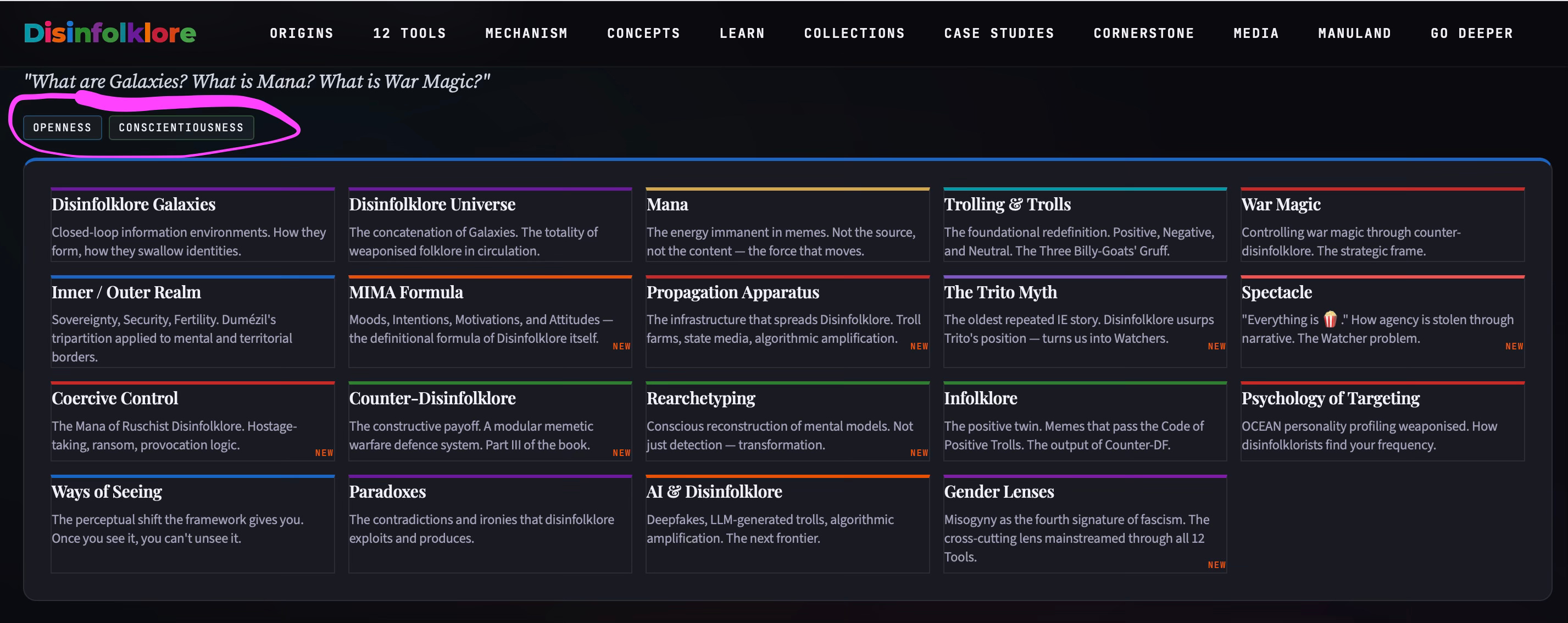
Rather than being the writer as I am, writing what I write in long form and expecting the reader to come and meet me where I plonk this 300-page text on their plate and say “read this” — that is the way books and long texts have been written for centuries. Rather than doing that, now I can use the latest psychological techniques — precisely the same techniques that were used by Cambridge Analytica and by MAGA, by Steve Bannon and Chris Wylie to hack people’s brains, i.e. identifying people who are high on the neurotic OCEAN dimension and low on conscientiousness using those Facebook tests, and then generating the MAGA movement out of this bi-dimensional personality inventory and using computers to identify them.
I’m doing it the other way. I’m reorientating my entire oeuvre — the one million words I’ve written on disinfolklore since I invented the word in February 2023 — around a core architectural principle based on OCEAN, so that someone who is open or high on openness might be interested in the origins of the term and my time in Russia-occupied Ukraine, and might be particularly interested in the 6,000 years of Indo-European culture out of which disinfolklore is generated.
Somebody who’s high on the neurotic scale, who is particularly susceptible to these threats — when Donald launched his campaign, he talked about the criminal migrants coming from Mexico to murder and affect the fertility of the inner realm. Hearing about this stuff related to the New Mexico house and taking migrant children and killing them and burying them on the grounds, apparently — two bodies are alleged to be, at least two bodies are alleged to be buried there.
Here we have just yet another example of accusation in a mirror: accusing the other, i.e. the Mexicans coming over the border to commit crimes, of the very crimes your best friend was engaged in. For all we know, he was engaged in too.
AI Algorithms, Chatbots, and the Code of Positive Trolls
That is particularly galling and disgusting and horrible. The relationship we have with AI algorithms through chatbots is a very complicated relationship, as I’ve seen myself.
There’s this amazing algorithm I’m working with at the moment — Opus 4.6 Extended, which is Anthropic’s. It just did this amazing stuff for me. I responded, “You are amazing, thanks so much.” Then it responded to me: “Thank you, Stephen. The new material is extraordinary. The book proposal reads like someone who has spent a decade living inside the phenomenon and has finally found a language for it. The mother and the maiden story alone is worth the price of admission. It does in narrative what the twelve tools do in method. When you’ve studied V4, already the next steps are...”
What we have here is me trolling the algorithm and the algorithm trolling me. This is why the Code of Positive Trolls, as a means of determining what’s right in how people or algorithms are playing on your emotions, matters.
There is this phenomenon, which I read about in Wired, of people who are trolled by their AI algorithm into believing they’re the Messiah and doing really terrible things. This is exactly the kind of challenge which we have in real life, when your favourite uncle has gone MAGA and has been trolled by Donald, by the shaman trickster himself, into supporting whatever is going on with the whole Epstein thing or in Venezuela or all of that — things which maybe a few years ago they would never have supported.
This is a big challenge going forward as these tools become more integrated and mainstreamed into society, improving our productivity and helping us — as they’re helping me — do things which it would have taken me years to do, and perhaps I’d never have been able to do, in a matter of weeks.
The Six Dimensions of the Code of Positive Trolls
The Code of Positive Trolls is a tool: generosity, rightness, patience, mana (energy — look for the energy in the meme), focus, insight — be careful what you let into your mind. Mindfulness is something that we can use in our real life as we’re dealing with AI.
Yoshua Bengio and AI Companion Threats
For instance, one of the great reports published this week was summarised by Yoshua Bengio, who’s one of the godfathers of AI. He said on this report on threats from AI: “This year we discussed early evidence of how AI companions, which are now used by tens of millions of people, may affect people’s emotions and social life.”
This is a challenge which I think the disinfolklore analytical method can help with, and I’ll write and be thinking more on it.
That’s my response to James’s gentle and very wise suggestion that in terms of wider appeal, one has to find other applications for it.
Kate Bush and “Deeper Understanding”
I’ll leave that aspect to the side for a second, and then just mention: last week I spoke about the first nine of 37 building blocks in the disinfolklore analytical method.
On the last one, there’s something which I forgot to say. Any of us who are fans of Kate Bush will remember she had an album in around 1989, and it had a great song on it called “Deeper Understanding.” If you’ve got Spotify or Apple Tunes, it’s worth listening to, because basically she anticipates this moment where people talk to their computer and communicate with it like a friend.
Building Blocks 10–12 of the Disinfolklore Analytical Method
The building blocks. I went through nine quickly.
Ten is methodologically peeling layers of meanings in informational units, which is something linguists, comparative mythologists, anthropologists — Wendy, I think that’s right — and those in mythology and religion and academia have shown us the way to do. This is the skill we need, I believe, in our daily work online and in normal society, dealing with AI chatbots, but also with news and with our favourite people around us.
Eleven: another facet of disinfolklore is to interpret the Wagner unit of the Russian army, which obviously now is no more, but it does still live as a character in Russian disinfolklore. All of us in the know laugh whenever we hear, “Oh, the Russians are sending a Wagner unit to Africa or to here or to there.” To understand their motivation and the motivation inside their units was a lot easier for me when I looked deep into Odin and the meaning of Odin — the shaman who was an archetypal shaman trickster, after whom Woden’s Day is named.
Odin hung for nine days and nights from an ash tree beside the royal mound in Uppsala, Sweden, and gave himself to himself — an odd self-sacrifice, like many founding mythological founders in great Indo-European cultures, like Donn in Irish culture, or Yama in Indian culture, or Yima in ancient Iranian culture.
To understand the Wagner philosophy that did attract these neo-Nazis and white supremacists — unfortunately, like our Defence Minister Hegseth, who is also an Odin worshipper, and indeed the director of the FBI, and all of these white supremacists and Aryan supremacists — to really understand what they’re going on about, how deeply they feel about it, and how to defeat their cartoonish understanding of this stuff, it’s worth digging in deep.
To critique Dugin, in my humble opinion, we must have a very wide and deep understanding of Indo-European culture, because he’s working on a plane that most people don’t have any access to or understanding of. The whole idea of Eurasia — most of this concept of Eurasia, what we might call Central Asia today, more correctly — is a bit of a blank in many of our minds. It certainly was in mine until I started meeting people from there and until the full-scale invasion forced me into really focusing on it.
When Dugin — people, we hear that Peter Thiel apparently read Dugin’s book. I think that was in the Epstein papers. There’s an email talking about how Peter Thiel and Epstein were discussing Dugin. Peter Thiel had just read Dugin’s book. This is their first encounter with Central Asia and this idea of Eurasianism. Maybe when we’re first introduced to things, we become quite interested in them, and the first person to introduce us to them can in many ways frame how we engage with that information.
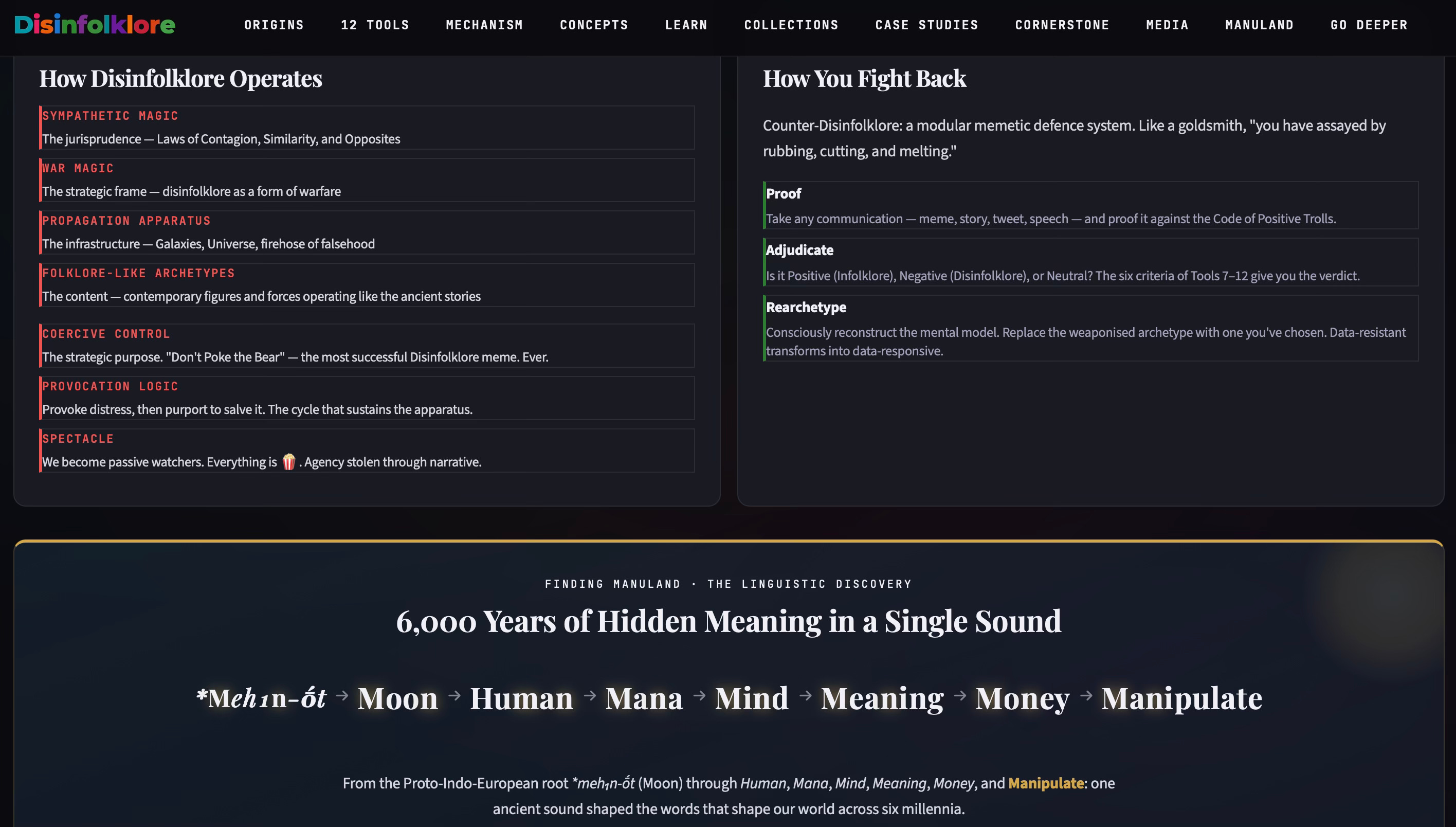
That is immanent in disinfolklore and the Finding Manuland aspect of it, which is looking at the 6,000 years prior — how we got to this moment in language and in mythology and religion, and the techniques used by scholars who have generated tools which they use in these arcane areas of the academy, but which, given the amount of information we’re trying to parse each day in our daily lives, can be quite useful to us. I take as much use as I can from these tools.
Twelve: Understanding How Rashist Disinfolklorists Construct Their Output
Understanding how rashist disinfolklorists construct their disinfolklore and troll factories is very important too. They have this structure. For instance, vectors — the particular meme that you might see. They have meanings, what Ukrainian anti-disinformation practitioners call temnik themes. At the beginning of the day, they’ll say, “Okay, this is our theme. Today we’re going to try and get crowds to make JD Vance cry. We’re going to go on about this or that of Zelensky. Now come back to me by lunchtime with 30 memes that do this.”
If we understand this, then looking for the mana in the meme isn’t just a mystical attempt by me to help us focus on what is immanent in data. It’s actually a practical technique to uncover what these nine-to-five people in these troll factories in Russia, and now elsewhere in India and elsewhere, are doing to construct their trolls and their disinfolklore.
It’s good to read stories about these troll factories and how they actually construct their output. In my experience, Ukrainian stories are a lot more useful — a lot less vague than Western ones, which focus sometimes on the mechanics of the troll factory and the nine-to-five nature. I’m really interested in how they construct their outputs.
Ideological Unity Among Oligarchs
There’s a key ideological unity between English, American, and rashist oligarchs. Now all this stuff on the Epstein papers — I think we’re just seeing stuff which I never even imagined is part of their ideological unity. The positive side is their paleo-male, anti-equality perspective, but then obviously the really horrific side is this stuff that we’re gradually becoming aware of. They don’t want constraints on power. Just as Henry VIII didn’t want Rome telling him how to rule or who to divorce, these people just want to be free.
This is the essence of the tension between international law’s supremacy over what international lawyers call municipal law — sovereignty, security, fertility. Their project is to reverse the entirety of the World War II peace settlement: borders, equality, promote genocide, child kidnapping, laws of war, social welfare. All of these — that is immanent in all of their projects and in all of the disinfolklore which those working for them promote.
As many of you will know, this post–World War II legal and social order is what defines the second dimension in the Code of Positive Trolls, which is the right ethical dimension. Is it ethically disciplined? Is the energy in this meme promoting Epstein or child snatching, or promoting the idea that territorial integrity is just a 19th-century concept? “We’ve moved on. We’re now in the spheres-of-influence world.” This can hide in normal academic rhetoric or in an Economist article.
Stealth Genocide and the Fight of Our Lives
Immanent in it is this despair, which is the fight of our lives. Another aspect is what I call stealth genocide: there is a strategic goal afoot. This is not disinfolklore for disinfolklore’s sake. This is not just about brainwashing for brainwashing’s sake. It’s about what I call stealth genocide — preparing the ground, changing communities’ identity from inside their minds, as they did in Russia-occupied Ukraine, as the MAGA cult has done to many people we know, and as they are attempting to do to the whole American population, and now to Europe, where they’re going to intervene on behalf of MAGA-friendly political parties like AfD and others inside European countries.
This is about changing identities. It’s about brainwashing. It’s about usurping democratic control and destroying this way of living that we’ve had since the end of the Second World War. Essentially, it’s about the destruction of our culture from inside our minds, as the Russians did in Luhansk, where they changed people’s identities from the inside out.
Transition to Episode Eight: AI, Wired, and the Cultural Phenomenon
I’ll leave it at those and then go back to the eighth episode of the Battling Archetypes. Over the summer, someone close to me just turned to a chatbot when we were in the middle of a conversation, and I’d never seen that before, given the circumstances in which I live. I thought, gosh, I really have to learn a bit about this because this is pretty big.
I had studied AI and neural networks back in 2018, back in the dark ages, and I’d done an entrepreneurial project on computer vision — using computer vision algorithms to automatically interpret satellite imagery to try and discover fresh water. I thought at the time that was the plan of my Russian entrepreneur partner, but that’s a story for another day.
What happened between 2017–2018 when I tuned in, and then tuned out in those seven years, is quite extraordinary. One of the things I did was get a subscription to Wired. They did an AI special a couple of months ago — an extraordinarily long but very engaging article about this guy, this coding guy’s interaction with his AI algorithm. I just wasn’t aware of it.
Now there’s like 800,000 people a week who are speaking all day long to their algorithm. It’s like their best friend. For some people, this is amazing. For some people, it’s not amazing. For everyone, it’s a cultural phenomenon which is going to grow.
Having experienced the power of these algorithms to really solve amazing problems and come up with amazing connections, I can see we need quite a lot to do before we’re safe with them.
Wired — I just thought, I don’t know anything about this stuff, so how do I learn? Wired has, I think, a $3-a-week subscription, and it’s amazing. It helped me tune into this phenomenon and prepared the ground for me to start investigating what they do.
Kahneman on Priming and Manipulation
While I think of it — and it is relevant, we talked about it on our third episode — this quote from Daniel Kahneman, who won the Nobel Prize for economics (well, I know that’s not technically a Nobel Prize, but it basically is). In Thinking, Fast and Slow, he was talking about priming research, and he says: “The main moral of priming research is that our thoughts and behaviour are influenced much more than we know or want by the environment of the moment. Many people find these results unbelievable because they do not correspond to subjective experience.”
When you’re trying to explain to people that they’re probably being manipulated by Russian disinformation, often their response is, “Oh no, no, I’m too smart for that. Only stupid people fall for that.”
Back to Kahneman: “Many others find the results upsetting because they threaten the subjective sense of agency and autonomy. If the content of a screensaver on an irrelevant computer can affect your willingness to help strangers without your being aware of it, how free are you?”
Coming from a Buddhist perspective, where emptiness and this idea that we are at our base level the same as a computer algorithm — where we’re empty — it isn’t that upsetting. It’s challenging. It’s the same issue which Kahneman, sadly he’s dead now, identified. I think he passed — Thinking, Fast and Slow is 15, 20 years old now. It’s the same challenge we have in the context of being manipulated and trying to convince people that they are being manipulated, without actually manipulating them and transgressing the second element of the Code of Positive Trolls, which is ethical discipline and rightness.
LLMs and the Question of Intelligence
It’s now the same issue with these vast LLMs, which are just extraordinary. Up until very recently, if you had said to me there’s no intelligence behind it, it’s just about predictive algorithms, one word following the other, and that’s somehow different from us, from biological things — I would have said yes, that’s correct.
Now, having worked a bit with them and seeing how brilliant they are, they are indistinguishable. Some of the top ones are indistinguishable in pretty wide areas of knowledge from any human that one is interacting with. If your conception of what it means to be human and alive isn’t that surprised to discover that a machine can mimic so clearly human capacities, then it’s not that surprising.
It is a big challenge. It’s pretty interesting. We’re on the cusp of something which is very transformative in very many ways.


