



The Soviet Union was so mysterious for many of us, as was eastern and central Europe. I was 17 when the Berlin Wall fell. Many people I’ve met since — I went as soon as I could. I spent time hitchhiking to Czechoslovakia and Poland and Hungary, went around those places several times, because I was fascinated by what it was like, how they lived.
I always imagined it would be really interesting working in the former Soviet Union, because it was such an interesting and alien place. In Ireland at the time, we did learn a lot about Russian politics. I think we learned more truth about Russia and the five-year plans and Stalin than they learned about us when it comes down to it. So it was planted as a seed of interest. But I never thought I’d end up going around villages and being able to just talk to people. The joy in that never left me, no matter how hard some experiences were — when it was minus 20 and having to be out on the bridge for seven hours, or fiddling around with camera systems and thermal-shutdown computers.
Having said that, Wendy, it was one of many ambitions I had, many of which I’ve achieved. It wasn’t like I was obsessed by it because I’d never looked for it. It just landed on my lap through accident — like a Grail tale or Don Quixote. My life in that sense has been more picaresque than a tightly planned novel. I didn’t decide when I was eight that I was going to work in Ukraine and get there in the end. That isn’t what happened. But when it did happen, I was aware that this was one of the many things I really wanted to do.
This is episode five of going over the basics of battling archetypes and the Disinfolklore analytical method. We were on the bridge and went through the luxury sausage troll saga. Last week we went through some of the folkloric resonances of my experience as a diplomat on that bridge in Stanytsia Luhanska — the passage to the other world.
I wanted to move onwards with archetyping. I had an interesting discussion with someone today about whether or not Donald is compos mentis. Some of us may be aware there’s been a bit of a divorce between Michael Cohen and the liberal media this week. I don’t quite fully understand it, but I think it’s something to do with one of the documents released in the 1% of documents released in the Epstein files. That document attests, apparently, to Michael Cohen’s lawyers offering the New York DA and/or AG during his case — I think this was during the case in 2018 when he ended up in Otisville, in prison for campaign finance violations. Unindicted co-conspirator number one is Donald.
Michael Cohen has been, in his podcast for the last couple of years, promoting the troll that he knows for certain that Donald — first, that he knew nothing about Epstein, because as is true, Epstein and Donald had divorced before Michael Cohen came on the scene — but also Michael Cohen was very strongly attesting to his very strong belief, as the person he believes knows Donald best of practically anyone in the world, that Donald was not involved in really bad stuff in the Epstein files.
There’s been this divorce. I’ve had to reassess almost everything I learned about Donald from Michael Cohen and try to think about whether he was lying about that or not, whether he was trolling us. There were a few things I was pretty clear he was just banging on about. But it doesn’t mean everything he ever said about Donald is incorrect.
One of the things he’s been very clear about is that Donald is acting. He does not have dementia — he is acting this role of someone who’s completely nuts. In the background of my mind, I’m recomputing all the data I collected over listening to Michael Cohen’s podcast every now and again over the past couple of years. There’s this data point as well.
I had this discussion earlier today. Certainly what Donald is doing — he is archetyping as the archetypal madman. Anyone who studied, or had the misfortune even though I did have a good teacher, to study game theory at college will know the archetypal example of the madman is Khrushchev at the United Nations in 1961, banging his shoe during the Cuban Missile Crisis — which seems like a very tame crisis at this point.
The people who established game theory as a science in political science — I think Harvard is basically the beginning of all of that — established this idea that you could play the madman. Donald is certainly a very convincing actor in that role. Whether or not he has dementia or is at death’s door, I just don’t know. I’m not convinced he is. Obviously we all wish he would just retire peacefully somewhere, preferably somewhere else.
I was pretty sure after January 6th that we wouldn’t have to deal with him again because he seemed so unhealthy. If you set out in your political career to try and gain immunity from whatever is in the Epstein files — and I do think his experience with Epstein and his knowledge that the stuff would come out is possibly the main motivating factor in his entire political career. Again, Michael Cohen is a source for: Donald did not intend to win the presidency in 2016. He was doing it to build his brand and it got out of hand and he won it.
But if, in the course of running for the 2016 elections, the Epstein case — certainly in 2018, I think that’s when it really broke, early 2018, but obviously people in the know knew about it — and he appointed as his Secretary of Labor, Acosta, who as I understand it arranged the plea deal with Epstein in Florida. Epstein and all that stuff was very much on his mind. If Donald is willing to threaten to invade Greenland over whatever is in those files and sacrifice the whole of Ukraine, then it might be pretty horrific. If he knows this is there, then that could well have motivated his political career.
The other thing is Ukraine has been central to Donald and to Republicanism and to American democracy since 2015, and certainly since 2016, when it’s always been my belief that Russia bet everything on Crimea. Then it doubled down on Luhansk and Donetsk. Then it doubled again on Syria. Then it ten-tupled its bets on the full-scale invasion.
Everything Russia does and has done over the past decade has been motivated by its animal and completely irrational drive to subjugate and kill and destroy Ukraine — which of course is the kind of vulnerability which President Zelensky and General Budanov and everyone, the leadership in Ukraine, have been using, trolling, knowing this vulnerability, trolling Russia to its doom.
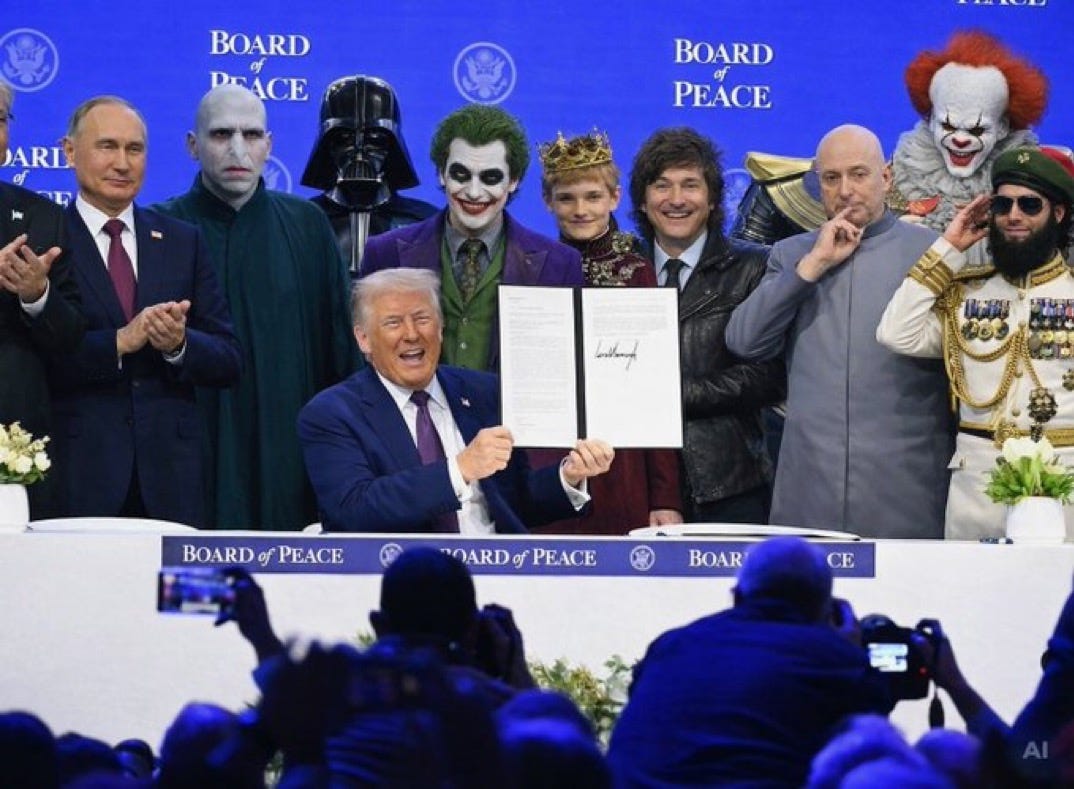
All of this is a way of introducing one of the central ideas in Disinfolklore and the battling archetypes: the idea of archetyping. I’ve spoken before about how Donald used Alphonse Capone — he would always say “Alphonse Capone” as part of his campaign speeches — and how Melania’s meme-chic costume at his inauguration earlier this year, feels like an eternity away, were deliberate acts of archetyping. As was all that stuff with Batman and Robin — Musk and him, daddy in the White House earlier this year.
If Donald is archetyping himself as the archetypal madman from game theory, then yes, he’s very convincing at it. He may well be suffering dementia. But when I reflected on it, I’m not sure I’d even heard of narcissism until maybe 2016 or 2017 as a psychiatric disorder. Everything I know about narcissism is from him. When I reflect on it, he could just be playing that role. I just don’t know.
All of this is introducing the idea of archetyping. If Donald is archetyping himself as the dementia-ridden, Alphonse Capone-admiring, crazy guy, and now he just has to keep on doubling down and tripling down — again, parallels with Russia — then my idea, the element in archetyping which applies to memes and overall strategies, I think is central to understanding what is going on. It’s even central to having a conversation about it.
My jury is still out. I swing both ways. Yesterday I was arguing with this particular person that Donald was strategically illiterate, because there is this argument that he just goes for things like the dog who catches the car — Venezuela, then what? And then they ad-lib, improvise. But improvisation is a central part of modern performance. There was a lot of improvisation, I assume, in The Apprentice as well. But we can have a conversation at least, if we’ve got this vocabulary, about archetyping.
Archetyping is a reciprocal process. It’s reflexive. It works both ways. I imputed into that scene at the bridge at Stanytsia Luhanska, where I worked between January 2015 and January 2018 — I imputed folkloric tropes into that scene. Long before I thought deeply about folklore, as I talked about last week, I looked into what folklore is, I looked into my immediate impression that there was something folkloric about the situation. But I didn’t really know what it was. All I knew about folklore was my memory of tales read as a child about forests and Hansel and Gretel.
As I talked about last week, it’s actually a lot deeper than that. The more I looked into it and unravelled what was folkloric about that situation, the more I arrived eventually at the idea that actually Disinfolklore as a narrative form can be used to signify the entire universe of brainwashing, information propagation, propaganda, combat propaganda apparatus that the Russians were running in Russia-occupied Ukraine — because it’s always using storytelling.
Another person I can’t quite work out — Konstantin of Inside Russia, who I was just listening to this evening — he was talking about his memories of the end of the Soviet Union and how, towards the end, the stories being told in the media were becoming more and more divorced from reality. He’s drawing the parallel with today. According to him, looking at regional and local media sources inside Russia, they’re really in trouble — in terms of power going down and such. But the mass propaganda media is painting a really rosy picture of Russia constantly making gains at the front and all of that malarkey. He was drawing that parallel with the end of the Soviet Union. These are all examples of Disinfolklore in the Russian media landscape.
That insight didn’t occur to me for years. But I archetyped the scene at the bridge through folkloric tropes. It was my way of seeing — something about it — folkloric identities of the people I met and the gardens I visited. I remember once being brought to see the garden of a couple who lived very near the bridge, an elderly retired couple who had retired from Luhansk City. She showed me around her garden, which was about two acres with something like 24 or 25 different crops. I wrote them all down in my notes. Their house, everything about it was like something from folklore. It imprinted the scene into my mind and the folklore into my mind.
This is common to all forms of archetyping in Disinfolklore. The elements of that bridge situation which were blatantly folkloric struck me. But what was truly Disinfolklore about the scene was then invisible. As with all great discoveries — and with all modesty, Disinfolklore as a narrative form and what I’ve made of it is a great discovery, because there’s no end in sight for me to unravel that insight, nor is there an end in sight for me to use it in my daily attempts to understand what on earth is going on in the world.
I accidentally followed — it was an accidental insight. The trail that I followed from that insight, that there was something folkloric about the bridge scene, became a lens through which to perceive many new things, many unexpected insights and things I couldn’t have imagined at the time. It’s an organising fiction as well — the idea of Disinfolklore and the idea that there was something folkloric about that bridge. Maybe there were zillions of different dimensions of that scene which might have led me to many of the same conclusions.
As I mentioned two weeks ago, I was looking for something new — a new way of describing what was new about what I perceived in Russia-occupied Ukraine: the use of multi-vector, constant information flows to manipulate people’s minds such that their identities were transformed. I believe that insight is still not generally well understood in our world.
However, we often use MAGA as an example, or Brexit in a slightly weaker way, as examples of how completely normal people we knew went crazy because of strategically directed information. But in 2015, we didn’t really have those examples. We just had the Nazis, or the idea of brainwashing, or cults.
Now at least we have a common resource in that everyone sees how MAGA has driven the entire world mad. That’s a positive thing. But I still don’t think it’s generally well understood how inorganic MAGA was, how strategically well planned it was. According to my main source, Christopher Wylie’s account, he and Steve Bannon basically invented the method of recruiting and building the movement of MAGA — through those Facebook groups, through the use of the Facebook questionnaires, those surveys which used the psychological inventory methods: the OCEAN scale of Openness, Conscientiousness, Extroversion, Agreeableness, and Neuroticism, as a means of charting how people would be susceptible to certain kinds of manipulative information.
The insight came from the assistant professor from a university in St Petersburg who happened to also be a research assistant at Cambridge University at Judge Business School. At the time, they didn’t know he was associated with St Petersburg, apparently. He had the idea that you could back-propagate — you could use these questionnaires, these surveys, which many of us may remember seeing on our Facebook back in the noughties, in 2008 or 2013, 2014. He realised that by getting certain answers to these stupid 30-question surveys, you could infer where people charted on the neuroticism and conscientiousness dimensions.
If you could identify highly neurotic, low-conscientious individuals — and they ran tens of millions of these Facebook tests — and identify a group of them in particular local areas, and then bring them together in real life in venues which were smaller than the number of people should require to be comfortable, you could then, with clever curating of the scenes in the rooms, ignite a movement which became MAGA. That is what Christopher Wylie and Steve Bannon did with Cambridge Analytica, in certain targeted counties across America which they knew they needed to win.
I don’t think Donald Trump was on the scene at that point. Steve Bannon was in search of a product, in search of someone to run. This idea that you could use storytelling — as we’ve seen them develop since — and basically radicalise people who started off in those rooms in counties across America in 2015, believing in America First and all this stuff, and then before you know it, eight years later, they’re talking about conquering Greenland and destroying NATO and are very anti-Ukraine.
That’s all done through storytelling, I believe — or at least, to explain this without reference to storytelling, what I call Disinfolklore, I think is very hard. I think it adds to our understanding of what is normally called disinformation or propaganda, or is posited as a mystery. If we look at the narrative form, we look at the commonalities in the narrative forms used in whether it’s MAGA or what Russia did in Russia-occupied Ukraine.
It just so happened that because I was there and I collected these data, I have a data set from which I tried to find patterns. I found these structures in it. I inferred that these structures were intentionally implanted — this inner-outer realm othering, for instance, and the idea of archetyping as well. Those same structures I can find in MAGA Disinfolklore as well.
To put it in a positive sense, I don’t really see anyone else talking about this, and I try to keep up with the latest research and analyses of disinformation. In that, I find the value of my work and my attempt to make it more common — to make it a toolkit that many of us can add to our existing toolkits as we navigate the world and information.
If we zoom out from the particular space on that bridge, and even from Russia-occupied Ukraine, to the universal aspects of it: what I was doing there was archetyping the scene as something folkloric. I wasn’t doing it intentionally. This was just something that rose up in my mind one of the first times I was there — because of the forest, because of the river, the characteristics of the locus amoenus aspect of it, that this was a pleasant place with breezes and songbirds, and yes, militaries and death and horrid things and horrific stories. But there was something folkloric about it.
Looking into that insight, one vector of how I’ve come to realise is that many of us perceive — I’m not going to say everyone, and I only ever speak for people whose native language and structure is Indo-European, because I don’t have any major experience of the other — so I’ll say most of us, to a much greater extent than we imagine, perceive reality through archetypes and through the folkloric resonances that we imbibed as young children.
Because I had this insight — and this isn’t the whole thing, it’s an interesting aspect of cognition I’ve identified — I’ve collected these references. We see it all the time from the Russians. Even someone like Simonyan, people who should be in prison for the rest of their lives, convicted by the International Criminal Court for public and direct incitement of genocide — there is something naively childish about them in some ways. The way Simonyan, for instance, dresses like Robin Hood, or Maid Marian, in green. The way this guy Dugin obsesses about Cheburashka, that little cartoon character — at the moment he’s running a cultural war against this cartoon character. The way they archetype Russia as a bear.
But this also applies when you get your eye in to your own perceptions of reality and reference points, especially when you come across new experiences. For me, the bridge was like that. It was something I had never — in my wildest dreams, I’d always wanted to live in the former Soviet Union. But to end up where I ended up, to go from working in the parliament in Dublin and in Belfast and in London to ending up on this bridge with loads of army and police people — it was quite a journey for me. The whole thing was new. My mind was looking for references, and somehow I’ve noticed we do revert to these folkloric tropes — something about childhood maybe. They’re all around us. I notice in indie rock music as well — once I got my eye in, I realised so many references to folklore and folkloric tropes.
Even the example I always give: Putler on the 20th of February 2022, likening Ukraine to a dead woman, a victim of necrophiliac rape. He got this from a song by Red Mould, a Soviet-era hard rock band. The song was called “Sleeping Beauty in a Coffin” — “I walked up and...” That is used by international lawyers as evidence of Putler’s intention to genocide.
Even there, Putler is thinking through folklore. When he’s talking about “little piggies,” he’s likening European politicians to little piggies — three little piggies going to market, to the slaughter.
I also remember this incident near the bridge, in a village, where two Ukrainian soldiers got drunk and drove their armoured car basically through this perfect archetypal Ukrainian market garden. I went there the next morning and we catalogued the damage. In the end, the individual Ukrainian soldiers repaid this family for the damage. But one of the things I remember was the APC, the Armoured Personnel Carrier the drunk soldiers were driving. They drove through the barn. And she said to me, “We’re so lucky that the door on the other side was open, because the pig we’re going to sell to pay for my daughter to go to university was able to run out the other side.”
That is quite telling. People in America save the college fund for 20 years. But in these folkloric situations in Ukraine, real people fatten up pigs and sell them and exchange that for their child’s university education. There was something folkloric about that.
I was then going through my memories of archetypes learnt from folktales. The Grail tales, which most of us will have accessed through Monty Python, King Arthur, and all that. They originate in Chrétien de Troyes’s Grail tales, where you have Lancelot and the characters — Perceval going around on their horses having adventures. It’s been pretty conclusively established, as far as I’m aware, that the origins of the Grail tales are in Irish mythological texts that found their way through West Wales, which had Flemish migrants, to Flanders.
Then, as the first folklore tale became really famous — the Ossian tales in Scotland by Macpherson, which he faked, as I talked about last week — so did the Grail tales and this idea of a wasteland, which I also mentioned last week. They’re folkloric — really, before the collections of folklore. It’s all about horses and archetypal characters and damsels in distress.
Then we have the great Ukrainian writer Gogol and his folk tales. Gogol was used — as I understand it, he went to Russia to try and educate them about Ukraine, and what the Russians took from his work was that Ukraine was full of little fairy-tale characters, like their little brother. His tales and stories, as discussed in many Maria episodes, particularly with Ming the Merciless, are very brilliant. His Dead Souls, on faking population statistics — which are still going — he really gets Russia in a very arch way.
Almost every city I lived in had a Gogol Street — Gogolivska in Dnipro. Every town in the former Soviet Union has a Gogol street, but probably for different reasons.
I remember at Christmas 2018 or 2019, when we were going for our Christmas dinner in Dnipro, one of the national staff members had booked this restaurant — they’re all over Russia and Ukraine, I don’t think it’s just a Ukrainian thing — where they try and pretend it’s like a peasant’s kitchen. But actually it’s all very chic, and they have people dressed in peasant costumes. They were playing this Gogol Christmas film perpetually in the background. That gave me a hint that folklore was very much part of the culture of the Soviet era, because this was the equivalent of what in America or Britain or Ireland might be Scrooge — every Christmas you’d watch Scrooge on the TV. This was the Russian equivalent, but it turned out it was from a Ukrainian writer.
Tolstoy’s village stories, which I’d read as a child and which my mother introduced to me. And Dostoevsky’s struggles and his folkloric elements — the idea of three brothers, one of whom kills the father, in The Brothers Karamazov. There are really folkloric archetypal caricatures in almost all his books. We look at them, unjustifiably so, as high art. But they, as with Dickens, as with Balzac and all the great 19th-century writers, really integrate folkloric elements — not least stories from servants and these archetypal characters.
I was collecting the media stories inside Russia-occupied Luhansk. In the spring of 2015, these stories were all full of how institutions were being founded — state institutions in Russia-occupied Luhansk. “We have a new national bank,” and then the next day there’d be a story about the new court system, and the parliament. At the beginning, they would invite us — OSCE, Organisation for Security and Cooperation in Europe monitors — to go and watch these institutions in action. But it was all a shadow play. It was all a Potemkin thing. It took me a little while to work this out.
The stories themselves — just as Konstantin is talking about the stories in current Russia, where if you’re reading the national newspapers in Russia, you wouldn’t know anything about electricity cuts, rolling cuts, and all the kinds of things that we know about because we listen to Mokrushyna and Genesis Man and This Week in Absurdistan. We’re really tuned in to many of the people — Ukrainians, or Prune, or people who are really monitoring closely, or Beefy monitoring Telegram closely.
Konstantin makes the point that the local papers do report it, because a local media source has to tell somewhere when your electricity is going to be on or off, or your heating. But if what he’s saying is true — and I have no reason to doubt this, and it brings me great joy to hear it — then if you’re in one part of Russia, you’re not going to know that the next region is also undergoing hardship, because the entire national Disinfolklore apparatus is spinning new stories of massive victories in Pokrovsk and villages in Ukraine, portraying Russia as always moving forward and how Donald is working for Russia.
Disinfolklore is the key, as a narrative form, to describe that subset of mind-altering articles and media stories that do not correspond to reality. They are illusions and they take on the pattern of being reality.
Long before I realised that what the Russians were doing in Russia-occupied Ukraine was spinning stories about the foundation of the state, I was monitoring all of these stories. But eventually my credibility monitor became much sharper, and I was like: this just isn’t happening. You’re just saying the High Court and the Supreme Court of Luhansk has now been established, it’s got three judges and it’s just made a judgment in this case. And it was all faked — absolutely all faked, not just for us but also for the local population.
What Russia was doing was archetyping a reality using references and tropes which meant very little to me then. I hadn’t grown up in the Soviet Union. Tropes from the Great Patriotic War were invisible to me. This constant trope of the Polish mercenaries, which we still see in our information space — Putler and others talk about Polish mercenaries. When most normal people hear “Polish mercenaries,” they think literally Polish mercenaries. But actually, “Polish mercenary” is an archetypal character — a complex of ideas and tropes under the guise of this quite normal phrase.
When Russians or people who grew up in the Soviet Union hear it — and maybe someone listening can comment on this — it means something different. It conjures up scary, warlike Second World War imagery. When my bosses, the heads of operations, were trolled through various information sources that 50,000 Polish mercenaries had established a camp two kilometres west or east of the bridge at Stanytsia Luhanska, on the Ukrainian government-controlled side of the Donets River, they would send us there to look for 50,000 Polish mercenaries.
I and my colleagues, knowing the villages and the areas, knew this was highly implausible. But the head of operations, sitting back in the office 150 kilometres away, thought this might be real. They completely fell for the troll. When you’re sent on your first couple of these operations, you just think this is ridiculous — they’re not going to be there.
But then this Polish mercenary character kept coming up again and again. I thought, there’s something deeper going on here below the surface. And lo and behold, to this day, we see Polish mercenaries popping up every now and again. Perhaps that’s one of the reasons why Poland is so emphatic about not sending troops to Ukraine — because they’ve been trolled into being quite defensive about the idea of Polish mercenaries. The ridiculousness of this when we hear these stories of how most Russian soldiers end up signing contracts when they’re drunk or under false pretences — they’re the mercenaries, and the Ukrainians are quite the opposite.
Like the Brothers Grimm did in answer to Herder’s call of 1777, I was collecting these stories and reading them every now and again, reading these media outlets, trying to make sense of it, trying to work out what was going on and what the structures were inside it.
One of the most common structures in almost every one of these stories — and this also goes for MAGA Disinfolklore, or Donald’s Disinfolklore — is this inner-outer realm archetyping. What Donald is really doing with Greenland and NATO now is: we always thought — we as the European Union, as NATO members — that we were inner realm, and then the outer realm was Russia or the Warsaw Pact or China. But now Donald is re-archetyping that archetypal structure. He’s making Greenland outer realm. When they have dogs and huskies, they’re turning it into this cartoonish place, using cartoons to articulate what are grave threats and violations of the UN Charter, making fun of huskies and world leaders who are taking this seriously by publishing their private correspondence.
Just as the MAGA cult did — if you wear the hat, if you go to the campaign rallies, if you fall for the trolls or if you have this arch view of Donald and his 3D chess, then you’re inner realm. All of his long speeches at his campaign rallies were inner-realm identification, inner-realm reinforcement operations. You’re waiting to hear the story about Alphonse Capone or the January 6th martyrs or hostages. Everyone else is a liberal or a Democrat or an enemy of true Americanness.
This is also what Russia did in Russia-occupied Ukraine through the medium of all these stories — thousands published every day, video, text, and visual images — archetyping those across the Donets River as outer-realm Ukrainians. Almost automatically, that re-archetypes your identity as a Ukrainian inside the occupation as Russian.
This inner-outer realm switching, which we see when the Russians talk about “liberating Kupiansk” — they’re switching it upside down. If you’re aware that this is what’s going on, then when you come across strange things like “liberating,” you immediately understand what they’re doing.
That’s part of what I try to do: make people aware. Most of us are now aware because we see so much of this data. But we know many people in our real lives who don’t tune in that much and aren’t quite aware that this is the subtext — these are the systemic effects of individual stories.
If you see this immanence, if you’re looking for the mana in the meme, if you’re looking for the energy in particular memes, then it doesn’t matter where the meme is emanating from — whether it’s your mother, your girlfriend, your son, your daughter, your friend, someone in your milieu, or Medvedev. You know for definite, if it’s coming from Medvedev or a distinct Russian source, that it’s probably Disinfolklore.
What I believe we need to become better at, as a society, as civilisations, is identifying — independent of the source of the brainwashing meme — we need to be able to look into the meme itself, whether it’s a flick of an eyebrow, a visual meme, a sentence, a tweet, something we flash by on Twitter, and look for its energy.
If you see this inner-outer realm dividing, or archetyping immanence in there, then we can be on guard. Obviously we need to be on guard — incoming troll radar. If we can keep that on, at least when we’re on X or listening to something that might be propaganda, then we may notice the inner-outer realm switching immanence in memes and texts.
With Donald, it’s easy because you know it’ll always be there. But the hard thing is seeing it in our friends — and then learning to sometimes quietly notice: “I see what you’re doing there. You’re archetyping immigrants as dog-eating outsiders who don’t deserve human rights. Let’s lock them up in ICE or deport them to some terrible prison somewhere.” That’s where it’s leading. “I see what you’re doing there.”
Sometimes you just keep that quietly to yourself, your perception. But at least you’re looking inside data, looking for this archetyping and this inner-outer realm immanence — which is in many folktales and every Disney film. Cinderella, the poor girl who meets the prince — that’s inner-outer realm. Sleeping Beauty. This structure is in so much folklore. This is probably where we first learn these structures — when I say “we,” I mean Indo-Europeans.
In the case of MAGA or Russian Disinfolklore, there was and is an intelligence behind what is happening inside the minds of those consuming what was masquerading as news. Whereas it had been me archetyping the scene as something folkloric, automatically, what was going on in Russia and Russia-occupied Ukraine was something very purposeful: archetyping Ukraine as outer realm and threatening, Russia as saviours.
This is why, when I brought up that case last week — Nihilanand, I think, was the name that Natalka from Ukraine had written about — I was very grateful for resurfacing it. He says he thinks this was just accidental, that the Russians had by accident ended up brainwashing themselves into annihilating Ukraine. He used this illustration: it’s like going down a dark set of stairs. You go down one step and you’re deciding to atomise the whole of society, and it’s quite dark. Then you go down the next step and you decide you need a bit more violence and coercion. A few steps down, feeling in the dark, you end up with where Russia is today.
But as I mentioned last week, I don’t really think it’s as accidental, based on what I saw in Russia-occupied Ukraine. There is an intelligence behind it.
This is with Druidy Don, my archetyping of Donald. When I have these debates — is he demented? Well, clearly he’s demented. Does he have dementia, or is he doing this on purpose? There’s a bit of a mix of both. If I apply one of the elements in the Disinfolklore analytical method: if I find myself — and this is where mindfulness comes in, you’re looking in at your mind and what you’re thinking about and processing, which is hard to do and hard to remember — the point of Disinfolklore, and part of its power, is it transports you. It makes you transcend the moment. It makes you hate your parents or your siblings because they’re “just liberals” or “they don’t understand Don’s genius” or “Russia’s 4D chess.” It does transport you.
But if we can keep in mind the objective of mindfulness — in the sense of looking in at our mind and trying to ask: why am I thinking this way? What am I thinking about? — one of the signs I use is that if I find myself questioning too much whether a person is doing something on purpose, they probably are doing it at least partly on purpose. They are partly manipulative.
But that’s as much a trick to stop me wondering too much about it. I don’t want to spend my life reading that race-car driver guy’s tweets. When I found myself thinking, “Is he a Russian patsy or not?” for too long, I just blocked him, and I haven’t thought about him in months until this very moment when I thought of this example.
I’m not making a determination about whether or not that person is, or Konstantin is — I’m just going: if I’m wondering too much about whether they’re doing this intentionally, whether they’re operating or not, then I can easily block them and move on to other things and make my mind space available for other things.
I’ll leave it at that.
Continued from:
Podcast | What's 'Folklore' about Disinfolklore?

I forged the word Disinfolklore out of disinformation and folklore in February 2023.
First in series:
Podcast | Disinfolklore Universe - Episode 1

It’s exactly a year since I detected the system-wide effects of the aggregatation of MAGA and Russian Disinfolklore artifacts invading our minds, information space and reality. In February in Munich at the Pirate Party security conference I declared what by then I had archætyped as a “Disinfolklore Universe” to be operating inside all of our minds and c…


