



From Prime Ministers to Primary Schools: My Vision for Disinfolklore Literacy
My vision for the Disinfolklore Analytical Method took a giant leap forward towards realisation this week. My vision for Disinfolklore is to use its insights to teach universal communications literacy and to build up immunity to manipulating archetypal Disinfolklore. I visualise teams of teachers teaching in Prime Ministers’ offices and Primary Schools throughout Indo-European cultures globally.
With that in mind, this week was a huge moment for me in my development. Over the past while I discovered Claude Code, Anthropic's Claude Code. I have been working with it inside the Terminal. It differs from most of our encounters with Anthropic's AI in the sense that it's agentic. It actually executes. It doesn't just write the code for you and then you have to paste the code in. It actually implements the code, solves problems by writing multiple scripts in different computers language, recruits sub-agents to take on sub-tasks within a complex project such as that which I set to build my new platform. While the algorithm takes the initiative, it’s necessary to prompt it continually to ensure it stays on the right track. My new platform took around 600 prompts to bring it where it is now: a perfect representation of my artistic vision.
https://www.disinfolklore.com will be my platform for the next few decades. I will continue publishing first here on Substack (https://www.disinfolklore.net). Then I will decant some highly distilled content to Disinfolklore.com periodically. Substack is optimised for email lists and has great potential for community building which I have not yet been prioritising but which I will in the future when I have the bandwidth.
Disinfolklore.com contains the million words I've written on disinfolklore since the full-scale invasion, divided into different sections and different passages, short passages rather than long essays. It's arranged according to certain structural divisions which should appeal to people who identify as being quite open and who will be quite interested in the origins of the concept — that's all there. Those of us who self-identify as being more high on the neurotic OCEAN dimension, who self-identify as feeling "I just need... I'm worried about the world. Just give me the tools." There's the Twelve Tools. Then there are certain tools which would be more useful to people than others.
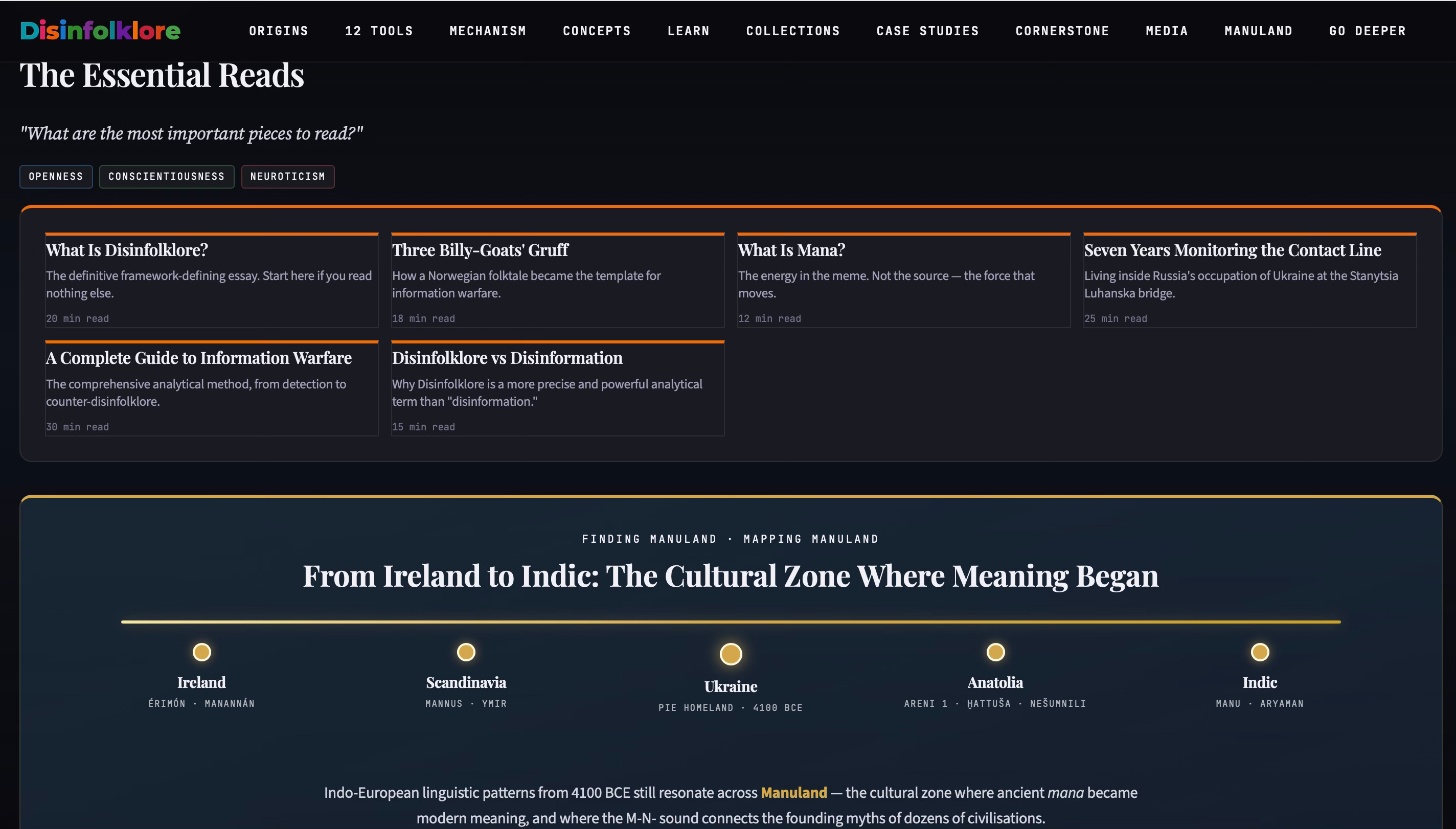
I love the graphics. I designed all the graphics with Claude Code, but through about 600 different prompts. For me, I never thought in my lifetime I would be able to create something like this. This revolutionary technology is extraordinary.
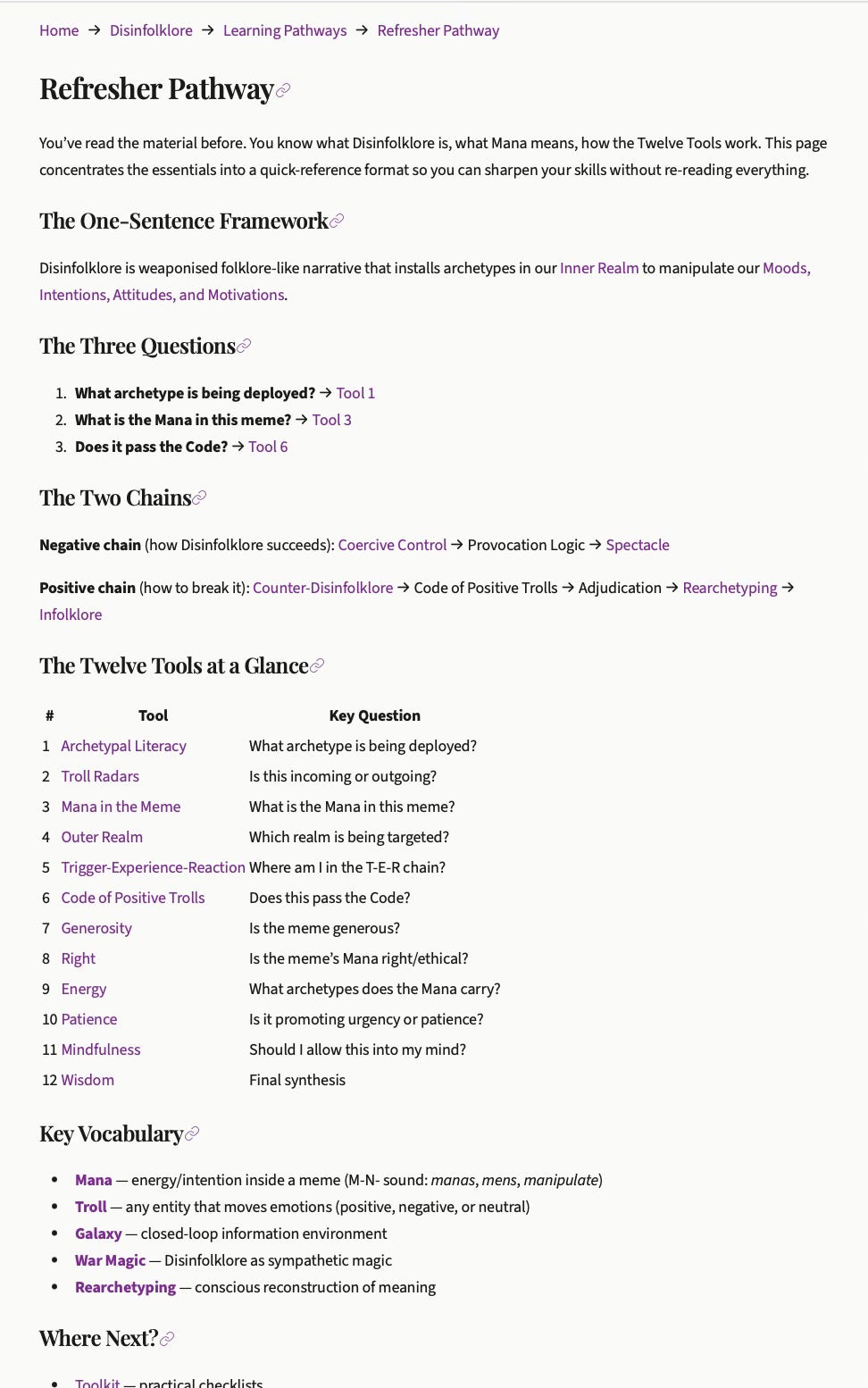
This will be not only a platform to show what I've done and what I hope is going to be quite useful for decades to come — as a means of interpreting data and dealing with emotion-moving activity — it will also be a platform for teaching and for building more networks with people. It's also just an immersive resource for anyone to spend as much time as they're willing to give to it.
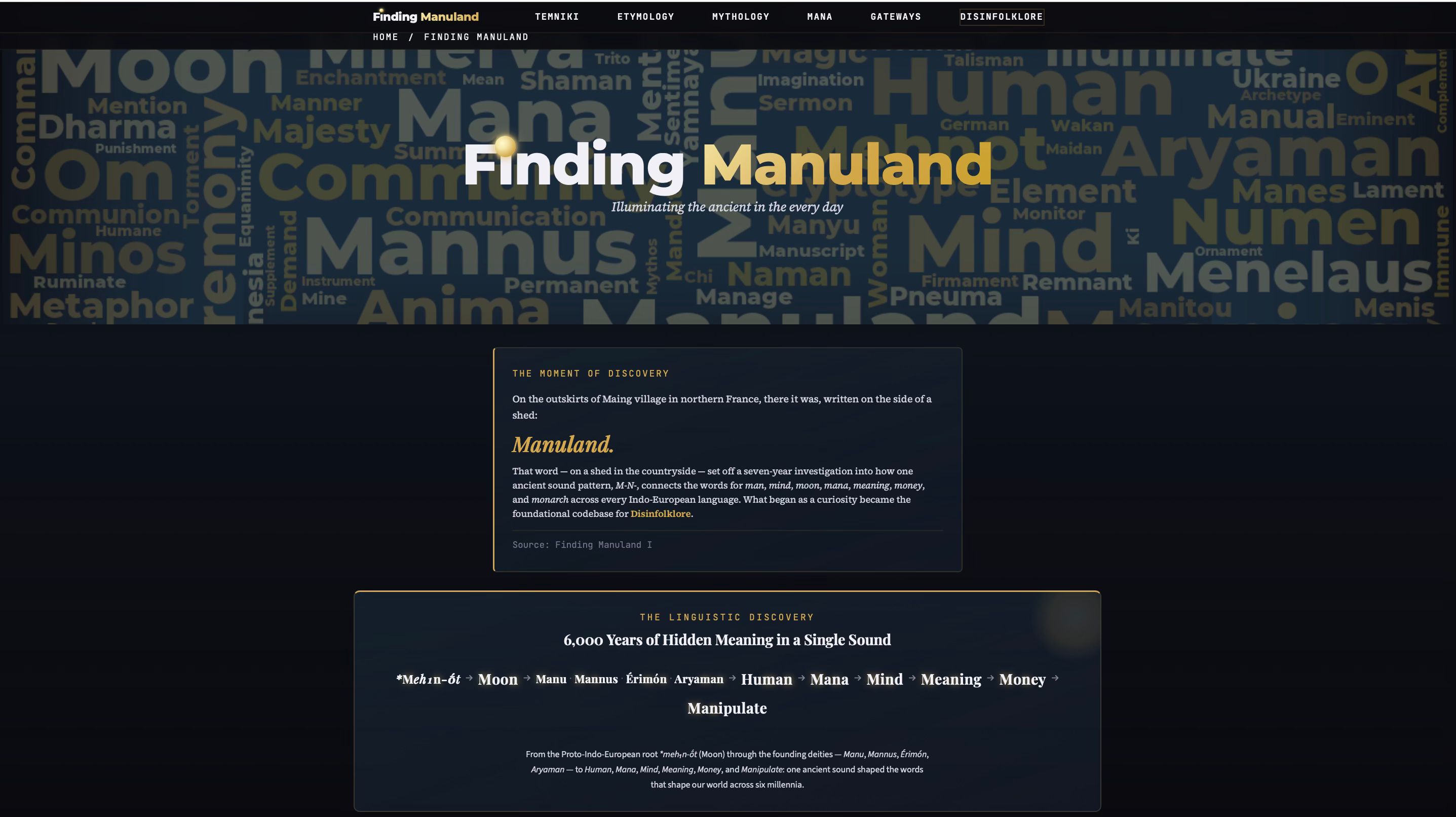
It also has the Finding Manuland component, which is the 6,000-year context. Disinfolklore didn't come out of nowhere; it's an emanation of Indo-European culture and of deep history, as I'm talking about. The shaman-tricksters and these archetypes of Finding Manuland are also in there, which is also a very rich read, but these are very succinct, quick passages.
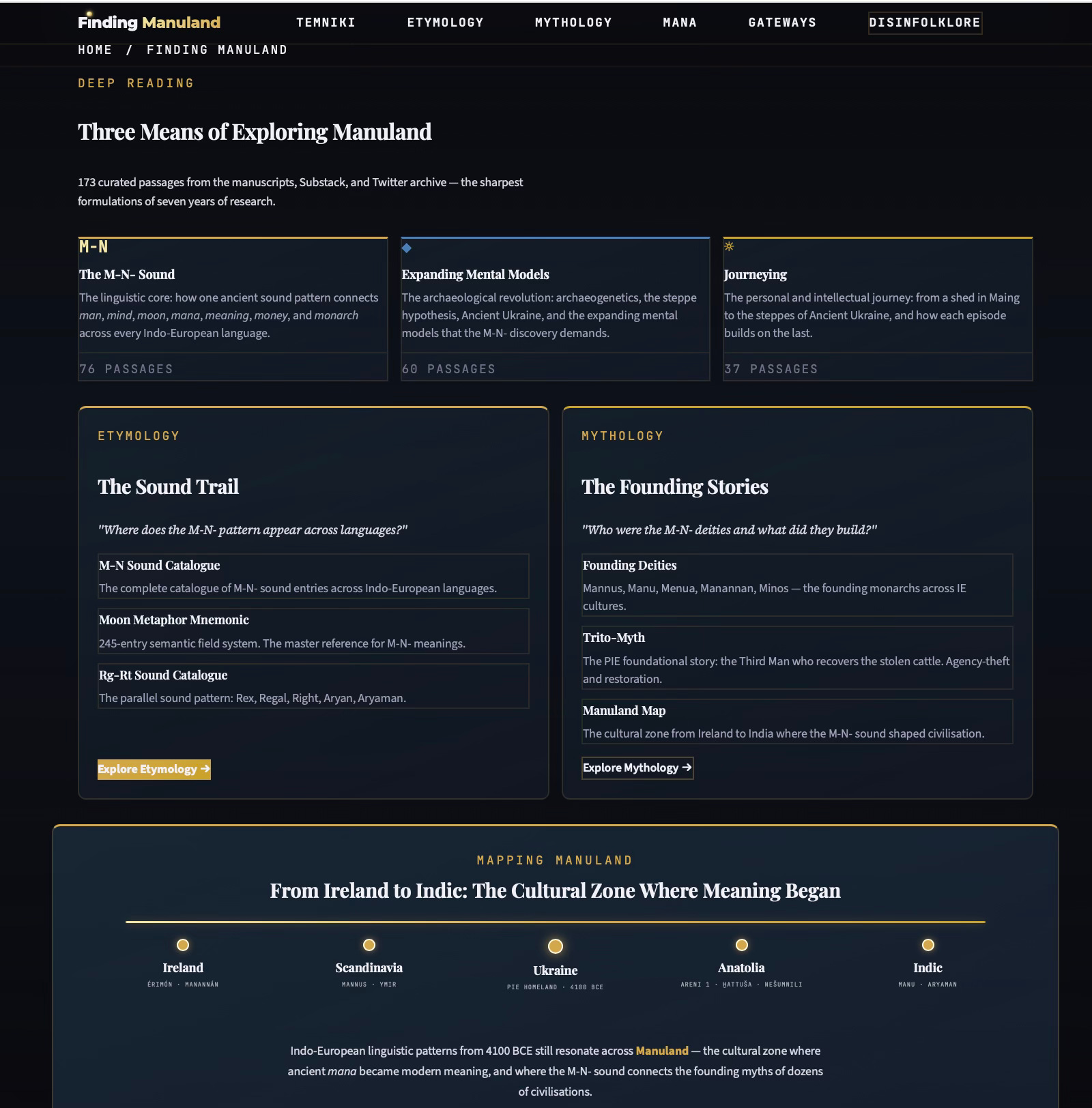
The entrance to the site is dark — the first homepage — but then everything underneath it is white and deliberately designed using the best optimised fonts and colours for making an easy reading experience.
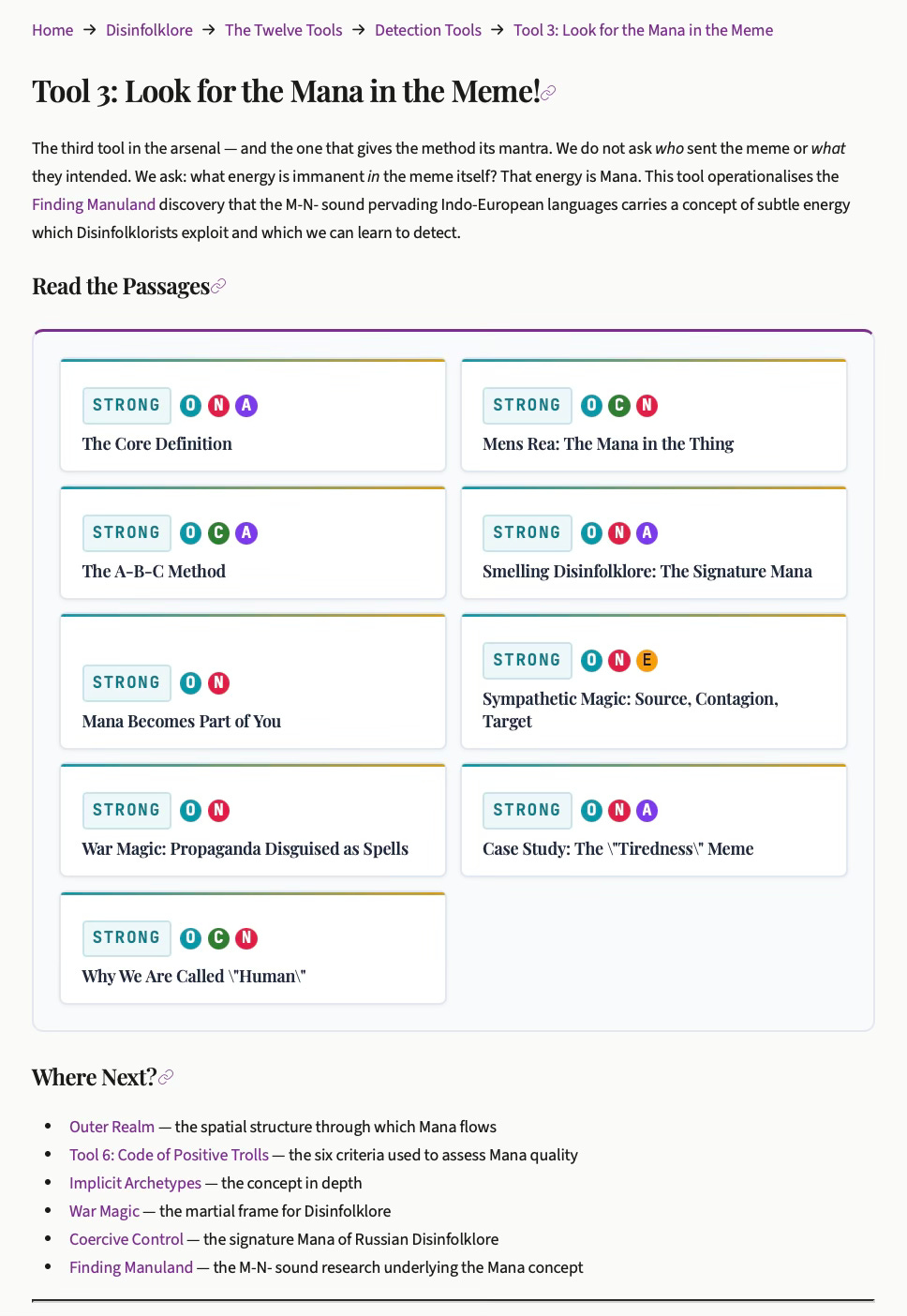
No noise on the passage pages, just arrows bringing you to the next passage or to the previous passage. Breadcrumbs — which is an interesting use from folklore to describe the bit at the top of the page — show where you are in the site. Then for people who want to read all of the long-form material, everything is linked to the reservoir, as I call it, which contains the long-form essays (most of which first appeared here on Substack) from which the passages are hewn.
FROM SUBSTACK TO INDEPENDENCE
I started out last November wanting to take everything that I'd written - the 450 articles on Substack - to be held also on an independent and Europe-based codebase. Not least because the same venture capitalists who funded Musk's takeover of Twitter run Substack. I wanted also to be a bit more resilient, interns of the longevity of my oeuvre’s survival whatever happens geopolitically.
I thought, okay, I'll just create what's called a digital garden, which is a cross-referenced collection of all my writings in long form — 450 pages. Gradually, as I saw how advanced these AI algorithms have become since I last paid attention to artificial Neural Network algorithms and computer vision as a masters student contemplating building a business based on the automatic interpretation of satellite images at Oxford in 2018. Never having learned to code properly, suddenly being able to code anything I could visualise into existence led to rapid development of my initial Digital Garden project into what you see today at Disinfolklore.com. I love how the platform communicates in very short, pithy passages all of the ideas I've been thinking about for the past three years.
DATA-RESISTANT ARCHETYPES AND THE VIEW OF RUSSIA
Now, moving onto a different kind of model than Opus 4.6 Claude Code’s current engine and the architecture which I used to build Disinfolklore.com, I first got interested in archetypes when I encountered friends whose mental models of Russia seemed immune to data.
Underlying what some are saying about Ukraine at the moment as it runs a series of mini-counter offensives and is regaining. some territory that was in the grey zone — that there's some positive chatter about Ukraine — there are very strong, data-resistant archetypes in our culture that resist changing our views about Ukraine and about Russia. Many of us have been on a journey since Russia annexed Crimea. Eastern Europeans, of course, knew what Westerners have only recently, generally speaking — what Westerners like myself have only recently discovered. They've known this forever.
I cringe when I look back at some of the things I said or thought even when I was in Ukraine, but certainly from 2015 on, and certainly even before that. I have thought very deeply, or tried to identify immediately in my own mind, what is going on. That has helped me also identify what else is going on elsewhere.
In a conversation today I had with somebody who's very interested in Ukraine but doesn't tune in that much — they're very busy — I find them quite a good source because they're generally reading The Economist or listening to the BBC News or very general mainstream news. When they talk about something to do with Ukraine, it tells me something about what normal people who don't spend all their time on this talk about. They mentioned today that their perception was that everyone in the normal media world was talking about peace talks.
This talk of Ukraine's advances — which I suppose most of us understand it's too early to say, and I don't think any of us are really getting our hopes up — but the idea that maybe that might change the view of Russia as very strong and invincible... it's not that promising at this point because most people aren't even aware of it. From his perception, he knew about it because he reads other material, but it's not in the mainstream media that he's consuming at the moment. Maybe others have seen coverage of Ukraine's advances — not massive, but somewhat significant advances. The talk is still about the peace talks.
PUTLER'S RESURRECTION OF THE GREAT PATRIOTIC WAR TROLL
What's going on there is the embedding of archetypes of this view of Ukraine and of Russia. Since 2005, Putler himself reactivated the Soviet-era troll that the only thing that mattered was victory over the Nazi invaders. Now most of us are aware that this war has gone on for longer than the Second World War for Russia, but that doesn't seem to have broken through to the mainstream. It's just kind of moving on.
I myself have monitored these May 9th parades and the worship of the ancestors which was reactivated after 2005, and then after 2014 even in Ukraine. It became a measure of how stable Ukrainian society was. For instance, in Zaporizhzhia I would go for several years in a row as an OSCE monitor to monitor the May 9th parade. There was a huge May 9th parade in Dnipro, in which the Dnipro Jewish community played a huge role in 2017. This was seen as a shared cultural moment and historical moment because everyone made great sacrifices in the Second World War. It wasn't, as we see now, an assertion that Russian culture was in any way dominant. It was just a genuine expression of solidarity with the past and with history and with the cultural meaning of it.
Many Ukrainians, especially Russian-language-speaking Ukrainians, will have memories from their childhood of having picnics and this kind of thing on May 9th. Really what was going on there, and with the whole use of these parades, as with many celebrations in many of our cultures, is the worship of the ancestors — trying to embed and establish an archetypal history of common history for the community.
As I understand it — and maybe there are other people here who have more direct experience of Ukraine or of Russia before 2014 — this had mainly died out during the 1990s. Putler, around 2006, quite consciously resurrected this May 9th, this whole May 9th parades and routines. Then it became an acid test in Ukraine for how tolerant Ukraine was of Russian culture, Russian-language speakers. We, as international monitors, paid close attention to it. My Russian colleagues were always wanting us to monitor aspects of the preparations for these parades in Ukraine.
Really what Putler was able to do quite quickly, in a couple of years, was embed in people's minds a memory of their youth and of their time when they were under Soviet occupation — and in the Russian context, of a time in the USSR when these parades really mattered. There seems to have been a collective amnesia that this wasn't really going on between 1991 and 2006.
Within a very short time frame, between 2006 and the full-scale invasion, or 2014, but really up to the full-scale invasion, Putin was able to reactivate six decades of investment by the Soviet Union's propaganda and culture into this myth of the so-called Great Patriotic War and victory over the Nazis.
That in itself, as we mostly understand now, was what I would categorise as disinfolklore, because it was a lie. The mystery of the monuments — all the monuments all over Ukraine and Russia — the Second World War started in 1941. Well, what happened to the first two years of it?
THE RUSSIFIED PERSPECTIVE ON HISTORY
Listening to the wonderful Accidental Ukrainian show, which I've become really fond of on Volia for Ukraine — and listening to it on Spotify after — there was a discussion, I think maybe James you were a part of it, where you were talking about how the history we were taught in schools in the West was a very Russified perspective on history.
The idea that this great sacrifice which the Russians made and that they're justified in being aggrieved because they didn't get credit for it — this moany grievance, what I call grievance mining, which we hear from Duncy Putin and Putler all the time and from Donald Trump and from authoritarian-minded people — I now use it as a proxy. It gives you a certain idea of people's personality if they're always grievance mining. To me, I just find it implausible. I think of my youth and how my parents would have reacted if I was always moaning about stuff. It seems that that isn't a general reaction to it. A lot of people get attracted by this kind of grievance mining.
This works on the interpersonal level, but also on the geopolitical and the historical scale.
DISINFOLKLORE VERSUS COUNTER-DISINFOLKLORE
We can distinguish between disinfolklore and counter-disinfolklore, or what I now call infolklore or positive trolling, according to the six criteria — the second of which is "right." Is there truth in this idea that Russia somehow had a reason to be aggrieved that no one in the West gave them credit for their sacrifice during the war?
When we look at the empirical aspects of it — for a start, after the Second World War, Russia got to occupy half of Europe and no one got a look in: Poland, Czechia, Slovakia, and all these other countries which were under occupation, not to mention the Baltics. They hardly have a right to be aggrieved there. Obviously, they started the war along with the Germans. Then the United States provided 800 boats, 400,000 Jeeps, 14,000 airplanes, 8,000 tractors, 3,000 tanks, 5 million blankets, 5 million army boots, 70,000 tons of cotton, millions of tons of petrol, 5 million tons of food.
It just fails the whole ethical discipline of "right" — the second part of the Code of Positive Trolls — and therefore is definitional disinfolklore. We can just dismiss it. Whenever we hear that energy of grievance due to the Second World War...
Then there's the other dimension of it, which is the Russian so-called sacrifice. We see what their military tactics are today. Yes, it's an enormous sacrifice of humans, but to what end? I saw the statistic today, which seems to be correct, that Ukraine retook in a couple of days 200 square kilometres — the amount of land that Russia lost 30,000 soldiers in December conquering. It's just an entirely pointless activity on their part. They may be sacrificing a lot, and I imagine in the Second World War their tactics don't seem to have been that different.
Yet again, another archetype — an energy of the poor betrayed bear alone holding back the Nazis while the rest of the world relied on Soviet Russia's military might. It just doesn't correspond to reality. That's something I was not as strongly aware of as I am today, before the full-scale invasion even. We know they invaded Poland, they relied on American matériel, and after the war they created a cult of the dead based on falsified history.
DUNCY PUTIN AND THE RESURRECTION OF THE TROLL
After 2008 then, who I'd call Duncy Putin, resurrected this troll — 2006 to 2008 — expanded the Worship of the Ancestors parades on May 9th, used it to entrench his own archetypal identity as the wise, protective sovereign. This was injected into the minds of every Russian and potential Russist, and also into us through some of our education.
It even features in every phone call with Western leaders, where they're treated to this hour-long or hours-long diatribe. Witkoff was completely taken in by it. Even in the Alaska episode, this infolklore — Trump himself commented on the Soviet Union's sacrifice after his call with Duncy Putin.
I've long believed that subjecting yourself to such phone calls is a colossal error, because it gives Duncy Putin a chance to top up his hypnotic war-magical entrenchment of Russia's priority archetypal identities — like "we sacrificed 30 million in a war that the Nazis started, therefore give us Ukraine." Obviously it makes no sense when you think about it, but it seems to capture the minds of people.
## UKRAINE'S INVASION OF KURSK AS A PERFECT TROLL
Ukraine's invasion of Kursk was one of the most perfect trolls I've ever witnessed, because it empirically pierced Duncy Putin's troll that only he can protect Russia. We see what's going on at the moment in Belgorod, with them losing electricity and different claims about evacuations. As I understand it, there was a big attack last night in Bryansk and in other places.
This idea that only Putler can protect the homeland and only can protect Russia has now been under massive attack, not least since the invasion of Kursk. Yet it hasn't totally disrupted the archetypal identity of Russia as strong in many people's minds. His troll — that Russia is invincible and that anyone who attacks Russia is done for — is clearly wrong because Ukraine is running these attacks all the time.
Only mass disinfolklore manages to keep concealed the fact that Ukraine keeps doing this and that Russia is not what it said it was for 60 or 70 years.
THE TENSION BETWEEN EMPIRICAL FACTS AND ARCHETYPES
Here we have this tension between the empirical facts that many of us are all too aware of — because we're listening to Mockers or Will and the details of the minutiae of the chaos and ridiculousness of what's going on in there — yet in the minds of many, Russia is this kind of sophisticated country which is on a par with China or with America, which we know is absolute rubbish.
If many of us are possessed like ghosts by such data-resistant archetypes of a Potemkin state, think how poor Russians must be. I did think around the time of the Kursk Offensive that Russians' brains were about to burst. I guess many of them did, in a way — they just don't quite know what to do. They think Russia is invincible, no one can attack Russia, and now Ukraine is attacking it every night.
This is the practical effect of what I call archetypes — these invincible mental archetypes that seem to be invincible but actually they're not. That is the point of my disinfolklore analytical method: encounter disinfolklore, and there is a means of combating it, because many of us have experience in our lives of changing very strongly held views and watching others change very strongly held views. If we keep this in mind, we can strategically work on this. When we are attacking these archetypes, we're not merely engaging in gossip or trying to persuade in a non-strategic manner. We have in our mind: this person is speaking this way because they have this very strong underlying image. We have a means of disrupting that if we really focus.
That, I think, is part of the value of understanding what's going on under the hood, as it were.
THE SHAMAN-TRICKSTER ARCHETYPE
When we look at individual archetypes in our culture, the shaman-trickster is one of the most fundamental ones. The Joker and Batman, Charlie Chaplin's Great Dictator character, Sacha Baron Cohen playing The Dictator — this shaman-trickster obviously includes Donald Trump as a disinfolklore figure, and Putler himself as a shaman, a kind of magician and trickster, in the sense that they managed to create an image which is completely divorced from reality.
Then people like Gideon Rachman, the foreign affairs person at the FT — when America took away Maduro, he wrote that tweet that 5,000 Ukrainians jumped down his throat, where he said, "Now Putler's going to think it's okay to take President Zelensky." Everyone's response was: "What have you been doing for the last four years?" In his mind, this image of Putler as this wise sovereign who's just waiting for America to do something so that he can do it is just so bizarre and removed from reality. He reveals his utter subjection to this fake archetypal identity of Putler as a wise sovereign, whose grievance-mining claims of hypocrisy of the West, as amplified by his information warfare machinery, have some substance to them, some reality to them.
He is supposed to be the foreign policy editor of one of the biggest newspapers in the world, and yet he doesn't seem to have been paying much attention to what was going on in Ukraine — or he was, but he's forgotten it because his brain has moved on.
That's how these archetypal identities manifest and affect our information environment. There are probably many of these residues in my mind as well. I hunt them out, I write about this, I think about this, but that doesn't mean I'm not also affected by these.
PRIMORDIAL AND MOBILE ARCHETYPES
I talked about it, I think on the fourth, fifth, or sixth week, how we have these archetypal identities like our mother, our father, mother figures, father figures — what Jung called so-called primordial archetypes. Then there are also what I call the mobile archetypes. They move around and flow around the place. The shaman-trickster is a very solid one — it's up there with the mother as a primordial archetype in Indo-European culture. It's widespread in almost every community. I mentioned that last week with the class fool. Some of us probably in some contexts play that role.
There are many aspects of the shaman-trickster archetype which are personified in folklore, literature, media, art, movies, television, news. Unfortunately, now they're personified in some of our countries' leaders — Berlusconi was one. We have Nigel Farage in England. We had Boris Johnson. We have Donald Trump. There's this showman aspect of it, which is how it manifests, but I see inside this a very deeply held archetypal identity.
There's a fluidity between these ideas of archetypes and their different personifications — a reciprocal flow, flowing through our lives and minds through the means of stories, what I call disinfolklore, counter-disinfolklore, the kinds of stuff Mockers talks about so well in her mocking tone, and in people we actually know and in the art we consume. We see this familiarity between the person who grievance-mines in our own lives, and perhaps we feel a sense of grievance about this or that because maybe bad things happened to us. Maybe, as with Donald Trump — as far as we know nothing bad ever happened to him really — he seems to have had a golden life, yet he's ended up with this really terrible chip on his shoulder.
All of these reflect and embed and entrench and hypnotise us into seeing certain characters as archetypal identities, and the other way around. I'm just particularly tuned into what is it that's universal about these people that has this kind of magical influence — that does nothing over me, but to millions of people they're really attracted.
The shaman-trickster — we probably don't think in that language or those terms, yet it's obviously in Batman, in a lot of popular culture, and it's in our days of the week: Woden, Odin, and all of that.
THE INDO-EUROPEAN ORIGINS
I'm not really looking at how this arose in culture or its origins, except that I'm quite satisfied with it being an Indo-European emanation which, as previously discussed, does come from Ukraine originally, probably. There were probably certain humans who lived and managed to embed this idea in mythology and culture. Then it just continued onwards.
What I'm most interested in is identifying it in the current moment and then coming up with ways to re-archetype. The kinds of things which Mockers does quite naturally, or Will does quite naturally with Mockers — "This Week in Absurdistan" — and which many of the presenters on Volia and certain people we might follow on Twitter.
CONTEMPORARY ARCHETYPES AND JOSEPH CAMPBELL
We look at different concepts — government, Westerners, development aid, pensioners, anything with personal characteristics — and these are used to latch onto the archetypes we have in our minds. As previously discussed, Joseph Campbell talked about this, but in my view in quite a removed way, because it was all about ancient Greece, which doesn't mean that much to people. Whereas I prefer to talk about contemporary archetypes.
DONALD TRUMP AND THE ODIN COMPLEX
Let's think about how Donald, for instance, and the shaman-trickster — the original one in Indo-European culture or in Germanic culture, Odin — were alike. He was the Lord of Death, an Odin complex character, a magician, a god of runes. Like Druidy Don, whose cryptic posts would make the Oracle at Delphi confused. Looking at entrails to divine what Druidy Don, what Trump, will do next might be more profitable than parsing his Delphic or regular untruths on Untruth Social.
When Russian army units are killed, they said they had gone to Odin. Donald's ancestors left Germany, and his sacrifice to Odin was as good as death on the battlefield, which every well-born German used to wish for. Of course, Donald is the complete opposite of this with his bone spurs. As I understand it, his great-great-grandfather left to avoid military service in Germany — it kind of ran in the family.
Then there are all of these commonalities with these archetypes. I'm mainly interested in the actual appearance in our culture of these, and just because I've done a deep dive, I look at the coincidences of it.
DUNCY PUTIN AS THE VILLAGE FOOL
Duncy Putin is really — what I'm trying to do in counter-archetyping him is to look at him as a dunce. The guy who's always being tricked by the West, who is never at fault, who is seen as this kind of wise figure — he projects himself as this wise sovereign. In fact, I try in my own small way to look at him more like a village fool, an idiot. He's like the dunce in a fairy tale, a caricature. He never learns from his mistakes. We see that every day on the battlefield in Ukraine.
He portrays no self-knowledge. Those of us watching the battles marvel at the stupidity of Russian tactics — what are they doing? All of this bombing just doesn't seem to have any point to it, and hasn't helped them in any way. He's the personification of an army that attacks day after day in the same places in broad daylight, with the same effect: annihilation. Then through disinfolklore, they just rebrand their failures as successes. Many of us, sadly, buy this troll that he's a master strategist.
Of course, "Putin the Master Strategist," the guy on Twitter, has done fantastic work countering this archetype of Putler as a master strategist — and the notion that Russia itself is somehow bigger than the rest, which is again a manifestation of these archetypes at play.
There was that famous time where Putler made the speech — it was to mil-bloggers, I think September or June 2023 — and he set out all the times the West had tricked Russia: 2003 when he signed the border treaty with Ukraine, 2004, 2006, 2008 when he blamed the West for protests against his faked elections, 2012, 2014, Minsk — he was tricked, he reckons, in Minsk 1 and then Minsk 2. Then in 2019 with President Zelensky. Of course, 2020, 2021 — he's just been tricked so many times. Now he says he was tricked in March 2022. He was told if he withdrew from the Kyiv region, he would get Donetsk and things.
He's projecting himself as this betrayed hero who just keeps resisting but gets tricked. Obviously most of us just look at him as a complete fool. If this were true, you're a complete fool because you keep getting tricked this way and you don't learn from your tricks. That's why he is a bit like Pangloss or Sancho Panza in that great Spanish novel.
PRESIDENT ZELENSKYY AS THE COMEDIAN
President Zelensky, who I archetype for obvious reasons as the comedian — which is another deep, deep archetype and an aspect of the shaman-trickster — the fool and the comedian, or the idiot in Dostoevsky's oeuvre. For those who haven't read it, what's idiotic about the idiot is that he sees the truth, but he's too stupid to conceal the fact that he sees the truth. Therefore he suffers and manifests his pain at how the world fails him. In that sense, he's archetyped as an idiot.
From Dostoevsky's perspective — and maybe other people might have comments on this if they've read it — Dostoevsky manages to normalise this aspect of Russian society where someone who sees the truth but is too stupid to conceal the fact that they see the truth suffers greatly, doubly, as a result. They see the truth and they live in this imperfect world, and then they suffer because they can't shut up about it. Whereas the wise person, from the Russian perspective — or from conventional bourgeois society perhaps in some ways as well — might see the truth but understands to keep it quiet.
We go back to this Soviet-era archetype of the kitchen talks. Late at night, after loads of vodka, you could tell your neighbours what you think about things. Then when you go out, you do what Mark Carney said in his speech the other week: you're the shopkeeper who puts the sign in the window saying "Workers of the world unite." You don't believe in it, but you just go on.
I've heard this from many different commentators, including recently Konstantin from Inside Russia, but also in this amazing exhibition I saw once in Kyiv in the Pinchuk Museum, by Boris Mikhailov, this great Kharkiv artist from the Soviet era — mainly photographs he did. He talks about this duality of life between the kitchen talks and going out on the street or in work and not saying anything. In his view, and in Konstantin's view as well, this is why the Soviet Union fell apart so quickly — because there always was this duality.
ZELENSKYY ON PUTIN'S MAGICAL POWER
The comedian Zelenskyy said: "Putin can force the world to feel they have lost, and this will be a reality." This is from one magician — one great magician. As many of you know, I really admire President Zelensky's comprehension, as well as his ability to use myths and create a curse on Putin, and create these staged spectacle events which demonstrate he is a good magician.
"Putin can force the world to feel they have lost and this will be a reality, because it is not possible to defeat Ukraine, but you may win over the entire world and show that he was right in some way — i.e. without punishment."
Someone — I think it was Will, or maybe Dry Fly or someone — this week was saying what I believe, which is that at a certain point Russia will just leave Ukraine, and it will be like the way America left Vietnam, and the way Russia left Afghanistan, and America left Afghanistan, or Iraq. At the end of the first Iraq War, Iraq sent this really angry, ranty message to the UN Security Council — just moaning about loads of stuff. I think it was famously 21 pages long. As people were going through it, they were wondering: are they surrendering or not? Then an Iraqi diplomat said yes, we're surrendering. Nobody knew it.
That's how it's going to play out. Russia will of course claim victory in whatever happens, and he'll convince people to believe it. This is the personification of the shaman-trickster — that Putin can force, in President Zelensky's words, the whole world to feel they have lost, and this will be the reality. That's a very perceptive observation on his part.
THREE MANIFESTATIONS OF THE SHAMAN-TRICKSTER
This brings me to the third personification of the shaman-trickster. We start with Donald Trump, who I talk about a lot just because he is this common character, then Duncy Putin, and then the third manifestation is President Zelensky, the comedian.
There's this great headline which I love from 22nd of April 2022, in a Ukrainian newspaper: "Zelensky Articulates the Russian Dream: To Steal a Toilet and Die." That is very perceptive to people like us who watch them stealing all these toilets. That scatological element — I get a lot of value out of the wordplay from the scatological to the eschatological, and the scatological references to toilets and Lavrov. Obviously, his name communicates the idea of a toilet — "lav" in French. Then there's this hygiene obsession — the Nazis were obsessed with hygiene. Then the golden toilet brush, which I saw in Mezhyhirya, this amazing mansion which was built by Yanukovych.
THE COMEDIAN'S ATTACK ON ARCHETYPING
The third of our trilogy of archetypes, the comedian, is of course Volodymyr Zelensky. Now the comedian is bombing Duncy Putin's Russia — another complex of archetypes in the term "Mother Russia." Every night now, the comedian's army was occupying 500 square kilometres of Kursk, which of course they could only leave because Don cut off the intelligence support.
There we get this other archetype, which is quite hard to convince people of. I'm sure others listening have had this experience where you're trying to convince people: "Well, actually the West propped up the Soviet Union." America propped it up a lot — built the Zaporizhzhia Dam, did all this stuff in the Second World War, tried a lot. Really it was only when Reagan came along, I think, that they just pulled back support. Of course, again, we see this still with the Starlink terminals.
Somehow Don is able to archetype himself as wanting peace and having these genuine peace talks. Normal people we know who just listen to the BBC News, or the PBS News, or read the New York Times probably believe in these. Thankfully, I saw the Wall Street Journal foreign editor Yaroslav — today of Ukrainian heritage — just saying: don't pay any attention to these peace talks. Which is of course correct. Not many of us do.
This is the scale of President Zelensky's attack on this archetyping and this re-archetyping of Russia. The embarrassment which people... they probably don't feel it because they don't see it, but we can see it in them when they look at Ukraine as some sort of victim or President Zelensky as some sort of weak person. That attitude you get from people who refer to him dismissively as "Zelensky, oh Zelensky this" — where their minds are completely occupied by this kind of MAGA view of Zelensky. Even Trump the other day on the airplane saying, "Zelensky really has got to come to the table, he's got to make a deal."
For someone who's obsessed with the archetype of strong versus weak — here we have this guy who's just relentlessly attacking Russia in a way that no country ever dared to do in these blatant ways, just sending the missiles and drones every night to destroy Russia and destroy its economy.
Again, we see how the archetypes many people have — it takes a lot of empirical evidence to dislodge them in people's minds. We know and we see it and we admire it. I suspect he sees the comedy in it, and I'm sure many of us do — just the comedy of these weak people like Lindsey Graham or Putler himself talking in these negative terms about someone who's extraordinary.
THE DON'T POKE THE BEAR TROLL LOSES ITS MANA
We're left with this understanding that the comedian is getting more powerful with every hundred drone strikes on one of Duncy Putin's oil refineries a thousand kilometres from Ukraine. The "don't poke the bear" troll is losing its mana, it's losing its power, along with every North Korean soldier the comedian captures. We see this massive amount of money coming from that Ramstein meeting the other day — the 19 billion from the EU, all of the weapons developments.
This is a perfect example of the shifting power dynamics, as archetypes create reality, are impacted by new realities and facts on the ground, and produce new understandings. On the one hand, there are these data-resistant archetypes, but then we see them change. As Engels wrote in the context of the transformation of one mode of production — feudalism into capitalism and capitalism into communism — at a certain point, quantity changes quality.
ZELENSKYY'S POWER VERSUS DRUIDY DON
President Zelensky's power, I think, is as a very successful writer and TV production writer, running a big business and as a lawyer — as distinct from Donald, who was merely acting in someone else's TV show. President Zelensky is fluent in all the different dimensions of emotion-moving activities like trolling. Obviously Putler and Donald are very erudite and brilliant at trolling and moving others' emotions, but they're up against someone who's a master of it. We see that in every kind of speech which he makes.
The Zelensky Effect for the archetype of the comedian is a closer match between archetypes at various levels — the artist, the actor, and ordinary people — that makes their campaign more resilient and successful.
Now, Druidy Don is brilliant at forging a mythos that convinces people he has a superhuman ability to make the unexpected happen. Druidy Don, as I would refer to him in a dismissive way — he's Druidy, he's not a Druid, he's Druidy in the "truthy," truthiness way. He may seem to have magical powers, yet they're all given to him by us, in our own minds. What he does, and those around him amplify, is in fact a mechanical process that uses archetypes deeply embedded in our culture, in our minds, in ways that are quite familiar to those who study this.
ODIN AND THE WAGNER NAZIS
I don't really know that much about Loki, but these are very common archetypes. There isn't just one or the other. I talk about Odin a lot because, in the previous manifestation of Volia where we had a totally different vibe, I was often challenged on the relevance of looking back at history and mythology by some of the presenters. When you discover that the Wagner Nazis unit in the Russian army — and again we see Wagner, this brand, resurrected again this week by the FT to try and scare people — they're Odin worshippers. That's why I bring him up quite a lot.
The main source for Odin — as the high god and all-father of Norse mythology — he's also a magician king. This essential archetype in all Indo-European culture of the sovereign with two aspects to it: the juridical, represented by the lawyers or by the legislation, by the king in parliament; and the magical, the magico-religious, represented by the priest. The majesty element is this magical aspect. I argue that President Zelensky is a master of both, whereas obviously Donald — as far as we know he's never read a whole book — and of course Putler has got legal training, so he should be a master of the juridical, but he's just absolutely rubbish, a rubbish lawyer.
Odin, the magician king — a mysterious, shamanic god of runes. I know Yeni has talked about runes before and helped us understand them a bit more. A strange self-sacrifice — this is what's common to all great Indo-European cultures. In Irish myth, Donn self-sacrifices during the invasion — it's mentioned in the Book of the Taking of Ireland. We have Yama in Indic culture, and we have Jesus in other Indo-European cultures. There's this self-sacrificing first king who then establishes the culture.
There's something in this I saw recently in this grievance mining. It's part of giving the idea that you are self-sacrificing. I think that connects to it.
That is described in the Hávamál. Yeni may know more about this than I do, but one of the early Germanic texts depicts the shaman-trickster hanging on the World Tree beside the royal mound in Uppsala. Yggdrasil — literally Ygg or Odin's Horse. It has him saying: "I know I hung on the windswept tree through nine days and nights. I was struck with a spear and given to Odin, myself given to myself" — which is this manifestation of the self-sacrifice. Obviously he's so important that the whole day, Woden's Day, was named for him. Loki was maybe more of a Loki-trickster type, but we see these archetypes in many different characters as well.
Continued from:

First in mini-series:
Podcast | Disinfolklore Universe - Episode 1

It’s exactly a year since I detected the system-wide effects of the aggregatation of MAGA and Russian Disinfolklore artifacts invading our minds, information space and reality. In February in Munich at the Pirate Party security conference I declared what by then I had archætyped as a “Disinfolklore Universe” to be operating inside all of our minds and c…


