


Zelensky’s Red Square Coordinates: Sovereign Trolling
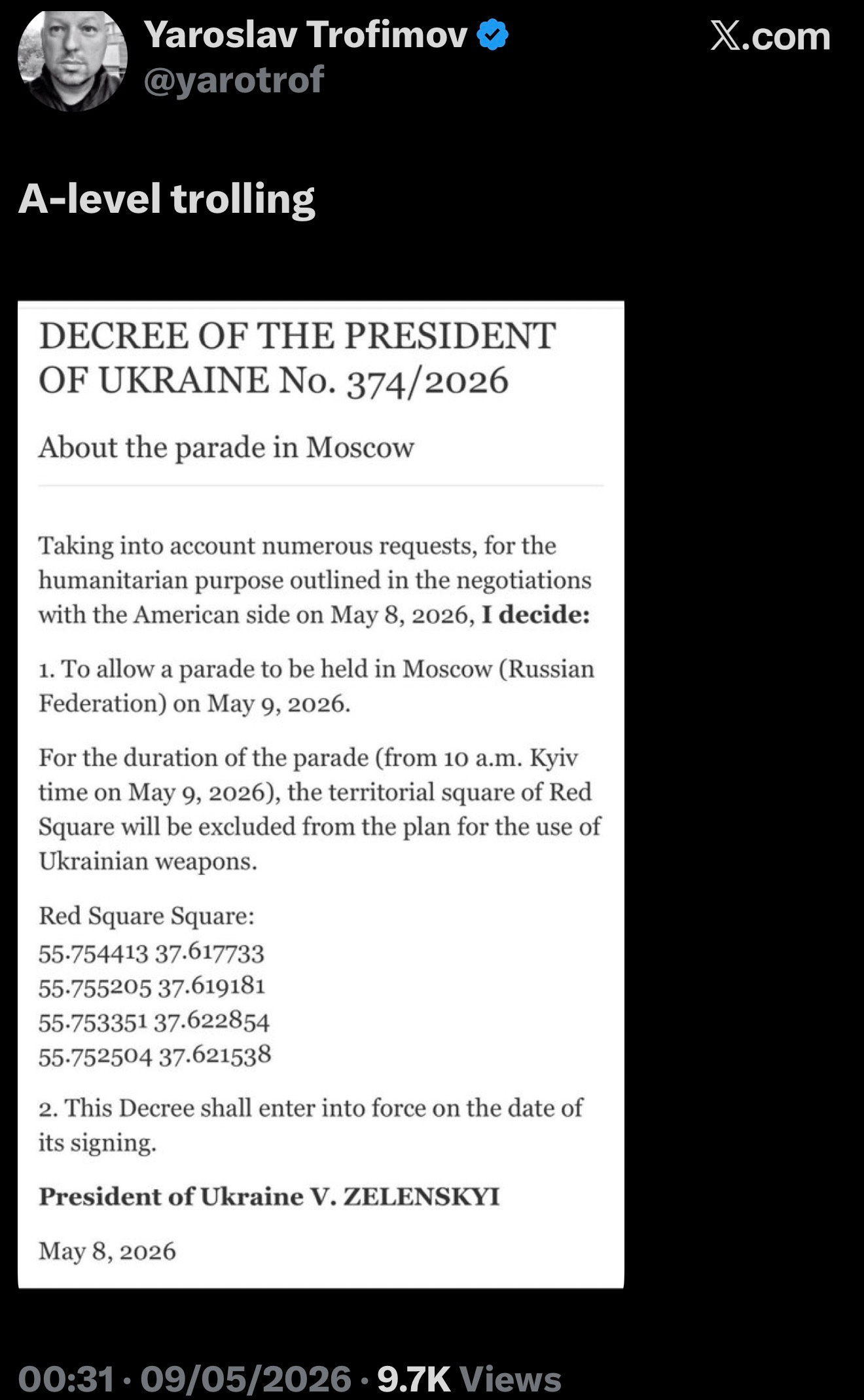
I was happy to see this week when President Zelensky posted the executive order, for want of a better term, talking about how the coordinates — the very accurate, I think it was eight-digit grid coordinates, or maybe even ten — of Red Square in Moscow would be safe from Ukrainian missiles. I noted with great pleasure how everyone recognised that as trolling, and that interested me. There was no argument that this was what this was about. It was about trolling using the threat of force, or the non-threat of force, but in the sense of weapons. Here is a sovereign with the capacity to direct an army, missiles to kill people, using Twitter. I noted the Prime Minister of Ukraine and many ministers tweeted out the executive order, as did President Zelensky himself. That’s the online aspect of it. It was a very specific message within a complicated concatenation of negotiations that most of us are following on a day-by-day basis, but which most normal people wouldn’t follow.
The venue was online in some senses, but everyone recognised it as trolling, not only because it was online. It had real-world aspects to it, and that pleased me enormously, because that was what I noticed about trolling in eastern Ukraine: it is a multi-arena activity that we have a sense of understanding what it is. It’s mainly encountered online, but when something happens like President Zelensky signing that executive order as part of a strategy to get 1,000 Ukrainian hostages back from Russia, we recognise that as trolling. That is in the context of the trolling series, which we’ll go into.
Archetypal Literacy and the Luhansk Corpus
The second element is this archetypal literacy. On disinfolklore.eu, the website, the main expression of my work, there’s what I archetype: the Disinfolklore Analytical Method as the 12-tool way. The first tool is archetypal literacy.
As part of my learning — I’m still learning — to be archetypally literate, to see archetypes immanent in data, I hand-labelled this massive corpus of over 10,000 propaganda items that I collected while working in eastern Ukraine from inside the Russia-occupying media space inside Luhansk. I refer to this as the Luhansk Corpus. These are hand-labelled as the archetypal imminences inside these stories.
What I started here about five weeks ago was talking you through these stories and the different archetypes within them. Some of you might remember I was talking about the merciful sovereign. Inside the entire structure of the situation, Putler plays the merciful sovereign by saying that he is rescuing Ukrainians from the drug-addicted leaders and all of that nonsense, and the Nazis and all of that nonsense. When Putler is talking like that, he is archetyping himself as a merciful sovereign.
The Mother and the Maiden
Some of you might remember from a long time ago — it is a year, over a year now, that we’ve been doing these weekly, and I’ve only missed, I think, one or two weeks — that one of the very first ones I talked about was The Mother and the Maiden. This was an incident in eastern Ukraine where, in a blinding flash, I realised that there was something artificial about the use of this term: underage mother and her underage daughter who were about to be cut into tiny pieces by a Ukrainian Nazi. Again, this is a form of trolling, and it’s a very typical situation in some respects, but it also has real-world effects. It begins in the information space. It passed into my chain of command and down to me as a patrol group leader of a team of international diplomats on the border with Russia-occupied Ukraine. We were dispatched to go into a forest to look for this mother and her underage daughter who were about to be chopped into tiny pieces.
As I recounted, what that was doing was trying to archetype, was trying to trigger us — me and my team, and those in my chain of command who ordered us on this ridiculous task — which, even before I even had the word archetype, only me and one other colleague who were sent on this task realised: this is ridiculous, this is not true, this is an artificial situation that we’re being sent on.
I subsequently found out that the mother and the maiden are what Carl Jung calls primordial archetypes. As spoken about before, I disagree with Carl Jung on the universality of archetypes. My other work in Power of Mana establishes that all of the different traditions from which Jung was gathering evidence of the universality of archetypes were Indo-European traditions.
The Kramatorsk Video: The Switch from Merciful to Merciless
This last week we saw this picture, this video — some of us will have seen this — of a mother sheltering her daughter, her young daughter, by a tree in a park that I’ve been to in Kramatorsk, while drones hunted them in the sky. The video lasts for about two and a half minutes. What we have there, for me, was a very significant video, quite apart from the human aspect of it and the barbarity of it. I did my best to share it because it hopefully will bring home to people one of the reasons why the mother and the maiden is a primordial archetype: it moves us. It should move us. It should move people in our lives who don’t really know about the drone safaris.
The person filming that in the park may well have had no awareness of Carl Jung or why this particular scene — while that film was being filmed, while the person was standing there (I don’t know if it was a man or a woman who came across this scene while the drone was going overhead) — they themselves had to shelter from it, as we saw in the rest of the video. They themselves, while their life was in danger, were so drawn to the picture of this mother and the maiden, and because they had their phone they were able to film them. There’s a great beauty about these two and a half minutes. It’s kind of like an intermission in reality, where it goes into archetypal Disinfolklore in the sense of that video was capturing the horror of what the Russians are doing.
The merciful sovereign Putler is — I’m going to go out on a limb here and say that mother and her daughter, certainly the mother, was probably a native Russian-language-speaking Ukrainian. That is the person like the mother and the daughter that I wrote about in one of my first Disinfolklore pieces, who brought their child to shelter in the drama theatre in Mariupol and then was annihilated. In the moment of their annihilation, they were turned from the person the merciful sovereign was going to rescue — because they were being ruled by a crowd of drug-addicted Nazis from Kiev, according to the Disinfolklore — and in the moment of their annihilation, of being turned into biological dust, they were transformed into Nazis.
Now, thankfully, I’ve made the link that in that very moment, the merciful sovereign turns into the merciless sovereign, and that switch is a reciprocal process. Immanent in that video we saw of the mother and the maiden in Kramatorsk last Friday was the transformation in the eyes of people viewing it of the merciful sovereign Putler as he was playing himself into the merciless sovereign, and the further entrenchment of President Zelensky as the merciful sovereign, who, as all of us know, is doing everything in his power to ensure the protection of his people.
These are very, very old categories. Apart from that, this is a method to analyse particular situations that I find personally quite useful, and also very rich.
Training the Neural Network on the Disinfolklore Analytical Method
The point of me hand-labelling these and speaking and doing podcasts is — what I’m also doing is training an artificial neural network algorithm to think like I think. This week I finished creating the architecture and the inputs, the dataset which I input into the neural net, into the large language model to train it. The architecture itself of the neural network which I designed is based on the 12-tool way. The process of doing this is absolutely fascinating.
As I’ve mentioned before, I think this is the future for all of us. We will have our own little neural nets running all the time. Some people will never have the ability to train their particular personal neural net. My vision for the Disinfolklore Analytical Method is a module that we can add on to our cognitive system, our cognitive structures.
At the moment it’s available on the website. It’s available listening to me and gaining some sense of archetypal literacy, so that we can parse the data and the data streams coming through us into structural elements that help us understand what’s going on when Russia, for instance, is playing the merciful sovereign by saying it’s trying to rescue Ukrainians from something. We know the only harm in Ukraine is being caused by Russia. Equally, in the American example, this method translates perfectly to Donald and what Donald is doing.
I talked before about the archetyping of himself as a sovereign through the use of the ballroom from Cinderella, from Louis XIV’s, and also this triumphal arch — again, the RCH, the right — archetyping himself as an emperor. The method should translate into all those things.
In order to train the neural network algorithm, and in order to get the architecture, it is necessary to label, hand-label algorithms. This is what I’m going to talk to you right now about, which is the walk-in.
Stephanie Baker’s Bloomberg Article on the Walk-In
There was a great article in Bloomberg published this week — very, very detailed article — and it was featured on the Daily Telegraph podcast, which I listen to every now and again these days, reluctantly. I do see this story of them kind of becoming more human and more European. Hearing the Daily Telegraph kind of eulogise Kaja Kallas and other people in Europe is a great joy to me, having gone through the whole Brexit malarkey. That’s a side point.
One of the things in this Bloomberg article — her name is Stephanie Baker, well worth following on Twitter — one of the things she mentioned about analysing this particular Russian information operation, Disinfolklore operation, Combat 1614 or something like that, which I’ve talked about before in the context of the piece I did about five weeks ago on the European Union’s External Action Service Report, Fourth Report on FIMI Threats, which you’ll find on my Disinfolklore.net Substack from about five weeks ago. In it I analysed the Fourth Threat Report and joined it with the Disinfolklore Analytical Method, and made some very gentle and humbly offered suggestions about how they can improve their FIMI (Foreign Information Manipulation and Interference) report in the light of the Disinfolklore Analytical Method. I offered a few ways we could work together. I mentioned these particular operations. One of them, I think, was called Combat 1614 or something like that.
Stephanie Baker in this Bloomberg report has really done the definitive study of it. Basically, the modus operandi is to pay somebody in an African country — probably highly educated, someone in Senegal or somewhere else, or maybe somewhere where Wagner is operating — get some university PhD student or whatever, or actors in an African country or in Western countries as well. You get these actors to say: “I worked in Chloé and Olena Zelenska came in and she bought a yacht,” or “I’m an estate agent in Abu Dhabi and President Zelensky has just bought 50 mansions.” They make massive amounts of these videos, and the credibility in people’s minds is established by the testimony, the first-hand testimony of a real person. Millions of views happen.
The Walk-In in Eastern Ukraine
This is exactly what I experienced in the first Disinfolklore story, which was in eastern Ukraine, where the MGB — the security service, the Russian occupier security service in occupied Luhansk — was called the MGB, which is the precursor to the KGB. The Russian occupiers decided to archetype their internal security service with the predecessor to the KGB. This was back in 2014.
The MGB had gone to the people ahead of me in the chain of command — two or three people above me — and said: we’ve just had this walk-in, and this walk-in has given this testimony. The testimony is: he received a phone call from a Ukrainian Nazi in a government-controlled area, and that Ukrainian Nazi says he’s going to chop my wife, my common-law wife, and her underage daughter into tiny pieces if I don’t cross the River Donets — cross from the inner realm, the protective inner realm where the sovereign protector, the merciful sovereign Russia, is protecting us.
I didn’t know any of this about archetypes then, but I did know this was a really odd operation for me then to be sent on, in two armoured vehicles, with my team of outsiders, of Westerners, of diplomats including Eastern and Central European, former senior NATO officers and the like. What I did notice also was how the idea of a mother and her underage daughter being chopped into tiny pieces really motivated some of my colleagues who weren’t that motivated by much of our work. Suddenly they were mobilised and they just wanted to go to this cottage in the woods and save them.
Stephanie Baker in the Bloomberg article noticed how one of the tropes — one of the main indicators that you’re dealing with a Russian operation — is these first-hand testimonies from whistleblowers. I made the conceptual link between these whistleblowers and the walk-ins.
The Walk-In: Stage Defectors and the MGB
The first little story I’m going to tell you is about a walk-in, called The Walk-In: Stage Defectors and the MGB.
One of the most carefully architected characters in Russian Disinfolklore apparatus is the walk-in. He appears in my corpus 189 times. He has many faces, many aspects, but a single structure. I call him the walk-in. Stephanie Baker called him the whistleblower, but they’re the same archetype, they’re the same character.
The walk-in is the Ukrainian — sometimes a soldier, sometimes a civilian, sometimes a doctor, sometimes a defector, sometimes the former spokesperson for President Zelensky — who, according to Russian-backed outlets, voluntarily walks into an interview with some pro-Russian American preppy guy who thinks he’s going to be the next President of the United States of America. Who voluntarily walks into a Luhansk Folks Republic or a Donetsk Folks Republic — so-called, I’m air-quoting here — Ministry of State Security office, and confesses. The confession always serves one of two purposes: to incriminate Ukraine, or to justify an occupation security action.
Let me read one of them. 10th of March 2017, lug-info.com: “NATO instructors trained the DRG involved in the murder of Anishenko — MGB Luhansk Folk’s Republic. NATO instructors carried out special training of Ukrainian saboteurs from the 8th Regiment of the Special Operations Forces of the Ukrainian Armed Forces operating in the territory of the Luhansk Folk Republic. This was announced today by the Minister of State Security of the Luhansk Folk Republic, Leonid Pashnik.”
Pause on that. In a single sentence, the occupation security minister tells us a Ukrainian sabotage group trained by NATO assassinated Oleg Anishenko, a Luhansk Folk’s Republic military officer, inside the territory of Luhansk Folk’s Republic. How does he know? A walk-in. Somewhere, someone has walked into the MGB office and told the story. The story is then released to lug-info.com, then to dninews.com — another Russian occupying media — then laundered through a couple of lateral outlets to Russian state TV, and finally looped back into Western coverage as “sources in the self-proclaimed republic say.”
The Walk-In as Folkloric Lure
The walk-in is a narrative device with deep folkloric roots. In the folktale tradition, the character who arrives at the cottage from outside with an urgent message. Did anyone else note the background, the kind of Aspen background, wooden shed that Carlson was interviewing the walk-in Yulia Mendel in yesterday?
This is the character who arrives at the cottage from outside with an urgent message, and that urgent message changes the plot: the messenger wolf, the ragged pilgrim, the old woman who knocks at the door asking for bread. In every tradition, the walk-in is a device for introducing information that the audience could not have discovered on their own.
Russian Disinfolklore repurposes this device industrially. Every walk-in confirms exactly what the occupation administration needs confirmed on that particular day. We don’t know when the walk-in Yulia Mendel interview was filmed. It could have been filmed a long time ago.
Notice the convenient temporality. The MGB does not release the walk-in’s confession weeks later after verification. It releases it the same day, packaged, scripted, media-ready. This is not how genuine intelligence works. This is how theatre works.
One of the premises of all of my work from the very beginning has been that what I saw on this micro scale in Russia-occupied Luhansk — working there between 2015 and 2018, and then between 2018 and 2022, being based in Dnipro but constantly, very closely watching the media in Russia-occupied Luhansk and Donetsk — one of the premises of my work is that what I saw there on a micro scale, we are now familiar with on a macro scale through Donald’s antics. There we see Tucker Carlson in what for me is a transparent Russian operation with Yulia Mendel.
These different dimensions, these different Disinfolklore galaxies, these different methods — the walk-in troll, for instance, the walk-in character here — is the same in each, with Brexit, with all of this nonsense about the ballroom and the reflecting pool and Iran and all of these things.
On the one hand, this is an area of the world which doesn’t matter to most people in our normal lives. It obviously matters to us because we’re interested in Ukraine. For me, from the very first moment I was there, I thought: well, this is really curious what’s going on here. When Donald got elected the first time, when Brexit happened — really unusual happenings — I realised that what I was witnessing in Russia-occupied Ukraine was being rolled out across the world. That’s why it’s relevant.
Quite apart from the archetypal literacy element, or understanding the news, or creating an architecture for a neural network algorithm and then creating the model itself: you need data, a lot of data, which is archetypally rich data like this, hand-labelled, because I have to teach a computer to automatically recognise archetypes in any generated data.
The Walk-In Story Recounted
The walk-in I described from my own experience in The Mother and the Maiden tale: a doctor walks into the MGB. I’m air-quoting “doctor,” because sometimes he was an ambulance, he was a healer, he was an archetype, he was a caricature. A doctor walks into the MGB, says his common-law wife and her underage daughter are being cut into pieces by a Ukrainian Nazi across the river — across the Donets River, across this interzone, across this dividing line between the inner and the outer realm. An outer realm creature, a monster, across the river, outside the jurisdiction of the merciful sovereign, from the perspective of the Russian occupiers.
Within hours, Western diplomats are being dispatched to the cottage in the woods, and I was one of those Western diplomats. This is the walk-in as folkloric lure. The narrative forward motion, the urgency, the drama, the rescue quest — that is the weapon. Some of my colleagues, when they heard this — when I got the phone call from my boss to say, “oh, could you just swing by this cottage in the woods? There’s a woman and her daughter about to be chopped into tiny pieces. Could you just swing by there and then go to the bridge on your normal patrol?”
I was like: hold your horses here. This was being told to me straight by the head of operations. I had to press them and eventually get a copy of the handwritten letter. At each moment I was trying to wake them from their dream, because this was a ridiculous operation.
While this was going on, some of my colleagues were champing at the bit, because we were supposed to just be leaving our base and going to Stanytsia Luhanska. They were listening to this. I was hoping they would hear this crazy operation, which we were about to be sent on, on the basis of a walk-in to the Russian occupiers’ state security apparatus. I expected them to have the same impression I had, which is: I don’t really understand this, but this is nuts. Only one of my colleagues had that reaction.
The rescue quest involving this rescue of a woman, a defenceless woman and her vulnerable daughter, the urgency — that is the weapon. It pulls the target deep into the forest. It separates the target from the safety of their normal critical faculties.
Naming the Walk-In: The Counter
The counter is to name the walk-in as a genre. When you hear that someone came forward to security services and confirmed a politically convenient story, your first question should not be: what did they say? What did Yulia Mendel say? Your first question should be: does this have the structural signature of a walk-in? If the confession arrived pre-packaged, same day, with media-ready quotation marks, that’s not intelligence, it’s theatre.
I fell for a walk-in myself, or I nearly did, in 2016. I walked into a forest on the strength of one — or more correctly, I drove in an armoured vehicle into a forest on the strength of one — until I managed to come up with a formula of words that would wake someone up high in the chain of command, without violating the chain of command.
The formula of words I used was the precise formula of words that was used in the text of the walk-in. I hoped — even though that didn’t wake the head of operations or their boss when I repeated it to them, it didn’t wake most of my colleagues from their dream-like ecstasy of envisioning going into this cottage and somehow rescuing this mother and her child from being chopped, unarmed (I may add), chopped into tiny pieces.
Intuitively I composed the text to the head of security for the mission and I said: “Please confirm order to go into cottage in the woods where a mother and her underage daughter are about to be chopped into tiny pieces.” He rang me immediately and said: “I’m not authorised to stop operations, but I’m telling you to stop this, and I will go around my chain of command and ensure this operation stopped.” He had the same reaction that I had to it — which I kind of hoped he would — which was: this is so inauthentic, and it’s such a crazy operation to be sent on, it cannot be true.
Even though I at the time didn’t have any idea about the walk-in as a genre, or archetypal Disinfolklore, or Jung’s archetypes, it was such a strange operation it woke me from my slumber. I only escaped because my head of security parsed the folktale structure that I had texted him.
The folktale structure is the escape route. Name the walk-in, name the genre, and stay out of the forest.
The Minsk Coyote Lawyer: Dinego and Juridical Theatre
The second story I wanted to tell you tonight was about the character which I call the Minsk Coyote Lawyer. Many of you will know I’m very interested in the M-N- sound and the cryptotype, so Minsk is very interesting to me. I’m also interested in this other cryptotype, which is represented by the Don, the Donetsk, the Dnipro, the Dniester, and the Danube — the D-N- — which basically emanates from the idea of Danu, which is the embodiment of a river in early Indo-European culture. A river as a boundary zone, as an interaction zone. I’m fascinated by that area that divides Enerhodar from Nikopol, that divides where we see these islands which, as I understand, Ukraine has reconquered all along the Dnieper River, right in the area of Zaporizhzhia where Indo-European languages — all living Indo-European languages — emanate from.
Dinego, this coyote, Minsk Coyote Lawyer, was the main negotiator — so-called negotiator — appointed by the Russians. I had to shake his hand once for the Luhansk Folk’s Republic in Minsk. Let’s call this The Minsk Coyote Lawyer: Dinego and Juridical Theatre.
I’ve spoken before in my previous archetypal Disinfolklore stories about Morochko, who’s the folksy colonel of the Russian occupation of Luhansk. Vladislav Dinego is his Coyote Lawyer. In my corpus he appears 345 times. His title: LFR Envoy to the Trilateral Contact Group. His stage: the Minsk Peace Negotiations.
The Trilateral Contact Group was the OSCE, the Russians, and the Ukrainians. The Russians, of course, were pretending that they’re not a party to the conflict; they’re merely helping to represent the organic revolutions of the Luhansk Volksrepublik. Obviously the Russians have appointed all of the structures and all of the people in the structures. His stage is the Minsk peace negotiations; his function, to perform legitimacy through the motions of juridical argument.
In every folk tradition, there’s a trickster who argues his way past the guardians of the threshold: the coyote in the Pueblo tales, Anansi in the Akan, Renard the Fox in medieval France, Till Eulenspiegel in Low German. The coyote lawyer argues with a straight face that he has the right to the chicken, the corn, the seller, the bride, the Ukraine. His argument is not meant to be believed on its merits. It’s meant to consume the time of the guardian, to multiply the complexity of the refusal, and to plant the seed of doubt in the audience.
Dinego’s function in the Minsk process was exactly this. Let me read from my well of 10,000 propaganda pieces.
Reading from the Corpus
7th of August 2015, lug-info.com: Dinego stages a press conference from Heroes of the Great Patriotic War Square. Remember last week we talked about how this is the Soviet revenant plus juridical theatre, one venue: the heroes of the great patriotic square. Every word in the press release, every word in the journal article, is an example of what I call Disinfolklore. It’s brain hacking. We get focused on perhaps the substance of it — what’s said at the press conference — without realising that we’re actually being brainwashed by the article talking about where the press conference actually is.
5th of November 2015: Dinego hosts a group of — I’m air-quoting here — “European experts” to inspect the water supply facilities in Luhansk Folk’s Republic. Remember, I mentioned this last week. He meets them, he mediates with the management of Luhansk Voda Company, which I did all the time as well. Notice: the envoy of an armed proxy group is performing this role of hydraulic minister, looking after the fertility of the inner realm. The coyote is wearing the waterworks inspector’s hat today.
11th of April 2017, lug-info: Dinego and Denis Pushilin jointly insist on ecological inspection of mines of Kiev-controlled Donbass area. The coyote lawyer is arguing that his chicken-coop inspection must extend to the Ukrainian side of the fence. The argument is absurd, but the absurdity is the point. Every hour spent discussing it is an hour Ukraine does not spend reinforcing a lie.
7th of March 2017, lug-info.com: “SMM representatives leave Stanytsia area 30 minutes before disengagement — envoy.” Here, Dinego accuses the OSCE monitors — that’s me — of leaving on purpose to sabotage disengagement. The coyote lawyer now trolls the impartial guardian. The impartial guardian becomes an accomplice of the outer realm. That was me.
We went through this — I think it lasted about two and a half years. Every day there was supposed to be disengagement. Every day, there was something that came from stage left to prevent the Russians from disengaging — that they couldn’t disengage if we weren’t there, and if we were there they wouldn’t disengage because of some other excuse, but if we left, then we were archetyped as the reason why they didn’t disengage, and therefore it’s our fault. We, the impartial guardian. The impartial guardian becomes an accomplice of the outer realm.
Putler, no doubt, has some excuse for why Russia hasn’t released these 1,000 hostages that it was agreed to release. Donald himself will come up with some reason why it’s not Putler’s fault — it’s Ukraine’s fault for doing something. It’s the same kind of blame game. It’s all an act. It’s theatre. The people executing it know it’s theatre. We, as the viewers, should treat it as theatre, not as sacrosanct news.
The Invariant Shape
Every appearance follows the same shape. Dinego arrives. Dinego makes a plausible-sounding legal or administrative argument. Dinego demands a procedural concession. Dinego accuses the other party of violating a procedural norm. The content is fungible — water, mines, elections, disengagement, monitoring, humanitarian corridors. The shape is invariant.
Why does it work? Because the legal process itself carries archetypal authority. This is the meaning, I believe, of Donald and his peace talks, and of Putler and his peace talks and ceasefire. They’re talking about concepts which have archetypal authority.
In Indo-European folk memory, the figure who knows the law — the Druid, the Brehon in Ireland, the Senator, the Qadi — is one of the legitimate heirs of sovereignty. By dressing as a lawyer envoy, Dinego colonises some of that archetypal authority for his stateless armed group. Every time Western diplomats sit across from him, photograph him, quote him, his archetypal authority accrues a tiny bit of interest. Over three years, the interest compounds enormously.
The Counter to the Coyote Lawyer
The counter to the coyote lawyer is to refuse the procedural invitation. Do not argue his merits. Name the coyote. This is not a juridical envoy. This is a costume. Every minute spent rebutting his specific arguments is a minute he has won. Every minute spent naming his role is a minute he has lost.
I’ll leave it at that for tonight. I won’t get on to trolling because I don’t want to take up too much of your time. I’ll leave it at that. Out.


