


The Sovereign Writes His Enemy a Letter
This week, the President of Ukraine did something a head of state almost never does. He sat down and wrote his enemy a letter — an open letter to Vladimir Putin, published in English on the official website, for the whole world and, more to the point, for all of Russia to read.
Here on Decoding Trolls — I’m Decoding Trolls, I work mainly online at disinfolklore.eu, and also disinfolklore.net, decodingtrolls.net, and powerofmana.net, which are three interwoven projects, but my main body of work is on disinfolklore.eu — I spend most of my time pulling apart the dark folklore the Kremlin pumps into the world. Tonight I want to do something I don’t do that often: I want to hold a piece of Infolklore up to the light. This letter is a near-perfect specimen of Infolklore, and it teaches us more about how the Code of Positive Trolls actually works than a month of theory. Let’s get our eyes in.
The Mocker Takes the Podium
I reference M’ockers on purpose here, because Mockers, like me, decided on her moniker before the full-scale invasion of Ukraine, and through all of her work each day on Volya Radio she mainstreams the act of the mocker. As I am programming my neural network algorithm, the Mocker and the mocking tone has become actually very engineering-relevant — because if you can detect the mocking tone, which frontier models can do, then you can distinguish Infolklore, from Disinfolklore which is never humorous but does mock, on the basis of the rightness of what it’s mocking. M’ockers on X, for instance, will always be mocking aspects of Russian society which are not right.
President Zelensky — as a lawyer, and as a comedian, and as an actor, as an honest actor. He is the most honest acting head of state there is in the world today, whereas Putler pretends he acts as sovereign on behalf of the siloviki and doesn’t admit that he is an actor — but he is an actor. President Zelensky, as all public figures do — they do act in a dramatic sense, but also in the sense of fulfilling their functions — there’s no hiding the fact that he is at heart an actor, an artist, and a true artist, and a great artist, perhaps one of the greatest artists ever, as we see with his career spanning Servant of the People and now taking care of global security.
The first thing the letter does is mock. Listen to the register. Ukraine’s long-range drones, he said, “paid a visit to the opening of your forum in St Petersburg.” “Paid a visit” — over a thousand kilometres, to crash the showpiece economic forum — and he calls it a social call.
Longtime listeners know the figure I mean: the Mocker, the positive troll who reads the enemy’s spell aloud, names it, and turns it inside out. The Russian propaganda machine spends fortunes staging a forum to project a serene, prosperous, unbothered Russia. One ironic sentence and a drone, and the stage set is punctured — by the artist, by the Comedian.
Mockery Welded to Verifiable Fact
Here’s the discipline, and this is the whole game. Mockery on its own is cheap. Grievance dressed up as wit is exactly what the other side does — that ressentiment-soaked sneering we decoded in Putin’s Astana press conference last week.
What makes this mockery Infolklore and not just noise is that it is welded to a verifiable fact. “We have video confirmation of every one of your losses,” he writes. These are not empty claims. The Mocker who earns his place doesn’t vent. He surfaces, frames, and outflanks — with the receipts.
“This War Is Your Personal Choice”
Then comes the move which I want you, and all of us, to tattoo on our brains. “Whatever you may say about NATO, geopolitics, or the Russian language, this war is your personal choice. A war without a real cause.”
Stop. That is the Counter Disinfolklore in a single breath. For 12 years the apparatus has wrapped this war in costume after costume — denazification, encirclement, protecting Russian speakers, defending traditional values — and President Zelensky declines every costume at once and names the naked act.
The cosy great-power deal cooked up in Alaska — Baked Alaska, anyone? — “Ukrainian and European issues are not decided in Anchorage.” Every time, he strips the mask and names the act.
Picking the Lock on the Tsar’s Channel
Now the part that makes the letter genuinely radical — and here’s a thought I owe to a conversation I had this week. I was on The Eastern Border podcast of Kristaps in Latvia on Saturday.
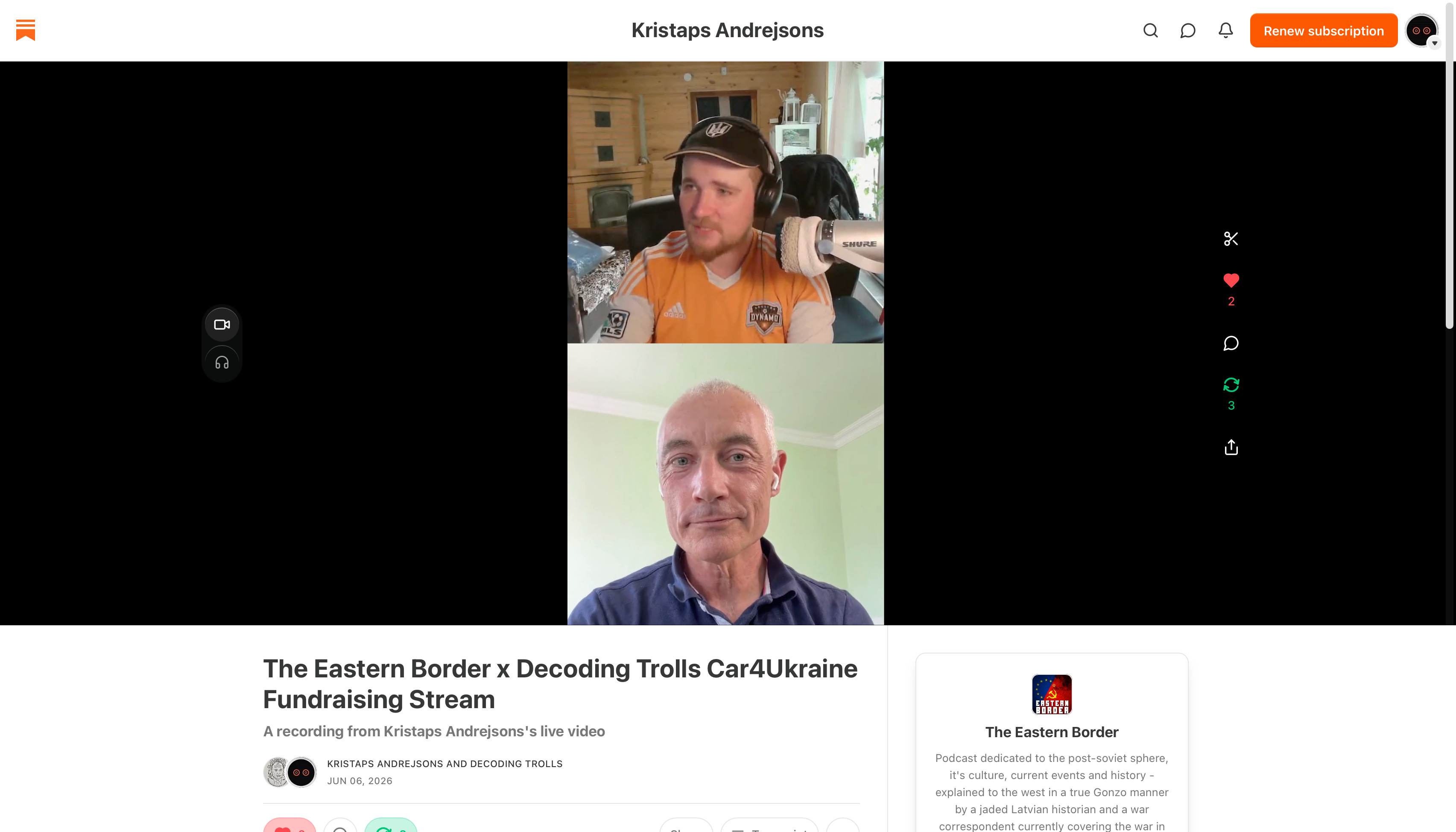
We did a two-and-a-half-hour session which was really fascinating and a really great conversation — I implore you to listen to it, and also listen to The Eastern Border; I look forward to his episodes every week. He did recently a really interesting one on food quality in Russia — he and his wife dug very deeply into the phytosanitary rules and the quality of food there. As we know from listening to Mockers talk about the butter, and the meat glue in the butter and suchlike — you should really avoid that stuff. But anyway, that’s an aside.
A ruler’s deepest power isn’t tanks. It’s the monopoly on speaking to his own people. The Tsar decides what Russians are told, what they’re allowed to want, who gets to define their interests. That channel — ruler to ruled — is supposed to be his and his alone. Putler’s alone. This letter picks the lock on that channel.
Read who it’s actually talking to. “They do not like our drones. They do not like gasoline shortages. They do not like your endless war.” That’s not addressed to Putler. That’s addressed over his head, to Russians — telling them what they want, what their ruler costs them, and that “the majority of Russians would respond positively to peace. And you know it.” A foreign president standing in the Kremlin’s own living room, talking past the host to the family. That’s why this is more than just a clever letter. It’s a usurpation. Not a march on Moscow — a letter that quietly annexes the one thing a Tsar can’t afford to lose: the trust of the people he claims to speak for.
Wounding the Prideful Sovereign
It’s engineered to wound a very specific target. Think about who Putler has to be. He is cast, by the men who put him there, in the role of the prideful sovereign: serene, eternal, untouchable, the fake strongman who never tires. The whole performance runs on pride. So look where the letter aims. “Age is beginning to take its toll.” The mutiny: “June 23rd will mark another anniversary of Prigozhin’s mutiny, and silence will not erase this fact from history.”
“Your own officials, businessmen, propagandists look at you with obvious fatigue.”
Here he is piercing the heart of Abramovich — who, we subsequently found out, was in Kyiv. So now the Russist siloviki will be thinking Abramovich was moaning to President Zelensky, while they met, about the fatigue. When President Zelensky mentions the businessmen, he is driving a dagger right into the heart of the coalition that keeps this war going.
“The first ruler of Russia ever to go begging to Pyongyang.” President Zelensky mentions North Korea — which the Russists made a joke of until two years ago, when they started importing their men to try and liberate their own territory of Kursk. “Fully dependent, for the first time in Russian history, on Beijing.” These aren’t insults thrown out at random. They are purposive trolls, each one a needle into the armour of the performance, placed by someone who knows exactly how the prideful sovereign is wired. You don’t roil the state with these lines — you roil the actor playing the state.
Refusing Fake Virtue: Mana and Name in Sync
Here’s where a lot of pro-Ukrainian content fails the Code, and this letter doesn’t. It would have been easy to drape the whole thing in halo light. He doesn’t. “It is not as if we in Ukraine are concerned about the fate of Russian soldiers,” President Zelensky writes flatly. “But I do care about Ukrainians.” No pretence of caring about everyone. No fake universal compassion. He even tells you the brutal exchange ratio — one Ukrainian for five or six dead Russians — and says it still matters, because these are my people. That refusal to fake virtue is the tell of the real thing. Mana and name in sync. The letter says what it is: an adversary’s hand extended honestly, with the receipts on the table and concrete offers attached. A full ceasefire. An all-for-all prisoner exchange. The return of the stolen children. That’s not a propaganda artefact. That’s Infolklore.
Because I won’t sell you a fairy tale, one honest flag: this is a weapon. A beautifully made weapon, but a weapon all the same. It’s built to corner a man. The line “we can work towards that fatigue” sails close to the wind. The casualty numbers are Ukraine’s own, and they flatter Ukraine. But here is the difference that the Code of Positive Trolls is built to catch: every one of those claims is falsifiable. You can check a drone strike. You can count losses. You can verify a returned child. That is the opposite of Disinfolklore.
So that’s the lesson. The same tool — mockery — that the Kremlin uses to poison, this letter uses to heal: to surface a lie, name it, and outflank it. Same instrument, opposite hands. The Code is what tells them apart. And the deepest move of all wasn’t a drone or a number. It was a man standing in his enemy’s house, turning to his enemy’s own people and saying: I think you want peace, and I think you know it. And he is the man who can deliver them peace. That’s not just answering propaganda. That’s picking the lock on the throne. Glory to the truth-tellers.
Putler’s Reply: The Man Who Won’t Say the Name
So I wanted to talk then about Putler’s response. Obviously, they found it a bit rude. I find it a bit rude when they plant mines between the dead body of a 21-year-old woman and her child in Bucha, so that the Ukrainian deminers will blow themselves up while burying these poor victims. That’s what I found rude. But Putler and Lavrov found President Zelensky’s letter rude.
I’ve just pulled apart the open letter. Well — the man on the throne’s answer, on Russia’s TV. Putler replied, and his reply is a gift, because it teaches the other half of the lesson. If the letter showed you what Inolklore looks like at the top of the world, the answer shows you how the Disinfolklore comes back at it. And it lets something slip — because by the end of this, I want to convince you of one thing: that letter was never really for Putler. Let’s get our eye in.
The first thing to notice about Putler’s reply is who he refuses to name. Zelensky is never President Zelensky. He’s “the author of the letter,” this so-called “colleague.” At one point — and this is almost too on-the-nose — “the authors of this letter,” “fans of the epistolary genre.” A head of state reduced to a man who writes letters. That’s not pettiness. That’s an archetype going to work — Tool 1. Putler is performing the role he’s been cast in: the Tsar. And the one thing a Tsar cannot do is negotiate with a pretender as an equal. So he doesn’t. He won’t dignify the name.
Then watch him perform the magnanimity — Tool 6, generosity, in its counterfeit form. “I’ve never refused a meeting,” he says. Generous, regal — except he spends the rest of the answer explaining why he won’t actually meet. So we can adjudicate this claim. Performed generosity with the substance withheld. That gap between the gracious words and the closed door is itself a tell.
He turns from the letter to the troops. “It is necessary to address not the authors of this letter, but our fighters on the line of contact. Comrade soldiers and sailors, the whole country is proud of you. Work, brothers.” The father of the nation, turning to his children. Note what just happened. The answer to a peace letter is to address the army. The reply to “let’s stop” is “keep going, lads.”
Tool 7 and the Starobilsk Claim: Accusation in a Mirror
Now Tool 7, the big one — right, ethical discipline. We ask: is it true? Here’s the most delicate moment in the whole episode, and I’m going to handle it carefully. Putler says that on May 22, Ukrainian troops hit a college dormitory in Luhansk, in Starobilsk — which we’ve talked about for the last few weeks — and killed children. With his own words: “not a single military facility nearby.”
I’m not going to tell you what happened. I’m not going to tell you it didn’t. I don’t know, and neither do you, and the honest move is to say so. What I can read is what the claim is for. Look at how he uses it: “They ask for a meeting and commit such horrific crimes as the murder of children.” The atrocity isn’t offered as news. It’s offered as the reason he can’t meet. And the specific shape of it — child-killing, pinned on the other side — is the oldest move in the Kremlin book. We have a name for it on this show: accusation in a mirror. You take the crime your own machine stands credibly accused of — and Russia is the side with international warrants out for taking Ukrainian children out of Ukraine, forcibly transferring them — and you hold it up like a mirror to the enemy. The structure is the tell, whatever the facts of that one night in Starobilsk turn out to be.
And he does the mirror twice. He lectures President Zelensky about elections. “If you hold on to power outside the Constitution, that’s a power grab, a criminal offence. Now, hold elections, rule constitutionally.” Fine principle. I won’t call a true principle a lie. But listen to who’s saying it. A man 25 years in power, who has never been legitimately elected, who murdered a million Chechens in order to secure enough mana to brainwash Russians into believing him to be their sovereign, who has built the entire constitution around himself — lecturing the leader of an invaded country who got 74 percent of the vote. President Zelensky won an unprecedented every district in Ukraine except for one near Lviv. This was thought to be impossible — for a native Russian-language-speaking Ukrainian to win every district in Ukraine. And he’s being lectured to by this autocrat who has never put himself forward for election, and who — I was reminded by Kristaps on The Eastern Border — has never even debated anyone. Not once, in the entire time since he emerged from the KGB, has he debated someone publicly. And he has the chutzpah to lecture the leader of an invaded country whose elections are suspended because of the invasion he launched. The principle is clean. The mirror is the trick.
The Minsk Splice: True Premise, Poisoned Conclusion
One more move before the turn, because it’s a beautiful specimen. Putler says the Minsk agreements — that I spent seven years in eastern Ukraine trying to make work — were really only about buying time to rearm Ukraine. And he’s got the receipts, he says. Western leaders did, after the fact, admit something like that. “So why do we need these agreements anyway?”
Watch the hands. He spends a true thing — a real, embarrassing Western admission — to buy your trust. And then, while you’re nodding, he splices on the part that doesn’t follow. This is the is-versus-ought: something happened, therefore we must kill all these Ukrainians. Which is in that very first foundational tweet that founded the North Atlantic Fella Organization, when that Russian ambassador in Vienna said: “You pronounced this nonsense, not me.” The serpent — the serpent adjudicating on NAFO memes, RIP, always to be remembered — characterising Russia’s excuse for entering Ukraine as: Ukrainians killed a few civilians, so we decided to go into Ukraine and kill hundreds of thousands of civilians. “You pronounce that nonsense, not me,” said the serpent, said the Rushist ambassador.
So while we’re nodding, he splices on the part that doesn’t follow: “therefore, no agreements ever.” The true fact is the mask. “Refuse all diplomacy” is the payload hiding behind it. A true premise carrying a poisoned conclusion. Once you can see the seam between the mask and the payload, you can’t unsee it. The Kremlin runs on that seam.
The Turn: The Letter Is Addressed to the Boardroom
And now the turn, because this is the thing I most want us to take away — it changes how we read both documents. Let’s go back to the letter. We said the letter talks past Putler to the Russist people. That’s true, but it’s not the whole truth, and a sharper read came up this week. Look again at exactly who inside the Russist power structure it is needling. “Your own officials, businessmen, propagandists look at you with obvious fatigue. We can work towards that fatigue,” said President Zelensky. And the cold, cold arithmetic — Ukraine’s own claim, but a checkable claim — of tens of thousands of Russist soldiers lost every month, every one of them photographed in their death.
Put those together, and the letter stops looking like a message to Putler at all. It looks like a message to the people around Putler — to the men who actually hold the strings. And the message is a deal. Your figurehead is an indicted war criminal who is bleeding you of 30,000 men a month, and the future, and the money to buy loyalty. Hand him over to The Hague, then we can talk about stopping that bleeding. That’s the lockpick. Not “Putler, please see reason.” It’s: gentlemen, surrender the patsy and the war can end. The letter is addressed to the boardroom, over the boss’s head.
Every needle aimed at Putler’s pride — the age, the mutiny of Prigozhin, the begging trip to Pyongyang, the dependence on Beijing — every one of those is doing double duty. It wounds the actor, and it advertises to the men behind him that the actor is damaged goods. And here’s why that read is so devastating: Putler’s own reply confirms the target. Listen to who’s actually running things in his answer. “My press secretary, Peskov, showed me the letter, slipped me this letter.” “Some businessman from our business circle gets invited to Kyiv. He goes, comes back.” And Putin’s role in his own diplomacy: “I can’t send you in any official capacity. That’s for specially trained people at the foreign ministry, the defence ministry. I can’t authorise you into anything.”
The Tsar — in the very speech where he insists he’s the Tsar — is a man being handed papers by his spokesperson and briefed by a businessman he can’t authorise to do anything. That’s Tool 12, reading the deep code under the meme. The throne is a costume.
And here’s the foundation defence — the part the apparatus’s own house philosophers won’t tell you. Dig into where these peoples actually come from, the real deep root, and you don’t find a Tsar there. This week, even a pro-war Russian military blogger — one tweet, second-hand, so weigh it as one straw in the wind — said he gets the impression the president is being sidelined, President Putler, with an artificial information bubble created around him. Read that again. They are starting to suspect he’s an actor being managed by the people around him. They’re arriving, from their side, at exactly what President Zelensky’s letter assumed from the other. Putler isn’t the seat of power. He’s the man cast to sit in it.
The Bubble Cracks: Simonyan’s Famine and the Oreshnik “Test”
If you want to watch that bubble crack in real time, here’s the moment from this week that did it for me. At the same St Petersburg Forum at which, in June 2022, Margarita Simonyan said, “oh, they’re saying in the offices that all our hope is in the famine” — and what they meant by that in Moscow is that there will be famine in Africa because we do not deliver grain to them, and millions of migrants will go into the European Union, and then the European Union will stop supporting Ukraine and will lift the sanctions on Russia, “because it’s impossible for us not to be friends.” Switching between the register of a five-year-old banging on about their emotional argument in the playground — because it’s impossible for us not to be friends.
At St Petersburg Forum 2026 — the one President Zelensky mocked, the one Ukraine’s drones paid a visit to — Putler explained the Oreshnik missile strikes. Now, for about a week, Russian channels had been roaring that one of these missiles vaporised a secret NATO command node hidden in some garages in Bila Tserkva. Big story. Huge. This week, Putler’s version: it was a test. “We struck where it was convenient to observe the results,” he said. The drones flew in afterwards so they could examine how the warheads were arranged. A test of how the pieces fell. No NATO node — just research.
Sit with that for a second. Two things. One: he just overwrote his own propaganda machine’s week-long story, to its face, without blinking. The NATO node simply evaporated. That is the artificial information bubble — a story with no author, where last week’s truth is quietly deleted to make room for this week’s. And two, the cold one: one of those test shots of the Oreshnik missile, by Putler’s own account, came down in Russia-occupied Donetsk. The very land he calls Russian, where his own soldiers stand. Remember “Work, brothers”? The father of the nation who turned to his troops and said “the whole country is proud of you” fired a missile into their ground to see how the blocks lay around, and called it a testing range. They were standing on it. That’s not a sovereign. That’s a man reading lines in a play whose script keeps getting rewritten, who doesn’t seem to feel the people beneath him. Either the war bloggers banging on about the NATO command node, or his own Russian soldiers fighting their genocidal war in Donetsk, who get an Oreshnik hit on them just as a test. Putler doesn’t feel the words.
I note that I owe a lot of this interpretation to Will — to Will Thiel’s immediate reaction to it, which was again a very solid performance from Will on Volya.
The Two Documents Through the 12 Tools
Let me do the thing which this show is for, really, and run both documents through the toolkit, quick, side by side, so you can feel the contrast — disinfolklore.eu, where I have the 12-tool way, the Disinfolklore Analytical Method.
Tool 1, the archetype: the letter is the mocker with the receipts. The reply is the cast Tsar with a mirror.
Tool 2, direction: both fired outward, but the letter aims at the man who can end it. The reply aims at the soldiers who’ll keep it going.
Tool 3, the mana, the energy under the words: peace and accountability versus keep fighting, dressed as dignity.
Tool 4, inner and outer realm switching: the letter walks into Russia’s inner room and talks to the family. The reply tries to slam the door and shove the guilt outward to Ukraine.
Tool 5, the trigger chain — the Dalai Lama and Paul Ekman’s timeline of emotions: trigger, experience, reaction. It’s that space between experience and reaction, which we all have — the moment before we share the meme, before we rise to get angry or to repeat Russist Disinfolklore. When we experience that emotion, if we can remember that emotional manipulation gives us an opportunity to just hold off before we react. The reply engineers it openly: dead children, outrage, rally to the troops. “The audience will understand me, especially the Russian audience, because they like children.”
Tool 6, generosity: the honest adversary versus fake magnanimity.
Tool 7, is it true? The letter passes: falsifiable, lawful. The reply fails at the mirror, not at the procedure.
Tool 8, the archetypes carried in the energy: the honest extended hand versus the father of the nation, weaponised.
Tool 9, patience: the letter says the front line is where diplomacy begins — now. The reply weaponises patience: “a long-term historical perspective,” “let the experts work.” Patience is a stalling engine to Putler.
Tool 10, mindfulness — should I let this into my mind? The reply’s whole ask is: accept the Tsar frame. And the answer is no.
Tool 11, does it deepen or flatten? Is it insightful? The letter deepens: it names the cause and offers steps to get out of this mess. The reply flattens: one man’s refusal and a projection.
Tool 12, the deep code, the cryptotypic code: one is the mocker healing; the other is the Tsar costume over an empty throne. Twelve tools, one verdict each. The letter: Infolklore. The reply: Disinfolklore. Same instrument.
Holding Myself to the Same Code
And I’ll hold myself to the same Code I’m holding them to. I did not decide whether that dormitory in Starobilsk was hit. The “Putler’s just a costume” reading is a lens, not a proof. He is a sovereign acting inside a machine — a cast role, not a powerless puppet. And the one war blogger’s tweet is a straw in the wind, not a verdict.
So here’s where we land. The letter picks the lock on the throne — and this week we can say it better. The letter wasn’t a plea to the king. It was an offer slid under the door to the men who built the throne and cast the king. Give us the actor, and the killing can stop. And the king answered by insisting on television that he is no actor — in a speech where you can watch his spokesman hand him the script, hand him the papers. The same tool: mockery, a letter, a turn of phrase. Glory to the truth-tellers, and we’ll see them next time.
The Beast from the Abyss: Naming the Beast
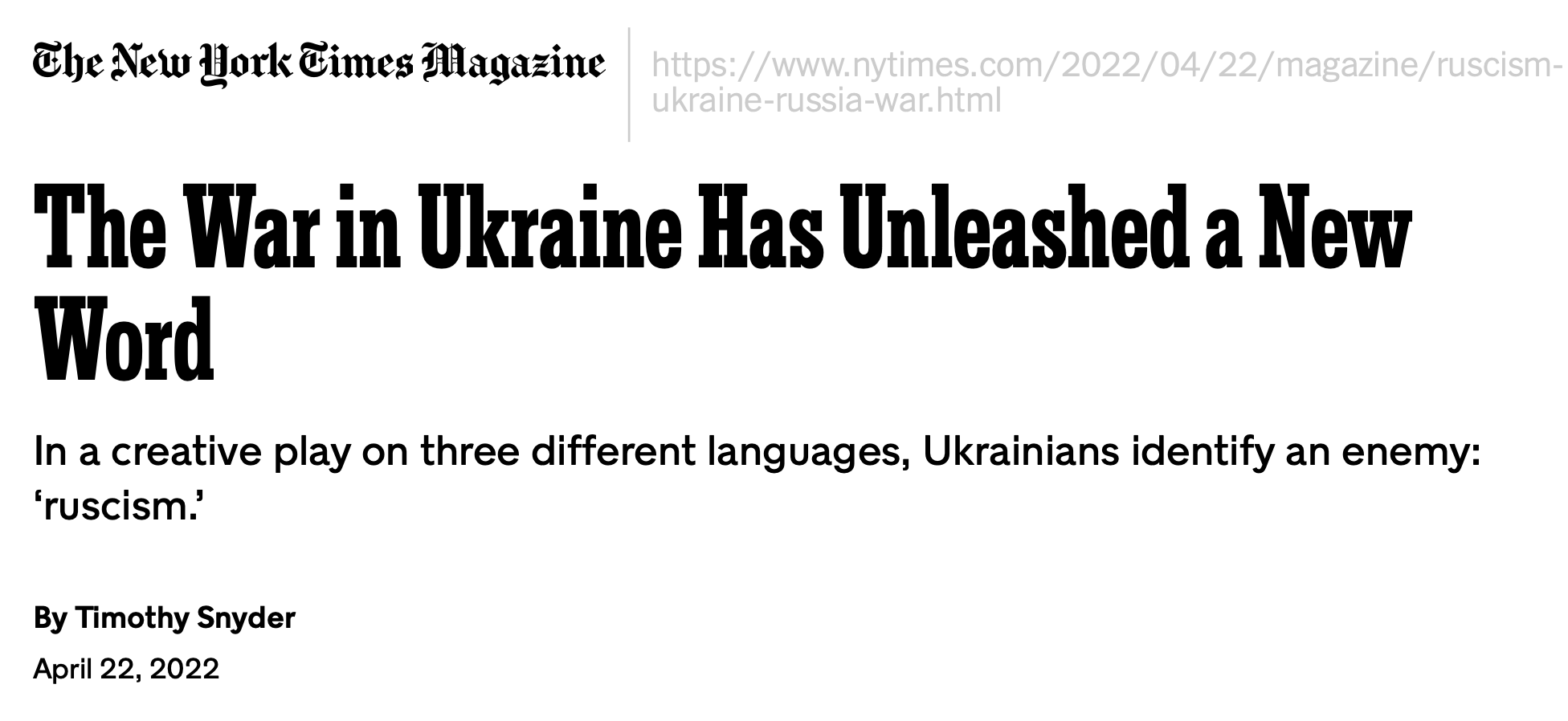
So — the beast from the abyss. Naming the beast. This is Larysa Yakubova’s masterpiece. She is one of the greatest scholars of Russist and Russian totalitarianism, from Ukraine’s National Academy of Sciences. The artefact under the knife in this episode is not a single meme, but the whole apparatus. Our guide through it is Larysa’s 2023 book, Ruscism: The Beast from the Abyss, published by the National Academy of Sciences of Ukraine and written by the historian Larysa Yakubova while her country is under fire. Every line of hers here is taken from that book.
I want to begin with a small bit of method, because it’s the thing this whole series runs on, and all of my work runs on. There’s this historian in Kyiv called Larysa Yakubova. She’s not a folklorist and not a poet. She’s a professional historian of totalitarianism at her country’s National Academy of Sciences. Footnotes, archives, Hannah Arendt, the careful apparatus of the discipline. And in 2023 she published a 318-page scholarly book about the Russist state, and she gave it the title a folklorist would give it. She called Russia the Beast from the Abyss.
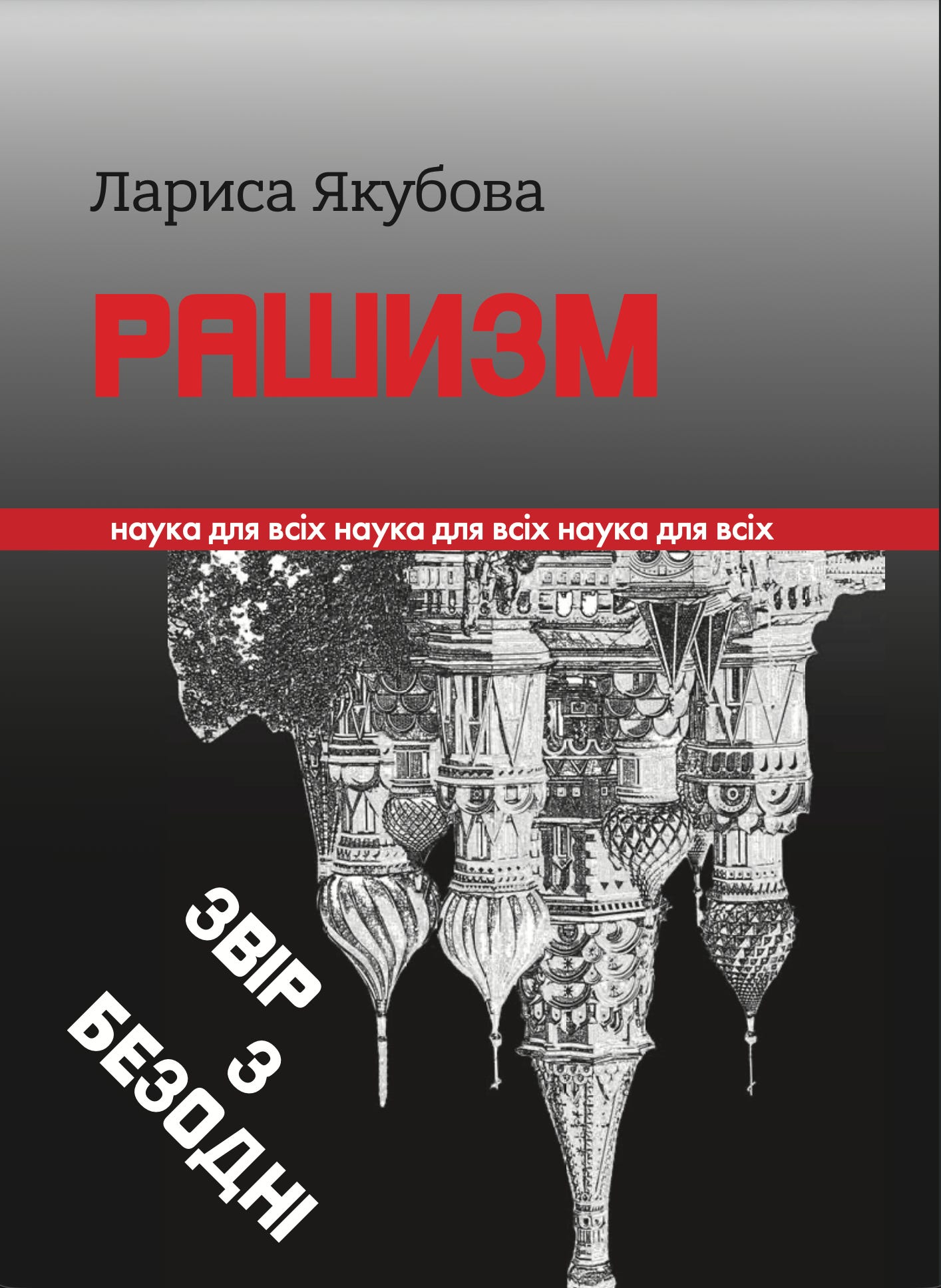
A serious historian reaching past the whole vocabulary of political science — authoritarianism, revanchism, hybrid regime — and taking hold of a monster. That is the scandal, and it’s not a lapse. It’s the most rigorous thing in the book, and tonight I’m going to show you why. Because it’s also the first tool — archetypal literacy — of the method I teach at disinfolklore.eu. The first tool in the 12-tool way is archetypal literacy, not to be confused with cryptotypic literacy, which is the 12th tool. Tonight’s anchor is Tool 1, archetypal literacy: the beast from the abyss. These are archetypes — deep Indo-European archetypes. The discipline of asking, of any piece of folklore that crosses your path: what archetype is being deployed here?
The claim of everything this evening, stated up front the way I try to state everything: you cannot fight a thing you will not name. Nama — you need to name it. You name the mana. Nama: you name the mana. And the Russian apparatus has spent 30 years making sure you cannot name it. They deliver the mana, then they misname it, so you get confused over what is the substance of this and what is the surface moniker of it. Yakubova names it: the beast from the abyss. That act of naming is where the counterattack begins, and it’s the act that this particular episode is about. I will proof every movement in her book against the Code of Positive Trolls — is it generous? is it true? is it patient? — and I will name the archetypes, because once you can see an archetype operating you cannot unsee it, and recognition halves the mana.
The Masks Have Been Thrown Off: The Elder Brother
Yakubova’s second chapter has a title that is itself a diagnosis: “The Masks Have Been Thrown Off.” The mask she means is the one this apparatus wears better than any other. It’s the mask of the elder brother — the archetypal elder brother from folklore, from The Brothers Karamazov, where one of the brothers kills the father, and Alyosha, the holy spiritual brother, goes off to the church and then is debauched by his other brother Ivan Karamazov with the great, great Grand Inquisitor episode. The elder brother archetype.
For 30 years the Ruscist state addressed Ukraine in the register of family. The Russkiy Mir, the Russian world, was sold as a warm thing: shared faith, shared history, brotherly peoples, one big tent. Russia was the patient elder brother, the regional peacemaker, the intercessor of the despised. When the tanks crossed the border in 2022, the official word for it was not invasion. The name — the official name — wasn’t invasion, but the mana was invasion, and we can adjudicate that according to the laws of war, the UN Charter. It was a “special military operation” to protect Russian speakers and liberate Ukraine from a “junta of Russophobes.”
Here is what the apparatus wants you to think. This is a family quarrel. Russia is the reasonable elder relative, reluctantly restoring order in a household that has lost its way. Whatever is happening, it’s being done out of love — or at worst out of necessity, and certainly not out of hatred. It’s an intervention.
Register the Mana first, the feeling before the thought. The charge here is fraternal reassurance — a big, calm, patient presence. This is the merciful sovereign. Proof it against the Code of Positive Trolls. Is it true? The “protection” was launched against a sovereign neighbour that had attacked no one. Is it generous? It cast a whole nation, Ukrainians, as a fiction to be corrected out of existence. The mask says brother. The conduct — the substance, the mana — says something else entirely. The moment you can see the merciful sovereign costume on the elder brother, the warmth stops disarming you, because you can see what it’s delivering.
Yakubova’s whole opening move is to refuse the costume. She will not say conflict. She will not say family quarrel. She lifts the mask, and underneath it she finds not a brother but a beast.
Why the Monster? Rigor Refusing the Euphemism
Why does a careful scholar abandon the careful words? Because — and this is the heart of Tool 1 — the careful words were the apparatus’s idea. For more than a century, Yakubova argues, and in her devastating phrase, the discipline “missed the birth and the formation of its own ontological enemy.” The mild vocabulary — the regional conflict, the post-Soviet space, the Russia question — these are not neutral. These are the elder brother’s own vocabulary, and to use it is to keep seeing through his eyes. The antidote is to name the thing in your own tongue.
Here Yakubova is not alone and not eccentric. The word she anatomises — Ruscism — is not an insult she invented. Ukrainians spontaneously coined it within days of the full-scale invasion. I was in Ukraine for seven years before the full-scale invasion. I didn’t hear the word once. Yet in the first week of the invasion it was everywhere, in all of the Telegram posts, and I was wondering: what is this Ruscism? Ukrainians — 42 million of them — spontaneously, within days of the full-scale invasion, fused Russia and fascism into a single moniker, a single name. They named what they were seeing. They named what they were meeting — not fraternal love — on the battlefield and under occupation.
On the 2nd of May 2023, Ukraine’s parliament, the Verkhovna Rada, formally ratified and formally defined it, naming Ruscism’s signatures: systematic human rights violations, the cult of the leader, the “Russian world” as a tool of expansion, the use of prohibited methods of war. And in early 2025 the European Parliament responded, condemning the same ideology of Ruscism and policy as incompatible with international law and European values. Two parliaments, an entire continent, naming the enemy by its name. That is Tool 1 performed at the scale of a continent.
That’s why the book reaches for the beast. The monster is not a loss of rigor. It’s rigor refusing the euphemism. This is why I created a term to describe something new. In our own terms: the most dangerous archetype is the one that has trained you not to call it an archetype at all. The elder brother’s deepest defence is that “brother” doesn’t sound like a weaponised story. Naming it as one is the whole fight. He’s not a brother. He’s a beast. And he’s risen from the abyss to kill every single Ukrainian — not out of love, but out of ressentiment.
Ruscism: The Highest Stage of the Russkiy Mir
Yakubova’s third chapter sets out the thesis the rest of the book proves: Ruscism is the highest stage of the Russkiy Mir. Not a betrayal of the Russian world, but its fulfilment. The warm tent and the beast are the same structure seen in two moments, and the warmth was always the delivery system for the thing inside. The warmth was the delivery system. The brother — that is the moniker, the name. But the mana is the beast.
What is inside, in her account, is not ideology in the ordinary sense at all. It’s something near a death drive, wearing the clothes of a civilisation. She describes a state that had dreamed of stretching Ukraine — these are her words — on the cross: defamed, humiliated, deprived of the right to its very existence. That is the project the elder brother mask was covering. Not the correction of a wayward sibling, but the erasure of a subject. And of the apparatus that does it, she writes the line that gives the book its spine: it is the beast that in the end thirsts for blood, and will drown in its own blood.
Hear what that sentence does, because it is itself a piece of Tool 1. It refuses the merciful sovereign’s two great alibis at once. It refuses reasonableness: a beast that thirsts for blood is not balancing books. And it refuses invincibility: a beast that drowns in its own blood is not eternal. She has, in nine words, dispossessed the costume.
The verdict writes itself. Is the Russian world generous? It is generous the way a tent is generous to the people it is being lowered onto. Is it true? Its central claim — “one fraternal people” — exists to deny that Ukrainians are a people at all. Is it patient? It’s been waiting a century, and it’s in a hurry now. The Russkiy Mir proofs at every one of the Code’s tests as Disinfolklore: folklore turned against the people it pretends to embrace. It’s the one that arrives dressed as your friend, or your brother. The Russkiy Mir worked for 30 years precisely because “brother” does not set off alarms. Warmth is the one charge we are built not to defend against.
Larysa Yakubova’s act — the scholar’s act of refusing the warm word and naming the beast — is Tool 1 in its purest form. And it’s available to you tonight, with any story that crosses your feed. When something addresses you as family while it takes from you as an enemy: lift the mask, name what is underneath it. The naming will not stop the beast — whether that beast is your spouse, or someone in your life who’s bullying you or being unkind to you or operating a coercive control operation on you, or your country, or your community, or your children. But it ends the spell that kept you from seeing it, when you name it. And everything else in this method begins there.
I’ll finish off on one more element from this, because it’s such an amazing book. If anyone wants it, I’ve translated it into English, so let me know — we can work out some way; I’ll post it on Substack or something.
The Deep Folk: Surkov’s Manufactured People
When I started this work, I believed the most comfortable thing that everyone in the West still believes. I believed there was a Kremlin and then there was a people — a vast, suffering, hostage population held down by a small clique of cynics — so that if you peeled the clique away, the people underneath would be more or less like us. It is a kind belief, and it lets you hate the regime and pity the nation with the same breath. Yakubova’s second move holds that belief up to the light and very quietly breaks it, because her hardest chapter is not about the men in the Kremlin at all. It’s about the millions who said yes.
Here is my claim up front, the way I always do it. The so-called deep folk — that’s Surkov’s archetyping of Russia’s people; he calls them the deep folk — and Yakubova addresses this. She says the so-called deep folk of Russia are not the regime’s hostage. They are its co-author and its accomplice. That is the most uncomfortable sentence in her book, and I think the most important, so I’ll earn it slowly.
Tonight’s anchor here is Tool 4: inner realm / outer realm switching — Tool 4 of the Disinfolklore Analytical Method, disinfolklore.eu. What Donald does every time he talks about the outer-realm migrants coming to steal our children, to steal your daughters, to eat your dogs, eat your pets. That’s inner/outer realm switching. It’s the cognitive division Disinfolklore exists to exploit. Every one of us carries an inner map: an us, a circle of the trusted, an arya — A-R-Y-A — a centre, the centre of our community. That’s what arya means. The Aryans were simply the people in the centre of our community, the inner realm, and the real. In outer darkness, the enemies and monsters lived. So they were the ones that the Russians in Russia-occupied Ukraine were archetyping Ukraine as, across the Donets River. They were saying that is outer darkness, through a million different memes and stories every day, which I was trying to parse and understand.
And the apparatus — the apparatus doesn’t invade that map. It redraws it. I’ll show you the most ambitious thing that has ever been drawn there: an entire manufactured people, a manufactured us, conjured into being by the manufacture of an enemy. And we proof every move against the Code of Positive Trolls — is it generous? is it true? is it patient? — and we name the archetype, because recognition halves the mana.
So: the people that was made. There’s a phrase Yakubova works with that we all need to know, and it’s one of the most chilling pieces of political branding of our century. The deep folk — from Vladislav Surkov, the Kremlin’s own stage manager, ex-deputy prime minister of Russia, reputedly on the Maidan, if not directly directing the snipers then overseeing the snipers’ work, when the Heavenly Hundred were massacred. He coined it in a 2019 essay, and he meant it as praise: a mystical, bottomless reservoir of ordinary Russians who always rescue the state in its hour of need by simply being there. Deep, loyal, inexhaustible. The regime gave itself a folk. It named its own foundation.
Yakubova turns that phrase over to show us the rot on the underside. Because a deep folk in the Surkov sense is not a people who grew. It’s a people who were drained. She describes a mass from which the load-bearing human values have been, in her account, surgically removed — conscience, the capacity for guilt, the sense of the other person as real — so that what remains can be pointed at anything and will not flinch. A mass she calls, in a word I’ll quote exactly, boundless — bezmernyi — measureless, without an edge or bottom. Not deep like a well that holds something. Deep like an abyss that holds nothing.
Here is what the apparatus wants you to think. We are eternal. We are the people. We are the folk — vast and humble and true — and our enemies are a thin foreign film on the surface. To stand with the deep folk is to stand with something older and realer than any law you could cite against it.
Register the mana first, the feeling, before any thought. It is belonging — warm, total, dissolving. The relief of being part of something measureless, never having to stand alone or answer alone again. That feeling is the product. That is what was manufactured by Surkov. The moment you can feel the engineering in it, you can name what is underneath.
The archetype is the outer realm monster, and it runs backwards from how you expect. You think the monster is the thing in the outer dark — but here the monster in the outer dark is the device. These are not beliefs the deep folk hold. They are the walls of the room the deep folk lives in. Tool 4 in its purest form: the inner-realm us is conjured by the manufacturing of an outer-realm them.
Proof it against the Code. Is it true? No. A folk defined entirely by the enemies it has been given is a fiction. The enemies are painted, and so therefore is the people. Is it generous? No. It’s built by the wholesale denial of everyone outside the war. This is Disinfolklore at industrial scale, because the unit of manufacture here is not a meme or a slogan. It’s a nation’s sense of itself.
Closing
Next week I’ll continue with that series, because I’m quite excited by it. She’s just amazing, and I think everyone in the West needs to read this book. If they don’t, I’m going to do my best to ensure at least all of us become aware of it. I’ll leave it at that for this week.


