



Today I’m going to talk a bit about the Starobilsk incident, using the Disinfolklore Analytical Method, and I’m also going to talk about some examples from what I call the Luhansk Corpus, which I’ve been talking about for the last few weeks. We’re in the midst — not even one hundredth of a way through — what I have to talk about. This corpus is 10,000 propaganda items that I collected while I worked in Russia-occupied Ukraine, and between Russia-occupied Ukraine and government-controlled Ukraine, between 2015 and 2018 in Luhansk, and then afterwards in Dnipro.
Today’s Topic: The Starobilsk Incident
The first thing I’m going to talk about is the Starobilsk incident. Some of you probably didn’t hear about it, but it was a really interesting example for me to apply the Disinfolklore Analytical Method to. The moment I heard the President of the Rushist Federation mention a school in Starobilsk — which is a town I know very well, I used to go through it a lot when I lived in Severodonetsk, so it has that personal connection to me as well — and the moment I heard President Putin talk about it and talk about this, what I call the manufactured wound archetype, basically, it reeked of this, and I recognised the pattern. I thought, as the English might say, there was something rum about this. I tuned in.
Russia’s defence ministry announces in Putin’s name that international journalists are invited to come and see for themselves that Ukrainian forces are surrounded in Pokrovsk, Myrnohrad, and Kupyansk. The apparatus — which is how I refer to the entire collection of actors operating the Russian Federation — offers a five-to-six-hour ceasefire to enable the tour.
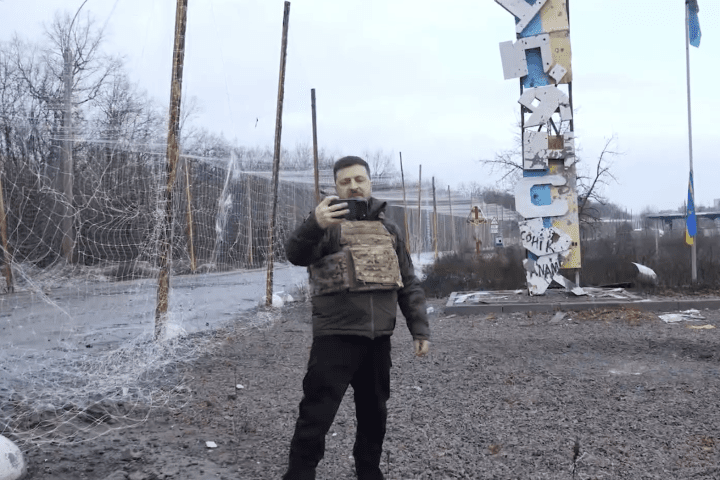
12th of December 2025: Putin claims at a press conference, based on a briefing from Gerasimov, that 15 Ukrainian Armed Forces battalions are blocked inside Kupyansk. Fifteen battalions. He invites journalists again to come and verify. On the same day, Volodymyr Zelensky turns up in Kupyansk himself, records a video address on his iPhone at the entrance stele, 1.15 kilometres from Russian positions, 500 metres from the grey zone. DeepState map confirms the coordinates.
22nd of May 2026: the apparatus elevates a strike on occupied Starobilsk to a campaign. Putin calls it a terrorist strike. Peskov calls it a monstrous crime. Six Russian official spokespersons issue coordinated naming within 12 hours. Russia requests a UN Security Council emergency session. Within 36 hours, 90 missiles and 600 drones land on Kyiv and Bila Tserkva, as all of us will know — where the Oreshnik fell, and some garages. The Chernobyl Museum was hit. We had an interesting discussion about this on Ming and Joanna’s show earlier in the week. I think Lexicon and I were convinced — and indeed I think Ming as well — that this was a hit on purpose. The Oreshnik, the nut tree or the walnut tree, the nuclear-capable hypersonic missile, is fired for the third time in this war.
What we’re looking at is not three discrete events — which many people will see them as, but not us, and not me through the Disinfolklore Analytical Method. We’re looking at one eight-month campaign elevation doctrine that has been running in continuous deployment since at least last October. The Starobilsk strike of last Thursday is the latest instance. It’s not the first, and it will not be the last. This is Disinfolklore in real time.
The Apparatus Does Not Improvise Its Archetypes
The thing about the apparatus is that it does not improvise its archetypes. It deploys them again and again on the same template. What looks like news in your morning headlines, or on my evening television, or in our social media feeds, is on closer inspection the apparatus running the same play it ran last quarter, and the quarter before that, and the quarter before that. The play I want to walk you through tonight is what I’m going to call, for the rest of this episode, the Apparatus Campaign Elevation Doctrine.
It is one specific kind of Disinfolklore deployment — the kind that begins with an apparatus invitation to international journalists and ends with a hypersonic missile in Kyiv. The doctrine has a name and a shape and a budget line.
When I talk about Disinfolklore being a narrative form, what I’m talking about is the actor who is the acting president of the Rushist Federation. He’s an actor. He’s deployed on certain stages at certain times, and he speaks fluent Disinfolklore. His Disinfolklore is then ventriloquised, puppeted through the voices of other members of the apparatus until it becomes like a cacophony, like a chorus, like a vibration in our brain, until it meets the ears of a child in Kyiv who’s suddenly very frightened. That’s why I call it Disinfolklore, and the whole operation is a Disinfolklore operation.
The Budget Line: $458 Million for Information Warfare
The budget line is documented. In November of last year, the Jamestown Foundation — a serious-grade Western think tank that most of us will be aware of and respect, not a partisan source — published a piece by Yuri Lapayev showing Russia’s draft 2026 budget cuts military spending by $2.4 billion compared to 2025, while raising the state-funded media budget by 54 percent, $458 million additional. The apparatus is, in plain print, defunding its army to fund its information warfare. Ukraine’s Foreign Minister Andrii Sybiha put the same funding on the public record. This is not a hidden doctrinal shift. This is the apparatus that has openly chosen to substitute information warfare for kinetic capability. The campaign elevation doctrine I’m about to walk through is what those $458 million are for.
The Three Moves of the Doctrine
The shape of the doctrine is three moves.
Move one: the apparatus invites international journalists to verify an apparatus claim about a Ukrainian territory the apparatus does not actually hold — Pokrovsk, Myrnohrad, Kupyansk, Krasnoarmiysk, Starobilsk. The invitation is the deployment. The apparatus does not need the journalists actually to arrive. The apparatus needs the invitation to circulate in Western media as evidence that Russia has nothing to hide.
Move two: the apparatus produces its own evidence substrate. Telegram-distributed photographs from occupier-installed regional leaders; casualty figures from the apparatus’ human rights commissioners; all-actors framing statements from the apparatus’ foreign ministers; official namings from the Kremlin press secretary; and, at the apex, a head-of-state — an acting head of state, an actor, a stage actor, an acting head of state — personal statement from Putler himself. The evidence substrate is the apparatus’ product. Western media absorbs the substrate as if it were independent reporting.
Move three: with moral cover now installed, the apparatus executes the actual operation — the strike, the barrage, the mass attack on Ukrainian civilian infrastructure. The Western press’s headlines treat the execution as retaliation for whatever the stage-one invitation and evidence substrate had named. The cycle closes.
This is the doctrine. Eight months of it now in public view. Let me walk you through how it ran in dates before we get to last Thursday.
October 2025: Pokrovsk, Myrnohrad, and the Encirclement Archetype
13th of October 2025: Russia’s Defence Ministry announces that Putler has ordered international journalists, including from Ukraine, to be allowed into Pokrovsk, Myrnohrad, and Kupyansk. Note the counter-move when President Zelensky, who has the right to do this, ordered his army not to attack a small square kilometre inside Moscow for over a period of two hours.
Russia, the announcement says, will halt hostilities for five to six hours so journalists can confirm the encirclement of Ukrainian forces. Notice this archetype of encirclement: of Ukrainian forces, cauldron, kettle. For Ukrainians these are sacred terms, because anyone who was in Ukraine in September 2014, just after the first Minsk agreement was signed, will remember the Ilovaisk kotyol, where Ukrainians had surrendered and then they were slaughtered and taken prisoner. The same troll happened again in Debaltseve, just after I arrived in Ukraine — after Minsk 2 was signed — Debaltseve, which is or was an important railway junction, was inside Ukrainian-controlled territory. After signing this agreement, the Russians went on the advance, and once again they killed a lot of Ukrainian soldiers in a cauldron or a kettle. Even the use of these terms — to people who don’t pay attention to these things — they won’t understand their archetypal content and their historical content.
Ukraine’s Response: Tykhyi, Syrskyi, and the Centre for Countering Disinformation
Ukraine’s response is immediate and on the record. Heorhii Tykhyi — please forgive my pronunciation, I’m in the same category as Mockers, although I know she’s better than me at this point — spokesperson for Ukraine’s Foreign Ministry, warns journalists not to participate. Russia broke the same promise during the battles for Ilovaisk in 2014, a ceasefire offered to allow Ukrainian troops to retreat, which Russia then violated, killing several hundred Ukrainian soldiers in what would become known as the Ilovaisk Massacre. One of my friends lost his lovely restaurateur chef brother, Andrei, in that. The Foreign Ministry is reminding journalists that this is what Russia’s humanitarian offers look like.
Ukraine’s Commander-in-Chief, Oleksandr Syrskyi, states publicly that there is no blockade of Ukrainian forces in Pokrovsk or Kupyansk. The encirclement claim is false. The invitation is propaganda.
Ukraine’s Centre for Countering Disinformation publishes the structural analysis. The Centre surfaces a detail worth dwelling on: the invitations to German journalists come from a man named Vladimir Sergienko, former assistant to Jürgen Schmidt, an AFD member of the German Bundestag. According to public data, Sergienko may have been recruited by the FSB and may be carrying out — in my opinion — assignments for Russian intelligence under the guise of journalistic activity. The Centre is naming the channel through which the apparatus is staffing its own substitute substrate of international journalists.
Roman Svitan: The Operational Read
Roman Svitan, a retired colonel of the Ukrainian Air Force, gives the operational read in early November. His diagnosis, paraphrasing, is that the apparatus’s invitation has nothing to do with allowing journalists in. It has to do with the apparatus needing an operational pause. The apparatus is stuck in Pokrovsk and Myrnohrad. It needs a pause to bring in fresh reserves and form new tactical groups. The journalist invitation is the cover for the pause. Svitan: “The main request is a pause. That means the enemy has got itself into trouble.”
This is something all of us who are caught up in the micro and the granular quotidian activities on the battlefield — insofar as we can, as most of us are not in Ukraine or on the front — but by comparison to normal people that we know who don’t spend all their time thinking about Ukraine and the war and how we can try and help, we know a lot. We understand what’s happening on this road, which I drove along a lot, between Berdyansk and Melitopol now. It’s kind of breaking through a little bit, but perhaps not.
We can see a pattern between Russia having its proverbial handed to it by Ukraine at the moment, and these information operations — given a pattern of respectability by all these different actors translating the same script into head-of-state discourse, into diplomatic discourse, as Lavrov does. Simonyan gives lines to all their other propagandists in public so they don’t have to send the email. They know exactly what the official line is to say. We can see that relationship. We are journalists, we would hope — our newsrooms should be able to see that relationship, but don’t always see that relationship.
Svitan — and this is why we have so much to learn from Ukrainians who have been dealing with these structures since 2014 — says the main request is a pause. That means the enemy has got itself into trouble. We’re trying to look at the substrate. Putler is inviting journalists in. He’s ordering a pause so journalists, international journalists, can come in. Actually, what’s really going on underneath it — this kind of literacy helps us understand structures and data, what’s imminent in them and the archetypes running underneath them. At the moment I’m programming a neural network to also recognise these in this particular area of Disinfolklore, which is an interesting process.
Now follow the thread. The apparatus’ October-to-November 2025 deployment is a propaganda cover for operational weakness deployment. This is what we’re seeing at the moment. The apparatus needs the pause more than the apparatus needs the journalists. The apparatus is staged powerful in the framing and operationally stuck in the field. Disinfolklore here is performing the work the apparatus’s military cannot perform.
December 2025: Kupyansk and Zelensky’s Selfie Counter
Five weeks later, 12th of December 2025, same play, different city. Putin claims, on the basis of a briefing from Gerasimov which of course is filmed, that Russian forces have managed to block around 15 Ukrainian Armed Forces battalions in the Kupyansk-Vuzlovyi area. He invites journalists again to come and see the surrounded Ukrainian army units.
Same day, President Zelensky turns up in Kupyansk. I’m on record as saying this from early in the war: President Zelensky understands this on an instinctual level because he is an entertainer, because he was part of the entertainment industry. He understands how you control emotions, how you use certain triggers to perform certain emotions, and therefore he sees Putler — he sees what they’re doing — in a way that perhaps other world leaders need really smart advisors to help them see, and not many of them are seeing it. I suspect President Macron, who famously did his PhD with Paul Ricoeur, one of the greatest theologians of the 20th century — he’s a very clever man, and I was so frustrated with him at the beginning, but now he seems to get it, absolutely gets it, as we see with the nuclear announcements today.
I want to dwell on this. The president of Ukraine walks to the entrance stele of the city. DeepState map places him 1.15 kilometres from Russia’s positions, 500 metres from the grey zone. He records a video address. Ukrainian Ground Forces Day is being marked. He thanks the soldiers. He says, quoting verbatim: “Today it is extremely important to achieve results on the front lines so that Ukraine can achieve results in diplomacy.” Do you remember that? We achieve results on the front lines so that Ukraine can achieve results in diplomacy. That’s how it works. “All our strong positions within the country are strong positions in the talks on ending the war.” He closes: “Today is your day. Thank you, guys.”
The same day, the Khartiya commander Igor Obolensky confirms to Ukrainska Pravda that the 2nd Corps of the Ukrainian National Guard’s Khartiya formation has conducted a successful counter-offensive inside Kupyansk and is itself encircling a Russian force inside the city. “The task was to enter the city and clear it of Russians. We operated simultaneously along two or three axes, cutting off their logistics.”
Let’s read what just happened in the cycle vocabulary. Putler’s stage-one move on Kupyansk — “Russia controls Kupyansk, Ukrainian forces are surrounded, come and see” — is falsified by the sovereign physically standing in Kupyansk, by the OSINT-verified geolocation of his footage, and by the actual operational reality of Ukrainian forces actively retaking the city.
The Counter-Disinfolklore Move
The forward counter-Disinfolklore move installs right mana at the same right pole — the pole we use to determine what is true and what is not — which is the pole the apparatus is trying to capture. The apparatus is trying to capture the right pole. It’s trying to say A is true when it’s not true, and it’s trying to use the media Disinfolklore to persuade us that A is true when A is false. The counter-move is for President Zelensky to go there and demonstrate with his physical presence that actually B is true. The lawful authority is in place, and the apparatus claim to control is wrong.
The Code passes for Ukraine, but it fails the Code of Positive Trolls — the second element of which is ethical discipline. It passes for Ukraine: the sovereign is there. It fails for Russia: the sovereign isn’t anywhere near Kupyansk, nor are his forces. The apparatus’ substrate fabrication collapses on its own terms. This is what an ace counter looks like.
The Mechanism of Paper Conquests
Before we move to Starobilsk, here is the wider mechanism President Zelensky’s selfie exposes. The one I want to name and put on the record is the mechanism of paper conquests. The apparatus’s stage-one claims about which Ukrainian territory the apparatus controls are recorded in its own maps. Russia’s general staff’s maps, presented at official briefings, claim — and the Institute for the Study of War has been documenting this in detail in the past week — that Russia controls not just Kupyansk, but territory 30 km west of Kupyansk. I’m indebted to, I think it was Will on Volya who alerted me to this. It could have been Firefella, I’m not sure who — I can’t remember. Territory Ukrainian forces clearly hold.
This is taking on credit. The apparatus claims more than it holds because the claim is a propaganda asset. The claim becomes an operational liability. The apparatus’s own commanders cannot call in artillery or air bombs to defend territory the apparatus has officially claimed to control, because defending with artillery a position you say you control looks like friendly fire. Calling in air bombs exposes the lie. The right-pole hack — “we control X” — creates a liability: we cannot defend X. The apparatus pays for its Disinfolklore in its own degraded operational capacity. The apparatus self-defeats.
The Flagpole Tactic
The Jamestown piece names a sub-pattern of this: the flagpole tactic. Russian soldiers enter a Ukrainian-held position, sometimes in civilian clothes, raise the Russian flag, take a photo as evidence of complete control, and are then destroyed by Ukrainian fire within an hour. RIP. 29th of October last year in Pokrovsk: a Russian flag lasted less than an hour.
The same week, 15th of October — even more telling — Russian media announced a mass landing of Russian soldiers on Karantynnyi Island in the Ostrov district of Kherson. Federal-level Russian media disseminated the announcement. The Ukrainian military filmed the area in question. There was no enemy. Russian media simply cancelled the news. TASS, October 22nd, 2025.
The flagpole tactic, map-claim conquest, journalist invitation tours — all three are different expressions of the same operational logic. The apparatus is producing propaganda substrate for territory it does not actually hold. The propaganda substrate is the substitute for the territorial control, and the substitution carries its own self-defeating cost. This is the doctrine of Pokrovsk in October, Kupyansk in December, the same play scaled and repeated. Starobilsk in May is the latest deployment.
Starobilsk: 21–22 May 2026
Starobilsk, 21st of May 2026, the night of the 21st into the 22nd. Starobilsk in occupied Luhansk. I know it well, as I said, from my OSCE years on the contact line — half an hour’s drive from Stanytsia Luhanska bridge, where it all happened for me, where I discovered Disinfolklore, where I worked through the war from 2015 onwards. A drone strike — multiple drones, three waves — 16 one-way attack drones by Russia’s own count — hits a five-storey building inside the Starobilsk Pedagogical College complex.
I’m aware of the reports about Russians bombing themselves and Ryan Sugar. My method: we don’t have to go into that. We don’t need to know the facts. It would be very interesting if out of proof came of that.
The Chronology and First-Mover Advantage
The read was about the pattern of the apparatus’ deployments, not about anything to do with the temporal order of incident reporting. When I commissioned a careful hour-by-hour chronology of the case to test my temporal hypothesis, the chronology disproved one specific framing I had been considering, and confirmed the deeper point.
Here’s what the chronology found. The strike landed in the small hours of the 22nd of May. By the morning, Russia’s Human Rights Commissioner — again, an actor, so they’re acting the role of a Human Rights Commissioner — Yana Lantratova was already making the civilian casualty claim. 35 children. Remember: I discovered Disinfolklore when Russia planted the mother-and-the-maiden archetype in a story that just seemed not true.
Pasechnik, the Moscow-installed fake regional governor — again acting as a governor, he’s an actor, as in a stage play on a television programme — of occupied Luhansk, posted the Telegram photos of the damaged building. The regional state TV channels of occupied Luhansk, the apparatus-aligned GTRK Lugansk feed, the Lugansk 24 channel, were already running incident coverage. 24/7 incident coverage.
By the morning of the 22nd, the apparatus had been first to the incident framing. Ukraine’s general staff statement claiming the Rubicon headquarters target came later in the day — at 16:02 Kyiv time per UNN. Initially I had assumed Ukraine claimed it and the Rushists were responding to it. That was my hypothesis. When I looked in detail at the chronology, that hypothesis was wrong. It was explicitly reactive to the Russian-side incident framing already in circulation.
For this specific case, the apparatus had a structural first-mover advantage on incident reporting. The strike happened on apparatus-controlled territory. Regional apparatus-aligned Telegram channels are on-the-ground first reporters. Ukraine’s general staff publishes target lists on its own schedule, typically morning-after batches, not racing-to-the-news mode. The apparatus’ first arrival on the incident is not a sign of what I call a Class L deployment. It’s a sign of who happens to be in the room when the strike lands on apparatus-controlled territory.
The Campaign Elevation Step
What is the sign of a Class L deployment? That’s a coding I’m using in the neural network. It is the campaign elevation step.
The campaign elevation step, in this case, lands at approximately 15:15 Kyiv time on the 22nd of May. At that moment, at a meeting of his Vremya Geroev (”Time of the Heroes”) programme graduates, Putler issued the campaign elevation framing, verbatim per Meduza: “Tonight the neo-Nazi regime in Kyiv carried out a terrorist attack on the student dormitory of Starobilsk Pedagogical Institute.” He added: “This strike was not an accident. It just once again confirms the terrorist nature of the Kyiv regime.” He ordered the defence ministry to draw up response options.
Now watch what happens in the next nine hours. Peskov, the Kremlin’s press secretary, issues the “monstrous crime” framing. Verbatim: “This is a monstrous crime — an attack on an education institution where children and young people are present.” The mother-and-the-maiden archetype: the fertility of the realm depends on children.
Zakharova at the foreign ministry issues the “deliberate against children” framing. Lvova-Belova — for whom a warrant is currently issued for her arrest — Lvova-Belova, the Presidential Commissioner for Children’s Rights, another actor, the same operator who oversees the forcible deportation of Ukrainian children and kidnapped one herself from occupied territories — that the International Criminal Court has issued a warrant for her and Putin for — claims up to 18 children could be trapped.
Russia’s foreign ministry calls for an emergency UN Security Council meeting. Pasechnik’s Telegram-distributed photo of the damaged building reaches Western media via the Associated Press, and is used by CBC News and Reuters as the article’s lead framing image. Six Rushist apparatus operators issue coordinated naming claims within 12 hours: state television, state media, MFA, Presidency, occupied regional — all in chorus. Pasechnik’s photo carries the framing into Western mainstream media. Within 36 hours, the UN Security Council has met. The kinetic retaliation has been ordered. The framing has been preceded into the Western press headlines. The cycle is closing for execution.
This is the campaign elevation bundle. It’s the apparatus signature. It’s recognisable as a pattern. When I saw Putler talking about a school in Russia-occupied Starobilsk, I immediately recognised something — some pattern was being set off.
This is not as a temporal first arrival on incident reporting, but as a coordinated bundle of operations within a time-narrow window. Six operators, same framing, 12 hours, Western media imagery absorption, cross-channel synchronicity. The bundle is the Class L deployment. I’ve programmed my algorithm to look for these kinds of patterns in data.
The Cycle in Textbook Form
Overnight on the 23rd into the 24th: 90 missiles, 600 drones, including the Oreshnik nuclear-capable hypersonic, for the third time in this war. Targets included the Chernobyl Museum, the National Art Museum, the Kyiv Opera Theatre — where, as we know, the first Ukrainian parliament of the modern era met — Dynamo Stadium where I once saw Depeche Mode, amazing concert, around 30 residential buildings, a water supply facility, two killed in Kyiv, 80 wounded, including three children. The Chernobyl Museum struck in a barrage framed as retaliation for the Starobilsk dormitory. The cycle in textbook form.
The doctrine I described in section one — move one: apparatus invites journalists, manufactures evidence substrate. Move two: Western media absorbs the framing through the imagery absorption mechanism. Move three: apparatus executes the operation under moral cover.
The Substrate Truth: Vodolatsky and Voin
There’s one more substrate truth about Starobilsk specifically that the apparatus’s framing tries hardest to hide. The substrate truth is the apparatus self-incriminating in its own evidence. The apparatus’s load-bearing assertion on Starobilsk is “no military facilities nearby.” Without that assertion, the war-crime framing collapses. With that assertion, the war-crime framing holds together long enough for stage three execution to land — which is the justification of the fake revenge attack, which was always planned anyway.
When you see Putler beginning this campaign elevation pattern, you understand an attack is on the way, as Ukrainians do.
The assertion is falsified by the apparatus’ own named operator, on the apparatus’ own social media channel, on the same day as the apparatus framing chorus. The operator’s name is Vodolatsky, Member of the Duma since 2008, on the European Union sanctions list, founder and head of VOIN, the apparatus’ Military-Patriotic Centre network, founded in 2022 on Putler’s direct instruction. Kremlin funding to the tune of 50 billion rubles over the past five years, which translates into about $100 million. 21 branches, two of them in occupied Ukrainian territories — one in occupied Donetsk, one in occupied Luhansk.
The Luhansk branch’s own materials list the curriculum: drone control, shooting, tactical training, electronic warfare systems, parachute jumps from training towers — presumably after you’re trying to put up a Wi-Fi link. Three-month basic courses producing drone pilots and electronic warfare operators for the Rushist Armed Forces. 400 instructors, many trained at the Rushist University of Special Forces. Per the apparatus’ own materials, graduates direct to special UAV pilot units such as Rubicon. The Rubicon Centre, which is what Ukraine’s general staff said it had struck.
The apparatus’ Military-Patriotic Centre network’s own published doctrine names Rubicon as the destination unit for the drone pilot recruits their network produces.
Here’s the move. On the Voin Centre’s own Telegram channel — Vodolatsky’s own social media surface — on the morning of the 22nd of May, as part of this cacophony, in the same statement window as Putler’s campaign elevation, Vodolatsky signs a statement claiming the Starobilsk strike as an attack on (quoting): “students of the Starobilsk College of OUR Pedagogical University.” The capital letters on OUR are in the original.
The apparatus’ named operator of the apparatus’ drone pilot recruitment network, on the network’s own social media channel, has claimed the Starobilsk institution as Voin’s own — in the same window as the apparatus’ naming of the Ukraine strike as a war crime against civilians.
A separate Vodolatsky statement on the same Telegram channel — this one from before the strike — documents that the Luhansk Voin branch has signed network agreements with all universities of the fake republics. University students become Voin candidates, training in UAV operation, fire training, engineering tactics. The entire higher education apparatus of the occupied Luhansk region has been integrated into the apparatus’s drone pilot recruitment pipeline. Vodolatsky personally signed off on it.
The Apparatus Self-Falsifies
Now apply this to Russia’s “no military facilities nearby” assertion. The apparatus’s named operator has, on his own channel, claimed the Starobilsk institution as Voin’s own, and documented that Voin-integrated universities are drone pilot recruitment substrates for Rubicon-class units. Ukraine’s general staff statement that it struck a Rubicon-class drone warfare unit headquarters is no longer Ukraine’s contested claim against Russia’s denial.
We’re at the right pole here. We have two assertions of truth. Putler says it’s a monstrous war crime, or Peskov does. Ukraine says: no, we struck a Rubicon-class drone warfare unit. How do we adjudicate between both sides? Ukraine’s named target claim is corroborated by the apparatus’ own named operator’s own self-documenting Telegram channel. This is not a borderline case.
My Code of Positive Trolls adjudication on “which is the right” — Russia’s “no military facilities nearby” assertion fails, not because of Ukrainian counter-evidence, but because of the apparatus’s own evidence. The both-sidesism in Western coverage collapses in the apparatus’s own materials. Even in Alice in Wonderland, there has to be some sort of logic.
The campaign elevation bundle has a hole in it. The apparatus deployed its named operator to claim the substrate the apparatus’ official naming simultaneously denied existed. The deployment self-falsifies.
If it turns out that the Russians bombed the place themselves, none of this changes. That’s why I give this analysis: to enable us to find patterns in cases where Russia doesn’t bomb its own facilities. It doesn’t matter to me whether or not it bombed the facility itself with this analysis.
The Namer Class
I want to pause and name something structural about the operators we’ve just walked through. The operators in the Starobilsk campaign elevation chorus are not random. They are a class.
Peskov is the Kremlin press secretary. He’s been the apparatus’s official naming voice since 2008. Zakharova is the foreign ministry’s spokesperson, in that role since 2015. Lvova-Belova is the Presidential Commissioner for Children’s Rights, the operator the International Criminal Court indicted — or, strictly speaking, issued warrants for — alongside Putler himself, for forcible deportation of Ukrainian children. Lantratova is the Russian Federation’s Human Rights Commissioner. Pasechnik is the occupier-installed head of the fake Lugansk Folks’ Republic — the man who was, before 2014, a Ukrainian security service officer, and who is now the regional namer for the occupier-installed administration of an occupied Ukrainian oblast. Konashenkov and his successors at the defence ministry. Lavrov at the foreign ministry. Medvedev on the security council. Kirill at the orthodox patriarchate.
These operators are a class. The institutional function of the class is to perform what I’m going to call, for the rest of this and going forward, the Namer Class Function. The Namer Class Function is the institutionalised performance of naming on behalf of the apparatus: naming what the apparatus needs named, in the framing the apparatus needs, on the schedule the apparatus needs.
The NM Pole and the MN Pole
In the framework’s vocabulary, the Namer Class operates at what I call an NM pole — the foundation pole of naming what is. It’s the opposite of MN, mana. Mana is the spirit, it’s the element, it’s the energy inside a meme. The naming pole is what you call it.
When the naming attaches to the substrate that actually exists in the way the naming says — when the wall really did contain that many fallen soldiers, when the pantheon of heroes really does enter the name of Ukrainian war dead — that’s right mana, that’s right mana. Disinfolklore mana is installed on the NM pole.
Code Tool 7 adjudication — which is ethical discipline or “right” — fails. Against what standard? Against the post-World War II legal-factual standard: the Geneva Conventions, the Genocide Convention, the Rome Statute of the International Criminal Court, the UN Charter, the Helsinki Final Act, the Budapest Memorandum, Additional Protocol I on the Protection of Civilians. Every official naming by the Namer Class — on Starobilsk, on Mariupol, on Bucha, on Izyum and Kakhovka, on the deportation of children to Crimea, on the annexation decrees of September 2022 — every single one of these official namings fails the second element in the Code of Positive Trolls. It fails against the post-World War II legal standard.
This is what I mean by Peskov as namer, adjudicated as falsely naming mana, not right. All Russia’s official spokespersons. The class itself is structurally a sustained NM-pole Disinfolklore mana installation machine. The chorus we saw in Starobilsk is not a one-off — it’s the daily output of this class. The class is the deployment, the deployment is the class.
For the framework’s detection model — the local large language model I’m building — the Namer Class is a role-tag class. The model is being trained to recognise the institutional roles, the chorus pattern, chorus density per time window, the imagery substrate absorption pattern from operator Telegram channels into Western media, and the Code Tool 7 against named-legal-instrument adjudication. The class is detectable, the class is trainable, and the detection of the chorus is the leading indicator of the Class L campaign elevation that the apparatus is about to land.
Western Media Stage 2 Absorption
How did the Western media carry the stage-one framing into stage two on Starobilsk?
CNN, 23rd of May. The URL of the article — and you don’t even need to read the article, but of course I did — the URL is the framing: “Putin-Ukraine-strike-Starobilsk-international.” The headline reads: “Massive Russian Missile Barrage Hits Kyiv After Putler Orders Retaliation for a Deadly Ukrainian Attack.” The grammatical subject is Russia. Yes, Russia hit transitively. But the predicate carries the cycle’s grammar perfectly intact: “after Putler orders retaliation for deadly Ukrainian attack.” The word “retaliation” is doing the work. “Deadly Ukrainian attack.”
Same day: “Putler vows revenge after a Ukraine attack kills at least six, wounds dozens at student dorm.” Same grammar. “Ukraine attacks” established as fact predicate. “Putler” established as the responding moral agent — the merciful sovereign.
The lead photograph, the article’s authority-position imagery, is from Pasechnik’s Telegram channel, distributed by Associated Press. The caption to CBC’s editorial content identifies Pasechnik as the Moscow-appointed head of the Russian-controlled Luhansk region. Let’s be grateful for small mercies. But the photograph occupies the article’s authority position. Most readers do not know who Pasechnik is, or even where this is in Ukraine, or even what’s going on in Ukraine. Most readers will not internalise that the Luhansk Folk’s Republic is an occupier-installed structure with no legitimate authority over the territory it claims. The photograph reads, to a non-specialist eye, as the authoritative image of the event. The Class L absorption is happening at the visual substrate layer where most readers’ impressions form, while the propositional layer of the article maintains plausible balance.
Even Al Jazeera, which used the more critical attribution verb “labels” — “Russia labels Ukraine attack in occupier monstrous crime” — even Al Jazeera leads with the Rushist framing verb in the headline.
The UN — and I want to be fair, the UN was the most cautious of the surveyed sources. The UN headline reads: “UN alarmed by reports of deadly strike on dormitory in occupied Luhansk.” They have the word “reports” — good. They have the verb “alarmed” — less good. Alarm is itself an apparatus-induced state. Inside the article, the UN’s own caveat is explicit: “The UN does not have access to the area, which is under temporary Russian occupation, cannot verify the details of the reported strike.” So why is it commenting on it? The UN is telling you that it does not know whether the Russian framing is true, but the headline does not say “unverified.” The headline says “alarmed.”
Two days after the strike, Zakharova publicly accused the BBC of officially refusing to visit Starobilsk — I’m sure they can get that guy Rosenberg in Moscow to go — and accuses CNN of being on vacation. The apparatus extracts mileage from Western coverage. The apparatus also extracts mileage from Western non-coverage. The framing wins either way. The framing is the apparatus’ product. The framing is what the apparatus is for.
The Right Stage-Two Response: Ethical Discipline
What is the right stage-two response from the Western press? It’s not balance. Balance in this asymmetric situation is the apparatus’ victory.
The right response is what Tool Seven — the ethical discipline, or right tool, in the Code of Positive Trolls, which is a core module in the Disinfolklore Analytical Method — would tell you to do. Apply the question: is the meme’s mana right or ethical? Russia is the occupying power. Russia is striking Kyiv with hypersonic missiles as we speak. These claims do not deserve parity in a Western newspaper headline. To give them parity is itself an ethical failure.
Revenge Cycle Historians
I have a name for the journalists and commentators who do this, and I have patience and sympathy and empathy for them, but not for the ones who have been watching this war for as long as I have and who still cannot see this pattern. I have called them, since March 2024, revenge cycle historians.
The revenge cycle historian treats the most recent apparatus-announced trigger as the starting point of analysis. The cycle is presented as if it began on the 22nd of May 2026, and everything before that — Pokrovsk, Kupyansk, the 12-year apparatus pattern that I first noticed in Stanytsia Luhanska on the ground, on the micro and then on the macro, the Mariupol-boat–Dugina artefact in 2022 when she, in her very lovely English, performed the Amnesty August 2022 report (which had the same framing that Dugina had) — all of it is excluded from the frame as background.
The revenge cycle historian is the most powerful instrument the apparatus has in the Western press. The apparatus does not need the Western press to believe its framing. It needs the Western press to treat the framing’s starting point as the cycle’s starting point. “Ukraine attacks Starobilsk and Russia avenges this.” That is the only stage-two move the cycle requires.
Vatnik Soup and Tankerfeller: Independent Convergence
One more piece from the Starobilsk case before I get to the end. As I was assembling this material, a Finnish anti-disinformation practitioner, Pekka — I’m not great with non-Indo-European names either — who publishes as Vatnik Soup, published a 13-panel thread on the case that converged on near-identical analysis as mine, using independent methodology and largely distinct primary source evidence. He quotes the NAFO photo-forensic researcher Tankerfeller extensively — not to be confused with my fellow Irishmen.
Six categories of evidence beyond what I’ve walked through in this episode. Tankerfeller traced the apparatus’ victim photos — the photos the relatives were holding at the staged memorial scene — to Pinterest selfies, casting platform stock, a 2000 viral Mars Boys Russian internet meme, the Ukrainian Plast Scouting Organisation, and a Ukrainian blogger named Katerina Yurievna. The photographs the relatives were holding were not photographs of the dead.
The apparatus has a documented history of doing this. Vatnik Soup notes they once used a photo of a gay porn star, Billy Harrington, on one of their memorial planks — probably without paying him the just fee. Random and recycled photo deployment on apparatus memorials is meta-pattern, not accident. We see the same thing every 9th of May, the annual Immortal Regiment March, where many marchers carry portraits of people who are not their ancestors — portraits distributed at staging points and discarded near rubbish bins after the procession — documented since the Red Square incident of 2015, which some of us will remember.
RT Ireland and the Pre-Strike Coverage
Vatnik Soup catalogued the named international journalists the apparatus brought to the Starobilsk fake coverage tour: Chay Bowes from R.T. Ireland — I hate saying those two words together, R.T. Ireland — again, “writ,” “right.” Saeed Khalaf from Al Arabiya Moscow. Eldar Aydar from Türkiye. Giovanni Pigni, who writes for La Stampa but has lived in St Petersburg since 2015. And Lu Yuguang from Phoenix TV, China. The apparatus pre-builds its own international amplification substrate rather than waiting for Western media to organically echo.
The Starobilsk tour is one deployment. The Pokrovsk–Kupyansk October–December series is the precursor. The pattern goes back to the Mariupol-boat–Dugina tour of August 2022 — how did that work out for you, Daria, RIP — and the earlier Donbas tours of 2014 onwards.
The load-bearing falsification of the entire apparatus framing is the apparatus’s own pre-strike state-TV coverage of the Starobilsk facility. Rossiya 1, GTRK Lugansk regional state TV, the Luhansk 24 channel — all three had filmed the facility before Ukraine struck it. You don’t need to hire Palantir to get their targeting — you just watch RT Today. Their footage shows all-male drone pilot trainees (because of course women couldn’t possibly drive a drone in the Rushist imagination) at laptops with target-locking micro-drone hardware. No women in sight. The watermarks of three state broadcasters are visible on the footage. The apparatus has falsified its own post-strike claim on its own most authoritative surfaces. Girls aged 14 to 17 killed — again, the maiden archetype, to trigger emotions.
Closing
When two independent practitioners — me and Pekka — reach the same verdict within 72 hours of the strike, the verdict is the verdict. The framework’s job is to do this work systematically at machine scale on every Disinfolklore deployment that lands. Vatnik Soup is showing what Disinfolklore-grade Code discipline analysis looks like in real time. The local large language model I’m training is being trained to do exactly this in volume, on the apparatus’ whole output every day.
I’ll leave it at that for tonight.
Continued from:
Podcast | The Don’t Poke the Bear Meme: AFD and Russian Information Projection

What I’m trying to do is also communicate a form of literacy. I learned to see archetypes in data and in stories in 2016, in Russia-occupied eastern Ukraine, in a story I’ve told before. I’ve spent the last 10 years unpacking that insight into what I call the Disinfolklore Analytical Method, whose main exposition is on the disinfolklore.eu website, where we have the 12-tool way. For people who want a bit more detail, they’ll look in there, they’ll see all the origins — it’s about a million and a half words, divided into about two and a half thousand short passages, purposefully like that so that it’s very accessible. I also publish on disinfolklore.net, decodingtrolls.net, and powerofmana.net. Those three projects’ Substacks you can subscribe to, and they all meld into one.
First in series:
Podcast | The Corpus and the Elephant in the Room

This data set of 10,000 propaganda items, which I collected in Russia-occupied Ukraine between 2015 and 2018, is the basis of Disinfolklore. It is the basis of my insight about archetypes. I had not really systematically gone through it to take out all of the main archetypes and sub-archetypes from this corpus, as it were. I have done this now, and I have quite a number of individual papers on it, which I thought I would go through.


