


I am going to continue today the series on The Beast from the Abyss, this brilliant book by a renowned Ukrainian historian. Last week, you may remember, I got to her chapter on the deep folk — which is the moniker that the Russist former deputy prime minister of Russia, Vladislav Surkov, used. He used this term, deep folk, to describe, highly ironically, the Russians, and Larysa is basically parsing this troll into its parts and making a play on the words.
Previous episode:

The title of the book is The Beast from the Abyss, and she draws the parallel between the abyss and the deep folk — the emptiness of the so-called deep folk of Russia.
The Lie That Holds the Room Together
So you have a manufactured folk defined by a manufactured enemy. Now the question Yakubova spends her hardest pages on: what holds it all together? Real people are bound by 10,000 real things — language, kin, a song your grandmother sang, the shape of a particular hill. What binds a people drained of all of those?
This is very apt, because those of us who were listening to Will earlier today heard him answer a question by Ming about when he expects the collapse to come — which many are cataloguing at the moment, including Beefeater.
Yakubova’s answer — Larysa Yakubova’s answer — is the most unsettling part of her whole book, The Beast from the Abyss. The binding agent is the lie itself. Not one lie: the lie as an atmosphere, all-pervading, the medium everyone swims in in Russia and no one is expected to believe. Everyone knows the official story is false. Everyone knows everyone else knows, and repeats it anyway. Knowingly, together, in public, that shared knowing repetition becomes the bond. You’re not asked to believe the lie. You’re asked to repeat it.
This produces what Yakubova, citing the sociologists she draws on, names as the terminal symptom: a mass so hollowed out that it denies its own subjecthood, gives up, voluntarily, being the author of its own acts. Sit with what that means. To deny your own subjecthood is to give up being an author of your own acts. “I didn’t decide. I’m not responsible. I just flow where the people flow.” It’s the abdication of the self as the price of admission. True selflessness.
“None of This Is On Me”: The Distributed Tyrant
Here is what the Russist apparatus wants us to think. None of this is on me. I’m a small person in a vast river. I didn’t start the war. I don’t make policy. I just live here. Judge the Kremlin, not me.
Register the mana. It is relief — the narcotic relief of laying down the weight of being a moral agent. No guilt, because no agency. No shame, because no choice. It feels like innocence to the Russist. It is the most dangerous counterfeit the Russist apparatus makes, because it counterfeits the very faculty you’d need in order to refuse it.
Name the archetype. This is the merciless sovereign in a mask. Not the tyrant on the dais, but the tyrant distributed — smeared so thinly across 40 million shrugging shoulders that no single shoulder feels the weight. Coercive control’s masterpiece is not the dictator who commands. It’s the population that has agreed, together, to stop being able to say no, and to call that condition peace.
Proof it against the Code of Positive Trolls. Is it patient? No. It depends on never stopping to think. The river only carries you while you don’t plant your feet. Is it true? Is it right? No. The deepest lie is here, because “I have no subjecthood” is the one statement that refutes itself. Only a subject can disown its subjecthood. Is it generous? No. It’s the refusal to extend reality to anyone, oneself included. This is Disinfolklore, and it’s the engine room. Everything else runs on this drained, knowing, lie-bound consent.
The Other Half: Yakubova’s Real Deep Folk
Now the other half — because without it, everything I’ve said curdles into the very thing my Disinfolklore framework exists to refuse: a story that paints a whole people as monsters. Yakubova — Professor Larysa Yakubova of the Ukrainian National Academy of Sciences, NAS — she does not do that, and neither do I. Because Yakubova has a deep folk of her own, a real one, and she sets it deliberately against the manufactured one, edge for edge, so you can see exactly what the counterfeit is a counterfeit of.
She points to the Greeks of Mariupol, the Rumeika-speaking communities who had lived on that coast for centuries — in her account, a unique people carrying a vanishing language, a thread of real human particularity the war was actively erasing. And she points to the village folk, the ordinary unarmed people who, in the first days of the full invasion, walked out into the roads in front of Russian armoured columns and, by nothing but standing there as a real person in a real place, made the machine stop. No weapons. Just subjecthood planted in the road.
Feel the difference in the mana. Feel it in the energy, in the charge of those actions, because it is total. The manufactured deep folk gives you belonging without a self. The real deep folk gives you a self that belongs — rooted, specific, named: a grandmother’s actual language and an actual hill. This is the mother and the maiden in her true register — not weaponised grief for bogus children performed for cameras, but the genuine article: the rooted folk who protect what is real with their bodies and their presence.
The babushka in the road is not denying her subjecthood. She is spending it — staking the whole weight of one real person against 40 tons of steel. That is the exact inverse of the drained mass. And it is why the war is underneath everything: a war over Tool 4 in the Disinfolklore Analytical Method, which you’ll see at disinfolklore.eu, where the 12 tools are. A war over who gets counted as a real us, and who gets painted into the outer dark.
Tool 4 is inner/outer realm switching: inner realm occupied Luhansk defining itself against the outer-realm monsters across the Donets River, the Ukrainians. Proof it against the Code of Positive Trolls. Is it true? Yes — Yakubova’s real folk is made of particular, checkable, rooted things: a language with a name and a people with a coast. Is it generous? Yes. The woman in the road treats even the boy in the tank turret as someone who might still choose. Is it patient? Yes. Rootedness is the most patient thing there is; it was there before the column and intends to be there after. This is in-folklore — the genuine folk energy the counterfeit was built to imitate and replace.
The Hinge: A Forgery of a Folk
That is the hinge of Yakubova’s whole argument, and of this episode. The Russian deep folk is not the opposite of a folk. It is a forgery of one — a real human substrate drained of its content and refilled with a manufactured enemy, until the measureless emptiness can be pointed at Mariupol and feel like destiny. The Beast from the Abyss is Larysa Yakubova’s name for what crawls out when you do that to a people. The abyss is not somewhere else. The abyss is what’s left in a folk after the self has been surgically removed by Disinfolklore.
Here’s the single thing I want to carry through in this part of the episode. When we hear the comfortable story — ah, it’s just the regime, the people are hostages — hold it up to the light the way Larysa Yakubova does. Some are hostages, yes: the real folk. The Mariupol Greeks and the woman in the road are the regime’s victims. But the manufactured mass that performs the lie and denies its own subjecthood — that one is not a hostage. It is, in her account, the machine itself. The co-author. The manufactured consensus is not a by-product of the Russian central apparatus. It is the apparatus — the engine that turns a whole country into a weapon.
This is why Larysa Yakubova warns that the West missed the birth of its ontological enemy by seeing Ukraine through — and I quote — “the eyes of the Kremlin.” Look through the apparatus’s own eyes and you see the deep folk the way Surkov wanted you to: eternal, humble, real, mystical, soulful. And you miss the surgery that made it.
The recognition carries its own antidote — the one hopeful thing in this dark chapter of her book. If the disease is the denial of subjecthood — I am not responsible, I just flow — then the cure is the restoration of subjecthood. The babushka in the road has already shown you what that looks like: one real person planting her feet, refusing to flow, becoming again an author of her own acts. That the way out exists at all is the promise I’ll redeem in the final episode of this miniseries. The machine is not eternal. A drained people can be refilled. But that is the end of the road, and we’re not there yet.
In the next part I’ll go to the altar — because a manufactured folk needs a manufactured god to bow to, and the god the apparatus installed has a face, and a liturgy, and a single commandment. Their god is war.
An Experiment: The Method Handed to a Teenager
But first, I’d like to try a little experiment. This week a friend spoke to me — two friends, actually — about their children, and they were wondering how they can explain to them, how to make them more resilient to, basically, pickup artists. That’s my translation of how they put it. I thought about it for a bit, and then I thought: maybe I can make the Disinfolklore Analytical Method help them.
The method I worked on was built, obviously, to read state propaganda — Russian bridge trolls, troll farms, presidents trolling each other online. So here’s a test of whether it’s actually powerful rather than merely clever. Does the same machinery work on a problem in your daughter’s or son’s life? It does. And watching it transfer is the whole demonstration. The archetype is prior to the domain. The instrument that reads a Kremlin meme reads a charming stranger at a party, because both are running the same ancient pattern on a human mind.
Tool 1 in the 12-tool way, which is up there on disinfolklore.eu, is archetypal literacy. An archetype is a stock character, a role that recurs across thousands of stories with different names and costumes. It isn’t a real person, but a part people play, and it exists to do a job on your feelings. The pickup artist is one of these. He has a recognisable script and a toolkit of techniques.
Here is the move that makes this teachable to a child, and it’s the heart of my insight. As an analyst, I can trace the pickup artist all the way down. His game — and it is usually a male — his game is a modern, commercialised descendant of the shaman-trickster: the shape-shifting seducer-magician, like Odin or Donald Trump, who uses charm and word magic to move others’ emotions and bend their will towards an end they did not choose. That deep layer is real, and it’s quite interesting. But our daughters do not need to know a single word of that. Archetypal literacy does not require knowing the substrate beneath the pattern. It requires only this: there is a type of person called a pickup artist; he uses techniques X, Y, and Z; if you spot the techniques, you’ve spotted the type. The deep pattern is the analyst’s business. The recognition is hers, and recognition is enough. Once she can see the role being played, she cannot unsee it, and the moment she names it to herself — oh, this is a pickup artist move — its power over her has halved. The spell only works while it is invisible.
Teach the Tells
So teach the tells. The technique set is well documented and concrete. One: negging — small put-downs disguised as compliments, “you’re pretty, for someone who…”, designed to knock her confidence so she starts seeking his approval. Two: love-bombing and fast escalation — overwhelming flattery and instant intimacy, “I’ve never met anyone like you,” rushing closeness far faster than real trust grows. Three: push-pull — hot then cold, attentive then dismissive, to make her anxious and craving the warm version back. Note: these are precisely the same techniques any cult leader — including Donald and MAGA, and indeed the Russists — use. Four: manufactured urgency — now or never, don’t overthink. Five: isolation — peeling her away from her friends, from the European Union, her group, her phone. Six: boundary creep — testing small yeses and escalating, so each step feels too small to refuse. She does not need all of them present; some or all is the trigger. A pattern of these is the signature of the type.
Tool 2: the incoming troll radar. This is the gatekeeper standing at the threshold of her own mind. Its job is not to argue or to be fair. Its job is to triage what gets in, fast, before her thinking mind has to. Crucially, the incoming troll radar runs on the felt charge first — the slightly-off feeling, the flutter of flattered-and-uneasy — and on the technique match second. When a behaviour matches the pickup artist archetype’s tells, the radar fires.
Here’s the part that frees her — and us, when we’re on Twitter and trying to resist being activated by trolls. The radar does not have to decide whether or not he intends harm. It cuts straight through that question with a simple rule: if the pattern matches and you can’t be sure, you stop, and you gatekeep. Better to misflag a harmless man than to let a manipulator pass your threshold. The cost is wildly lopsided, so the radar is allowed to be precautionary. That is permission to trust herself.
Tool 5: Trigger, Experience, Reaction — and the Gap
Tool 5: trigger, experience, reaction — which, as long-time listeners will know, I took from the psychologist Paul Ekman and the Dalai Lama’s Atlas of Emotions model. We can use this on Twitter too. We’re triggered by something, we experience a feeling, and then we react to it. This explains how the manipulation actually works, and it’s the key to situations people don’t freely choose.
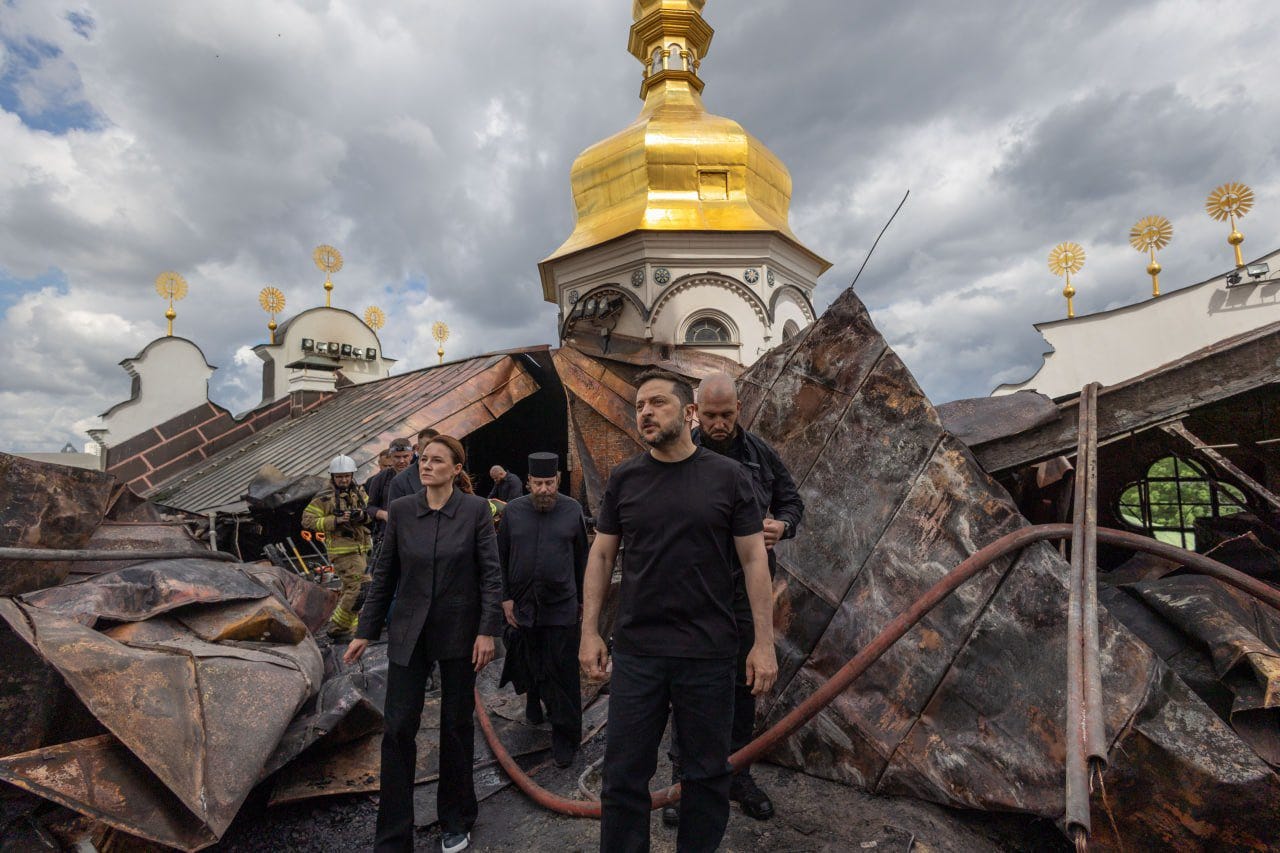
Every push on a human being runs in three beats. A trigger arrives — a missile into the Pechersk Lavra; a line, a touch, a pressure. The body has an experience — excitement, flattery, fear of losing him, being appalled. And then comes the reaction. Between the experience and the reaction there is a gap. Mockers, for instance, was operating in that gap for the entire show after the Russists hit the Arsenal, the museum in central Kyiv, which I’ve been to; after they hit the Pechersk Lavra, very close to it; and after they hit the film studios and all those other sites. Mockers, though grotesquely appalled by all this, didn’t let that overcome the way she presented the show. That’s a perfect teaching in how we can control that gap — between the experience of feeling appalled by grotesqueness, or feeling attracted by a pickup artist, and the reaction.
In that gap lives our freedom, and any of our daughters’ freedom. The free choice happens there and nowhere else. The entire craft of the pickup artist is to destroy that gap: to flood her with feeling and pile on urgency, so that she reacts from inside the rush before she’s chosen anything. That is precisely how people end up somewhere they would never have walked into with a clear head.
So the counter-move is small, and it is negative. When she notices the rush and the pressure, the discipline is simply: do not decide anything important while the window is open. Don’t answer now. Don’t go anywhere now. Step out, find her friends, let the feeling settle. Real connection survives a pause; manipulation needs the pause not to happen. The moment she insists on the gap, she’s taken her freedom back.
Counter-trolling, then, is four moves, none of which require confrontation or proof. Name it to herself. Let the radar gatekeep without needing to justify it. Refuse to act inside the urgent window. And get back to her people. No scene, no certainty about his soul, no debate she has to win. That is the power I wanted to show my friends: a method built for geopolitics, handed to a teenager — protecting not against an idea, but against a moment, and giving her, in place of fear, a clear and usable competence.
Their God Is War: The Cathedral
So — their god is war. Back to Larysa Yakubova. I want to start by asking everyone to picture a building, because Yakubova does, and the building is the whole episode in miniature. Appropriately, for this week, it is a cathedral. And the thing they have gathered to worship, Yakubova argues, is not the God whose costume the building wears. It’s the war itself.
That is the claim of this part of my exposition of Larysa Yakubova’s Beast from the Abyss. Behind the orthodox, traditional costume, the apparatus does not worship God. It worships war. Yakubova’s whole anatomy leads there: the state’s true object of worship is force and death — the sacralised violence that turns the two into a liturgy. She calls the thing the title names — the Beast from the Abyss — not as a flourish but as a diagnosis: a totalitarian, apocalyptic sect that has put on the vestments of a church.
The anchor for this part is Tool 3: look for the mana in the meme — the energy, the intention, the charge a thing carries before you have finished reading it. A war cult does not persuade you with arguments. It works on the mana, the feeling in the chest before the thought in the head. The two mechanisms beneath it are the ones we name again and again: war magic — the weaponising of sympathetic-magic logic, the belief that if you perform the ritual hard enough the world will bend — and drama, the stage that substitutes for reality, which the audience are made to sit and watch. We proof every move against the Code of Positive Trolls — is it generous? is it true? is it patient? — and we name the archetype underneath, where the voltage lives, because recognition halves it.
Yakubova walks us through the surface of Russian state religiosity: the processions, the icons carried at the head of columns, the St George ribbons knotted on lapels and gravestones, the priests with their censers swung over tanks and rockets, and the Z and V markers, which she reads as Nazi-style adept marks — the brand worn by the initiated. The costume is total. Everything looks like the oldest, most rooted faith on the continent.
And then she shows you what the costume is wrapped around. Not orthodoxy at all, but a thing she anatomises as Z-orthodoxy: a war faith in a church’s clothes, whose actual object of devotion is not the divine, but the violence performed in its name. Here is what the apparatus wants you to think, she writes: this is an ancient holy people defending its sacred tradition; the ribbons, the processions, the blessed weapons — these are faith; to stand against them is to stand against God and history.
Register the mana first, the feeling, before you reason about it. Strip the incense away, and the charge is the worship of force — the thrill of the consecrated weapon, the holiness loaned to a missile by a man in a cassock, so that the man who fires it feels not like a killer but like a celebrant. This is the mana: sacralised violence dressed as devotion. This is the merciless sovereign in his most dangerous guise — the one who has stopped pretending to rule in God’s name and started asking to be worshipped as a god. A god of war, with war as the sacrament. The cathedral is his temple; the blessed weapon, his relic.
The mechanism is war magic in its purest form: the sympathetic-magic conviction that if you bless the weapon, sing over it, build it a temple, then the killing becomes a rite. The numerology in the floor — dimensions tuned to encode an eternal victory — is war magic written into architecture. Build the promise into the stone, and the stone will make it true. Proof it against the Code. Is it true? No, it’s a costume, worn to make a lie look like the oldest truth there is, borrowing the authority of faith to license the atrocity. Is it generous? No. A cathedral whose floor is melted weapons and whose worship is the blessing of the next strike is the least generous building on earth. Is it patient? It promises eternal victory, and a thing that promises eternity is selling you urgency — the standing red flag the Code of Positive Trolls is built to catch. So this is Disinfolklore: a religion assembled to make force feel holy.
The Cult of Death: The Martyred Commander
Yakubova’s anatomy turns to what she reads as a cult of death — a necrophilia at the centre of the war faith, in which dying is not the tragic cost of war but its point. The apparatus stages the funeral as parade, the coffin as banner, the killed son rebranded a hero, so that his mother’s grief is converted before it can become angry. To die for the war is held up as the highest thing a person can do. Death itself reframed as the supreme form of patriotism. Her image of where this ends is unsparing: a beast that thirsts for blood and will drown in its own blood. Page 282.

Here is what the apparatus wants you to think. Our dead are not victims of a catastrophe. They are saints of a holy cause. To mourn them honestly — to ask who sent them and why — is to betray them. The only loyal grief is grateful grief.
Register the mana, because here it is overwhelming by design. The charge is grief — the oldest, most weaponisable charge in the whole folk store. But grief captured, turned inside out, with the question surgically removed from it. You are not allowed to ask: why did my son die? You are handed, in its place, a swelling, terrible pride: my son is a hero. That conversion — sorrow into glory, before the sorrow can become a question — is the mana of the death cult. And it’s the most dangerous energy this apparatus produces, because it recruits the mother and the maiden archetype; it recruits the mother’s love itself as fuel.
Name the archetype. This is the martyred commander — the fallen one held up not to be mourned but to be spent, his death reframed as a debt the living must keep paying. And laid over it, the mother and the maiden: the grieving mother whose love is hijacked and pointed back at the war that killed her child. The mechanism is drama — the funeral staged for an audience, mourning converted into theatre, so that the watching nation feels the cause is holy rather than asking whether it is real.
Proof it against the Code. The verdict writes itself. Is it generous? It uses dead sons as the load-bearing beam of the very war that killed them. Is it true? It inverts the truth: it calls catastrophe sanctity. Is it patient? No. So this is Disinfolklore at its apex: a death liturgy. And the Code’s counter on the martyred commander is the subtlest, and the only honest, one. Mourn the dead, refuse the liturgy. Do not dismiss the son. Do not let him be turned into the key that licenses the next coffin. Grieve him honestly — which means asking the question the cult has cut out: who sent him, and why?
The Stage Without Actors: Law as a Prop
This is the most revealing move she makes, because it shows what the war cult does to everything around it — to law, to politics, to the entire public square. Yakubova — Larysa Yakubova, in The Beast from the Abyss — argues that the Russist apparatus has hollowed out the centre of its society, and hollowed it out for a particular reason. The ruling party, in her reading, is reduced to a stage without actors — a set that performs the form of politics with no living politics inside it.
Law is mocked into a stage prop. She points to the grotesque celebration of the sledgehammer — the execution tool turned into a souvenir, turned into a brand, turned into an anti-law openly flaunted as the real source of authority. The courts perform justice; the sledgehammer is justice; and everyone is meant to see both at once and know which one is true. The whole public sphere becomes a staged substitute reality — a performance the population are made to watch, in which nothing is what it claims to be, and the watching itself is the point.
Here, she says, is what the apparatus wants you to think. There is a state here, a law here, a politics here. Parties, parliaments, courts — everything is in order. Look at the stage. See how complete it is. Register the mana. The charge is strange and cold, and you have to name it precisely: the mana of enforced spectatorship. Sitting in a darkened hall, watching a play, not allowed to leave and not allowed to call it a play. Beneath the warmth of move one and the grief-fire of move two, this is the substrate: a whole society demoted from citizens to audience, from participants to watchers — the realm of action quietly replaced by the realm of performance. The charge is passivity manufactured at scale.
Name the archetype. This is the merciless sovereign again, seen from a different angle: the sovereign who has dissolved every institution that might check him into a stage set he controls, so that the law itself becomes one of his props. The mechanism is drama in its fullest sense — not a single staged event, but the spectacle: the society in which authentic life has been wholly replaced by its representation, where you no longer live but only watch.
Proof it against the Code of Positive Trolls. Is it true? It manufactures a false reality and criminalises noticing — the opposite of true. Is it generous? It strips a whole people of agency and hands them a script. Is it patient? It needs the performance unbroken, the audience seated now and always, no pause in which someone might stand and say “this is a play.” So this is Disinfolklore: an entire public sphere converted into a death cult’s theatre, with the sledgehammer where the law should be.
The Architecture: One Engineered Liturgy
Let’s step back and look at the whole architecture, because the three moves are not three things. They are one engineered liturgy. The cathedral consecrates the violence, gives force the costume of holiness. The death cult sanctifies the dying. The stage-without-actors empties the public square so there is nowhere left to object. That is the war faith.
Yakubova’s word for the thing assembled from those three moves is the title of the series, chosen with exact care: a beast from the abyss — a thing that, in her line, thirsts for blood and will drown in its own blood. And here’s the single thing to carry out of this part of the episode. A religion is recognised by what it asks you to love. This one asks you to love force, to love dying, and to mistake a stage for a world. Once you can feel the mana for what it is — sacralised violence wearing incense — you cannot unfeel it, and the costume stops working. That is Tool 3 doing its whole job: read the charge, look for the mana in the meme, and the church clothes fall off the gun.
And it tells us, by its shape, what its counter must be. You cannot out-argue a religion of death. You can only answer it with a religion of life. The counter to a cult that worships the coffin is not a better coffin. It is the cradle. Hold that, because that’s where the rest of the series, which I’ll continue next week, is going. In the next episode I’ll talk about the wise counsellor’s poison — the figure the Russist apparatus sends out to make all of this respectable: the philosopher in the wings, the sage who lends the beast its patina of thought. Because every war cult needs a man in a study to tell the war its wisdom. I’ll save that one for next week.
Plotnitsky: The Vanished Koshchei
I’ve got 15 minutes, if you’ve got the patience. Let’s move back to a series I started weeks and weeks and weeks ago, on this 10,000-piece corpus which I collected in Russia-occupied Luhansk way back, 2015 to 2018. It’s the basis of the Disinfolklore Analytical Method, because I excavated it for archetypes.
So: Plotnitsky, the vanished Koshchei. Koshchei is someone Larysa Yakubova uses too, in her book — and maybe Iona knows who Koshchei is already, but I’ll remind you. In Slavic folklore there’s a deathless villain called Koshchei. He is an old man in black armour who cannot be killed in the ordinary way. His death is hidden in a needle, inside an egg, inside a duck, inside a hare, inside a chest, buried beneath an oak tree, on an island in the middle of the sea. To kill Koshchei you must undo every layer, and if you do not kill him properly, he comes back.
Igor Plotnitsky appears in my Luhansk well-corpus 445 times between 2014 and 2017. He was the self-declared head of the self-declared Luhansk Folk’s Republic, its so-called president in miniature. Then, in November 2017, he vanished. An armed challenger, Leonid Pasechnik, moved on him with tanks. Plotnitsky was deposed. He fled to Moscow. He did not die — he is reported occasionally to be alive (this is unlike his parents, who died eating mushrooms in Russia, a very dangerous activity). This is the perfect Koshchei arc. The occupier-installed leader is created, elevated, liturgised as sovereign. Then, when his usefulness expires, removed by a younger Chekist who wears the same uniform and speaks in the same folksy voice. The sovereignty is transferred, and the archetypal position is never vacant. Plotnitsky vanishes, Pasechnik enters. The ceremonial chair is always filled.
Let me show you the prophetic moment. 5th of April 2016, ria.ru: “LPR and DPR leaders to stay in power until 2018.” The director of Russia’s Political Environment Centre, Alexei Chesnakov, said to RIA Novosti that he had recently attended a meeting of advisers to President Putin. Read that carefully. In April 2016, a Russian official is telling a Russian wire service that Plotnitsky is authorised to remain in office until 2018. His removal is already, in the spring of 2016, being timetabled in Moscow. This is how you know the Luhansk Folk’s Republic is not a state. It’s a Disinfolklore creation. The leader has a Moscow-assigned expiry date, like a bottle of milk. Plotnitsky was never sovereign. He was Koshchei, with a scheduled death.
Notice the co-occurrence. 17th of February 2017, in the English-language lug-info.com: Plotnitsky issues a joint statement with Zakharchenko from the Donetsk People’s Republic, demanding that Kiev let the republics’ observers carry out inspections of Ukrainian-controlled industrial facilities. The Koshchei figure, one year from deposition, is performing peak sovereignty — issuing demands across an international frontier, acting as if his title carries diplomatic weight. The louder the performance, the nearer the end.
Why should we care about Plotnitsky specifically? Because his disappearance illustrates the interchangeability principle of Rashist occupation governance. The individual leader is a costume. The costume is hung on whichever Chekist is useful this year. The population’s loyalty is to the costume, not the man, because the population has been trained by the daily fake-state liturgy to revere the position. When Plotnitsky is replaced by Pasechnik in November 2017, almost no one in occupied Luhansk protests. The Koshchei figure has changed, but the spell has not.
This is why Russia can afford to burn through occupation leaders quickly. Zakharchenko is assassinated in a café bomb in 2018. Plotnitsky is deposed in 2017. Gubarev is sidelined. Mozgovoy is killed. Dremov is killed. The Koshcheis fall and new Koshcheis rise, and the archetypal chair is never empty. The counter is to name the chair as empty. The Luhansk Folk’s Republic has no legitimate sovereign — only a rotating cast of disposable characters.
The Helpful Gardener: The Bridge Troll Points and Shouts “Troll”
I have one more, which is quite quick, so I’ll go for it, even without your permission. This is in the same frame — again, I mined these documents for their archetypal presences, and they really have quite a lot. This one is The Helpful Gardener.
December 2015, the bridge at Stanytsia Luhanska. The militia of the so-called Folk’s Republic puts out a line: the Ukrainian Army, and what it calls the National Battalions, again limit the movement of civilians through the checkpoint on the front lines. And then — this is the part to hold on to — the People’s Militia, together with the OSCE, is making every effort to ensure the smooth movement of the civilian population.
The bridge troll: the creature under the bridge who owns your crossing. Name it, and the voltage halves — because now I can ask the questions the voltage was built to stop. Is this true? “The army again limits movement” — asserted, never shown, and that line in the road only exists because the occupation drew it. Is this generous? No. The cost falls on civilians crossing in the Christmas rush, and the actual armed party holding that side is dressing itself up — with the OSCE pinned alongside it for cover — as the kindly helper at the gate.
And that’s the move. The troll points down the road and shouts “troll.” So this is Disinfolklore — a weaponised story — and the counter to it is simple to say and hard to live: be the keeper who keeps the crossing open and answerable, whose account of who blocks whom survives an honest, careful look. In 2015, that bridge was still contested ground. The question is never which side blocks the bridge. It is who built the line in the first place.
I’ll leave it at that for this week. Out.


