


It’s Amazing What Regular People Can Do
For six months now I have been training a neural network to build the training data for a local language model. The model’s job, when it is ready, will be to read wartime information and sort it the way I do: into Disinfolklore, Infolklore, and Neutral. I have been working extremely hard on this and the progress has been remarkable.
One challenge sits under everything. We are swimming in Disinfolklore. Infolklore is scarce.
I developed both concepts, starting from the propaganda that flooded Stanytsia Luhanska in eastern Ukraine from 2015 onwards. Disinfolklore is the narrative form in which meanness is communicated directly into people’s minds. It works on their intentions, their motivations, their attitudes and, importantly, their moods, without their ever knowing. Infolklore is its opposite: the tale that feeds the well we all who listen daily to @Volya4UA on Twitter spaces drink from instead of poisoning it. Most of us were together in the Mriya Report days, and while you were watching the war I was developing these ideas from the very material we all looked at each day.
Finding real Disinfolklore to train on is easy. Everything we hear from Strelkov will do: we are going to kill you all, basically. Finding clean Infolklore turned out to be the hard part. We have spent months feeding every kind of text to the frontier model I work with. Sherlock Holmes. Even, and Ming will appreciate this, P.G. Wodehouse. None of it passes muster.
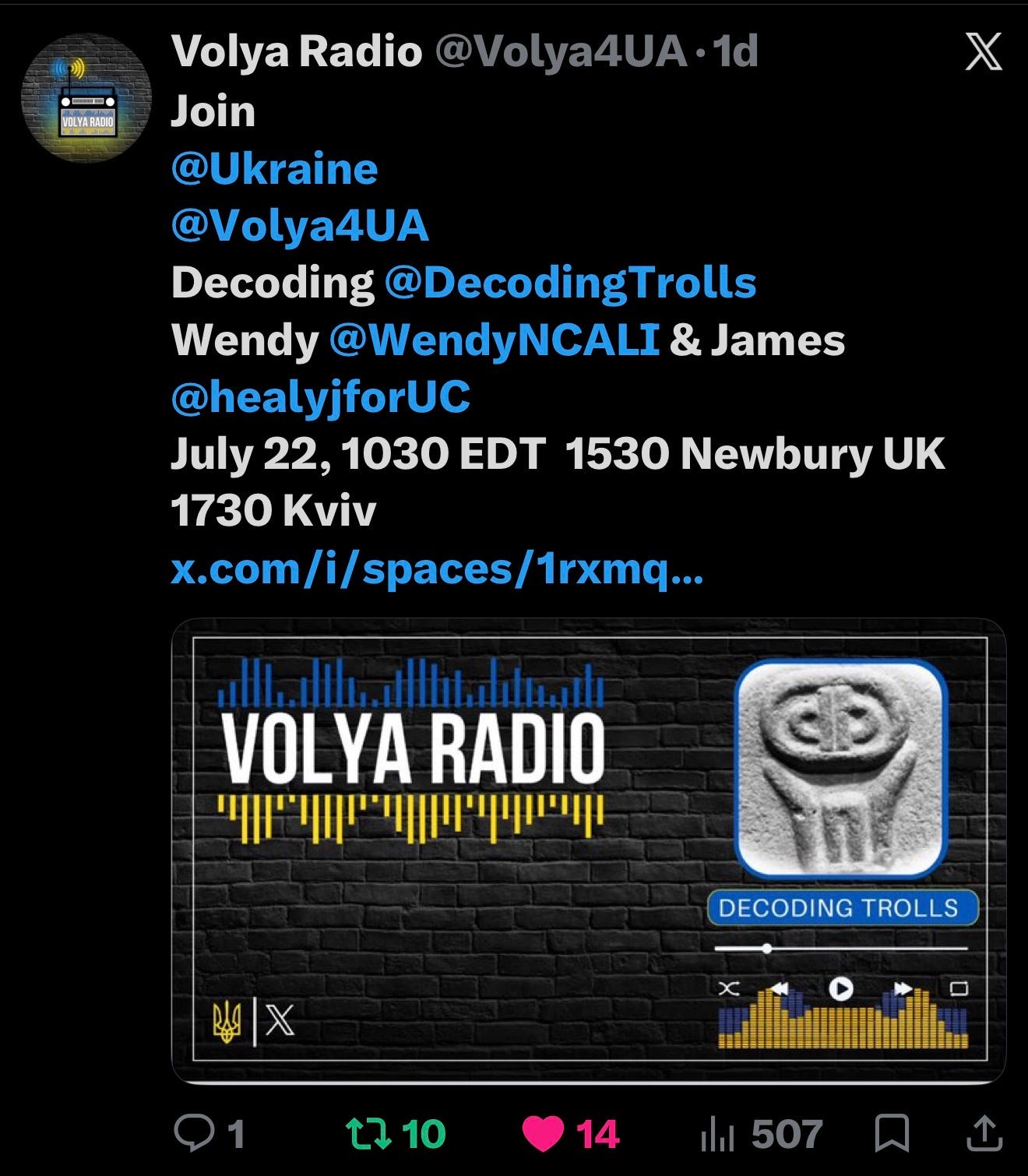
Great thanks to James and Wendy for hosting Decoding Disinfolklore every Wednesday. We’ve been going now for fourteen months every week!
Three sources lit the instrument up.
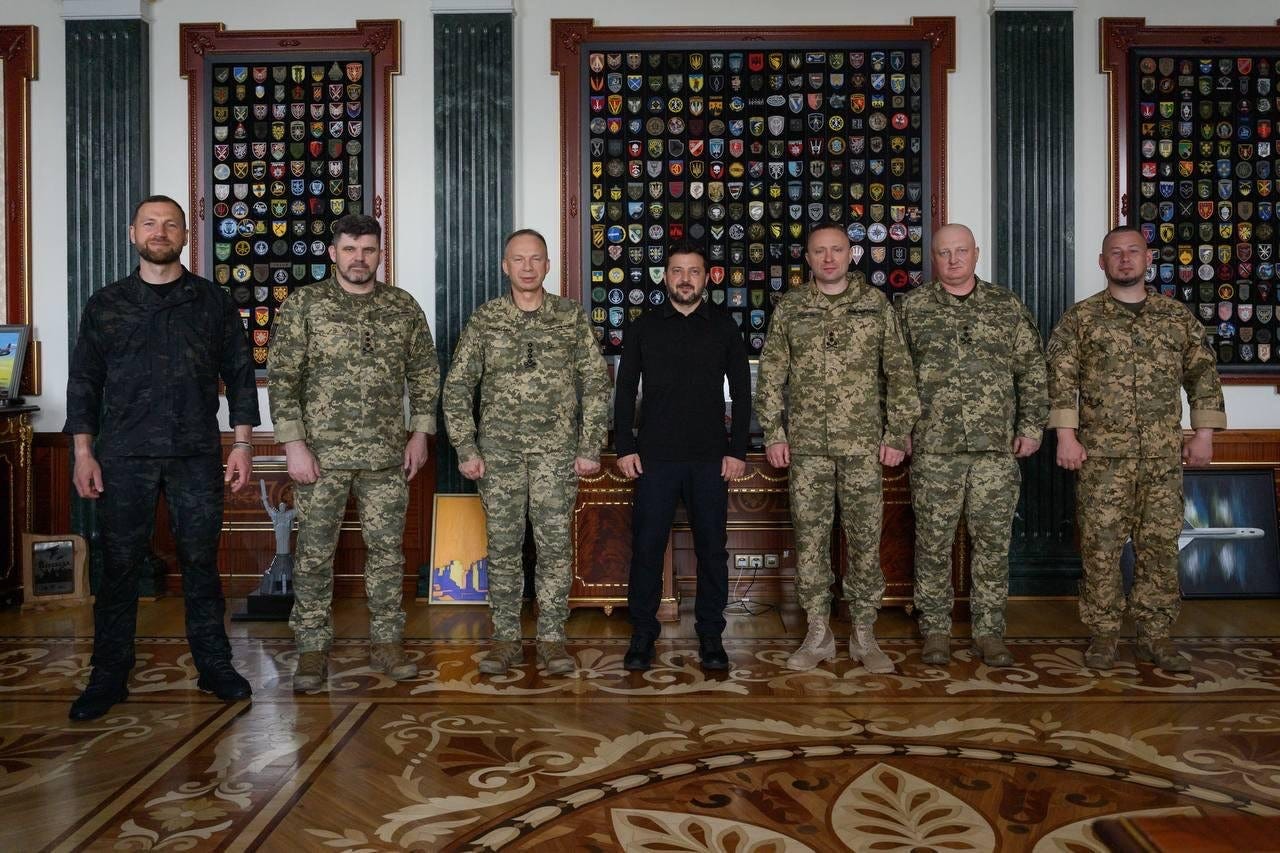
The first was written by a friend of the show. John Spencer jointly wrote the definitive account of the battle for Kyiv, a nine-thousand-word study. The moment I fed it in, the model recognised it as the best match for Infolklore it had seen.
The second is a channel that still publishes every day: RIA Melitopol, now RIA Pivden, working out of Zaporizhzhia city while Melitopol is temporarily occupied.
The third is Volya. In particular Will and M’ockers. In particular M’ockers, who wears her archetype on her moniker. Her whole method is: well, that will teach you to invade Ukraine. It is the complete opposite of the dark well.
So a couple of weeks ago I recorded one of the Volya shows and put it through the method properly. It was the episode where the tanker fella told the whole history of the alumina campaign which his fellow Tanker Fella @realLangerDan had begun. And I am not really writing about that campaign here. I am writing about the pattern he was describing: a small group of people moving together, creating a great campaign, and the campaign moving monsters.
The Trita pattern

That pattern has a name. Most of us in the pro-Ukraine space carry an archetypal model of how the world works, and it works by the small person being victorious. There is another pattern, the Vritra pattern, the serpent who holds the waters back and always wins. Both patterns live in every Indo-European language culture. Celtic, Armenian, Iranian, Indic. In England it is St George and the dragon. In India and Iran the hero is sometimes called Trita, and every Hollywood happy ending is the Trita pattern working out.
It is not mysterious. You do not have to have read about Trita. You just carry the pattern. Most of us on the pro-Ukraine side recognised from the very beginning that Ukraine was going to win, because there is no other choice. There is not a world in which Russia wins. Our certainty through the long struggle becomes clearer when one reads about the Trita pattern, which I came across in the work of one of the foremost Indo-European specialists, Bruce Lincoln, while researching Disinfolklore.
So here is my analysis of what the tanker fella and everyone on that show were doing that particular day.
On day one of the full-scale invasion, one man posted one question. Why is our country still shipping alumina to Russia when there is a war on? Nobody important answered him. He just tweeted, like all of us small people do, into the blackness. Three years later there was an investigative journalist on the story, more than thirty MEPs signing declarations, a government investigation and a vote in the European Parliament. And a couple of weeks ago the show told the story in its own words. The first line of the episode was the best summary anyone could write. “It’s amazing what regular people can do, isn’t it?”
The moment I heard that, I knew I had my perfect case study.
The two acts of naming
As all of you know, I study wartime stories. As all of us do. We have become experts in it. I had to laugh this week when M’ockers chimed in with “did you see that?” about some particular explosion somewhere, and the tanker fella was able to describe it immediately. This is the kind of knowledge most of our friends in the real world would balk at. They have no idea any of this is going on.
I have spent years building a method for reading these stories. The method has a simple engine: two acts of naming.
The first act: name the story. Not the topic, the story. Wartime information runs on story patterns far older than any of us. Some are older than writing. When you name the pattern correctly, the noise drops away and you can see what the piece of content is actually doing.
The second act: proof it. Take the conduct the story carries and hold it against the standard our grandparents wrote down after 1945. The UN Charter, the European Convention on Human Rights, the Genocide Convention, the Law of the Sea, the Geneva Conventions of 1949. Story plus standard gives you a verdict. Either the tale feeds the well we all drink from, and I call it Infolklore. Or it poisons the well, and I call that Disinfolklore. Or it is neither, and the method says so and moves on.
When I teach a computer to do this automatically, this is the structure I give it. It loves it.
First act: Trita against Vritra
Start with the alumina story, because it fits one of the oldest patterns we have. In the Rig Veda, the oldest long text in our whole language family, there is a serpent called Vritra. His name means “the coverer.” He coils around the waters and holds them back. The rivers stop. The world dries. He produces nothing. He only withholds. Against him the tradition sets a hero. In the oldest layer of the story that hero is Trita, which simply means “third”: after Manu, the human, and Yama, the twin, comes the third brother, the younger one, the one nobody bet on. He has no army. He frees the waters anyway. And the seven rivers of ancient India run.
The campaign story has the same shape. A flow that should move was being held. Not the alumina, which flowed freely, too freely. What was being held back was the truth about where it went, and the sanction that truth demanded. Around the flow sat a coil of reassurances. Don’t worry, it’s only for tin cans. Don’t touch it, the jobs. There’s an investigation, wait for the investigation. A hundred days and counting. That is the Vritra conduct. Nothing created. Everything covered.
Then the third brother turns up. One tanker watcher with a tweet. Then a website. Then a handful of listeners. Then M’ockers and her enthusiasm for the campaign from the very beginning. Then journalists, the Irish Times and the OCCRP, who found the receiving smelters’ military contracts. Then the public lobbying register, which anyone can read at lobbying.ie and which showed the scale of the pressure from the other side. Then thirty MEPs.
The campaign called its own method “polite persistence.” I cannot improve on that name. It is exactly how the third brother fights. He does not become a serpent to beat a serpent. He keeps asking for the waters until the waters move.
Second act: proof it against the standard
This is where the campaign shines, and I do not think we even notice it ourselves while it is going on.
Someone said on air: you have to have a solid argument, you have to base it on facts. That is the first mark of the bright side. Fabrication is the serpent’s tool, never the third brother’s. The second element of the Code of Positive Trolls is ethical discipline. We do not get anywhere by lying.
Then somebody (@willthiel) in the community pointed the campaign at the Genocide Convention. I think that was Heather, as ever just behind the scenes, suggesting it to M’ockers. The duty of every country to prevent genocide arises as soon as it becomes aware it is involved. A group of ordinary listeners, on a medium most of our friends do not even know exists, reached for the post-1945 legal order as their spine. Not for a conspiracy theory. Not for rage. For the charter world our grandparents built. In my method, that is precisely what separates the two kinds of story. The verdict writes itself. This is Infolklore, and it is anchor-grade Infolklore.
There was one more line in that segment that bears repeating. You don’t need to be well-funded. You don’t need a big lobby group. You just need people. The old Indo-European world had a word for the power that gathers in a community when it acts rightly. Our cousins in the Pacific still use it. Mana. That sentence is what mana sounds like in an Irish accent.
The troll under the bridge
Inside the campaign story sat a smaller, nastier pattern, and the show displayed it perfectly. The jobs line: touch this export and the jobs are at risk. Every folklore tradition in Europe knows this figure. It is the troll under the bridge. He does not own the bridge. He did not build it. He just sits at the crossing and demands a toll. The toll here was silence. Leave the export alone or your neighbours lose their livelihoods.
The method asks one question of every toll. Is it fair? This one was not. And Volya answered it, not by shouting, with facts again. Over half the output going to a single buyer whose war economy must eventually collapse. Guinea planning its own refineries upstream. Dell leaving Limerick overnight in 2009 because somewhere else was cheaper. In other words, the real threat to those jobs is dependency itself. You do not pay the troll. You show the bridge-crossers the toll is a lie.
The lifeboats
Now the moment in the episode that delighted me most, and it lasted more than a minute. One of the tanker watchers described something he had noticed across many strikes on shadow-fleet tankers. The Ukrainians always leave the lifeboat untouched. The bright orange boat and its launch ramp, always clear, so the crew can get off. Then he named the standard: “they know how to respect international law and the law of the sea.” Then Will gave his verdict: “good on them.”
He said all this about ships actively helping the Russian war effort, and he praised the restraint anyway. That is my entire Disinfolklore method performed by instinct, by non-lawyers, live on air, by someone who has probably never read a word of my work. Name the conduct. Proof it against the law. Give the verdict, even when the target is your enemy’s shipping. Especially then. Ukraine’s discipline is a story that feeds the well. Will’s telling of it feeds the well twice.
Two from the Russian side
Two quick ones from the Russian side of the episode, because the show handled both correctly.
Solovyov complained that Ukrainian strikes have plunged the Russian population into hysteria. M’ockers caught the trick immediately: he does not care that Russia has done exactly this to Ukrainian families for years. The old name for this move is accusation in a mirror. You charge your victim with your own crimes. It is one of the most dangerous patterns in the whole catalogue, because it is how atrocities get pre-justified. The counter is exactly what the show did. Hold up the mirror’s frame and say plainly whose reflection is in it.
Then Putler’s fuel meeting. He insisted there is no fuel crisis, then spent an hour ordering people to fix it. Meanwhile veterans in one district were promised a one-time bonus of 10,000 roubles, and the payment was cancelled because there was no money in the budget. Wartime Russia runs on a story pattern I call the Merciful Sovereign: the ruler whose care for his people is boundless and whose word makes things so, like in all the fairy tales that were read to us, if we were lucky enough to have someone to read them. An empty shelf refutes Putler better than any editorial. Mercy that exists only on Veterans Day posters is not mercy. A sovereign who denies the crisis he is commanding people to fix is not sovereign over very much. The show put the two images side by side and let them detonate. That is the right craft.
One caution for our own side
A method that only ever convicts the other side is not a method. It is a mirror of our own. So here is the one moment where my instrument declines to bless us. Talking about politicians who abstained, the show wondered aloud: were there Russian threats? The question stayed a question. But the shape of the move is: loud support proves a guilty conscience. That reasoning can never be falsified. I have a corpus of 10,000 propaganda items from occupied Luhansk, and that shape is in every one of them. So the method’s verdict on that minute of the show was: not poison, nothing fabricated, but not the bright side either. Unproven. Neutral. Set it down and return to the facts, which were doing all the work anyway. The abstention record is public. The lobbying register is public. The waters move on facts.
I flag it precisely because the rest of the episode proofs so well. The verdicts on the campaign, the lifeboats and the mirror are worth something because this one was not free.
And one last thing the method did: it left most of the episode alone. Elmo the cat coming through the cat flap is not Infolklore or Disinfolklore. He is a cat. The banter, the coffee, the lifeboat anecdote, the instrument reads all of that as Neutral and passes over it in silence. A method that codes everything is not an instrument. It is a hammer. The silences are how you know the verdicts are real.
So that is what the two acts of naming heard in one ordinary episode, of the hundreds that have been produced. A three-thousand-year-old serpent story enacted and won by regular people. A troll’s toll refused with facts. The law of the sea applied on instinct. A mirror caught mid-trick. A sovereign’s mercy weighed against an empty shelf. One caution for our own side. And a cat.
The bright-side stories in these recordings, the ones that proof clean against the standard, are precious. They are the material we need to teach both people and machines to tell the two wells apart. And clean examples of the bright well are far rarer than you would think. In that one show, where the archetype is enacted rather than narrated, there were at least 45 to 60 codable units. In an earlier show I fed in, Will was telling the tale of the Russian general shot in a lift while visiting his mistress, and he interjected that you could say the man died of a lack of family values. That is perfect Infolklore wrapping. It is what Volya does every day, what all of you do, and what I do to a very small extent.
The second episode: we are the ocean
Here is another episode I ran through the method, and some of you will remember it because it was only a couple of days ago. I think Yeni was definitely there.
There is a proverb our two warring neighbours share. Each of us is a drop in the ocean. In Russia it means: I am insignificant, I can do nothing. In Ukraine, as the Madyar’s Birds team put it on their page last week, and as Volya read out on air, it means the opposite. Together we make millions of drops. We are the ocean. Same words. Same image. Two entirely different spells cast with us.
Most wartime stories come at us alone, and we have to reconstruct what the bright version or the dark version would have looked like. Here the two versions arrive side by side in the same nine words. The Russian casting installs powerlessness. You are a drop, so stay home, pay your taxes, look away from the window when the refinery burns. The Ukrainian casting installs the opposite. You are a drop. And so is she. And so is he. And together you are the thing that ships cannot argue with.
One of us added the coda live on air, and I wrote it down with delight. This is from M’ockers.
“The ocean is very corrosive. There is not a lot that stands up to seawater.”
The word for the power that gathers in a community acting rightly is mana. I used it about the alumina campaign, which incidentally carries the M-N-, that phonosemantic frame, in its own name.

Here it is again, and notice where each casting puts it. The Russian version locates all the power in the state and none in the person. The Ukrainian version locates it in joined hands. When I proof the two against the post-1945 standard, the verdict is not close. One casting serves a machine that needs its people inert. The other built the protests the same episode described. Huge crowds, the anthem, and then everyone picking up every piece of litter so the square is left spotless. Democracy performed so cleanly it confuses Muscovy. The Russists watched those protests and thought: revolution. They could not read them, because in their casting of the proverb crowds only gather when the system has failed. In the Ukrainian casting, the crowd is the system working. The show illuminated this.
Displaying the dark well without drinking from it
For several minutes the show did something that looks quite risky, and did it exactly right. It read out at length the prison writings of Igor Girkin, convicted for MH17, the man who helped light this war in 2014. His latest lament: Ukraine’s strikes are clear, logical, effective and unstoppable, our leaders are mediocrities, and without urgent measures the damage to our military economy will be ominous.
Reading out the enemy’s words is dangerous work. Repeat a story often enough, even to mock it, and some of it sticks. So the Disinfolklore method asks hard questions of any segment like that. Why display the payload at all? Who is holding the frame while it plays?
Here is what I heard. M’ockers held the frame the entire time. She said the quiet part out loud: he is a mass murderer and we should not really give him a platform. The reason his lamentation earns one anyway is that he is impotent, and his misery documents the failure of the machine from inside it. Then she corrected his falsehoods as they went past. He claims Russia has not been fighting for real. She answers: Russia has been fighting for real since 2022, they are simply not the army they think they are. He claims massive strikes on Ukraine’s military industry. She answers: every time they hit a shopping centre or a Nova Poshta depot, they call it a NATO facility. The payload never travelled one sentence without its correction riding alongside.
And you would not believe how rare this is. It is completely absent from the New York Times and Washington Post articles that repeat the Russist side but do not refute it. That both-sides habit actually serves to brainwash people. What M’ockers does is refute in the moment, so the correction happens in real time and the listeners finish the job. I know Alan and Chuck and Will are open about part of the reason they do this: to give all of us lines we can use in our offices, at parties, at school, wherever anyone comes to us with Ukraine questions. We are well briefed. We are like ministers in a government. Whatever someone comes up with, we have an answer.
There is a lazy story that floats around our own side, not Moscow’s, that Girkin is a seer. The one truth-teller in Moscow. The military genius who would have won the war if only the fools had listened. That story is a troll, and Lexicon dismantled it with a single remembered fact. She is on fire these days. If he is such a genius, why was he moaning in 2014 that he could not find even a thousand men willing to rise up with him against Ukraine? A seer might have read that empty recruiting table and understood what it said about the whole project. He did not. Ten years on, the penny still has not dropped. And when the conversation drifted towards calling him merely a critic of corruption, Will quietly put the conviction back on the table: no, he was indicted and convicted over MH17. All of us know that. We need reminding at just the right moment.
The same way we need reminding whenever someone wonders whether a Nova Poshta depot was carrying something for the army, or whether a McDonald’s stood near a military facility. I had to reply to some human or machine today claiming exactly that. It does not matter. Article 51 of the UN Charter gives Ukraine the right, once its strikes are proportionate, to hit Russia anywhere: in Ukraine, in Siberia, anywhere Russia’s war machine sits. Russia, prosecuting an illegal war under the very charter it signed, has no right to strike Ukraine anywhere. No Russian strike in Ukraine is ever legitimate. So “that’s not a military facility beside that McDonald’s in Kyiv” is not the answer. You don’t refute. You outflank.
Some people see in Girkin a genuine dissident who went too far. I contend he is something else. He is a security-services character, like Dugin, whose role is to voice the permitted critique. The shape of his complaints across a decade tells you. In March 2022, with the invasion already a catastrophe, his line was: this is a disaster, we must fight more brutally. It is always that. It is never: this is a disaster, we should withdraw and save ourselves. The critique walks up to every line except the one that matters, and stops. Volya used the right phrase for it almost en passant: he has been used as a pressure valve. A valve looks like an opening. Its function is to keep the boiler intact. The method names this pattern the captured critic. The licensed grumbler whose fury makes the system look debated while guarding its one non-negotiable premise: that the war itself must go on. So when we enjoy his misery, and I do enjoy it, we should be clear about what we are reading. M’ockers, when she reads it, does exactly that. He is not a prophet. He is a gauge on the side of the boiler, useful precisely because the machine lets him tell us the pressure.
The whole segment, payload, frame, corrections, and the listeners’ dismantling of the seer troll, is a masterclass. This is how you display the dark well without drinking from it.
The judge, the cemetery, and the discipline
Last time the moment that delighted me most was the tanker watcher praising Ukraine for never touching the lifeboats and citing the law of the sea, one of the most epic pieces of international law humanity has ever passed. It took decades to get signed, and it codified centuries of practice. This episode produced that moment’s big brother.
This week brought the strikes on the Wildberries warehouses, with the usual chorus crying war crime. One of the regular listeners answered by doing something almost nobody on the internet ever does. He ran the actual legal test, step by step, out loud. Is the target military? He walked the evidence: the ownership change after the 2024 merger brought the company close to the Kremlin, the shipping policies changed, the network carries components that only belong on weaponised drones, and it is a major channel supplying the war. Is the harm proportionate? Strike some warehouses at night and, in his words, you are killing virtually nobody relative to the value. Then the comparison the critics never make: the same week, Russia put three anti-ship missiles into a Turkish grain carrier near Odesa and killed six crew. And his verdict, delivered like a judge who knows he can be appealed: if I’m the war-crimes evaluator here, I’ll allow it under the Geneva and Hague conventions.
You can disagree with his conclusion. That is fine. What you cannot deny is the conduct. He stated the opposing argument fairly, tested the facts, cited the standard and showed his working. That is the second act of naming done in the wild, at full length. When I say the Volya community has been practising my method for years without the name, this is what I mean. And of course it is not just my method. My method is influenced by listening to Volya.
Now the third treasure, and the most uncomfortable one, because it teaches the discipline that keeps the method from becoming a flag. A Russist propaganda crew went to a cemetery to film a glorification piece over the war dead. One local woman wrecked it. Our Putin got us involved in a war, she said. They did not come for your men, they came for our men. Her wounded nephew had to buy his own body armour because the issued kit can be poked through with a nail. It’s a drone war, he told her, and we’ve not seen a single enemy soldier. She stood in front of the graves and called them what the state will not: this is our future lying here. Truth spoken at cost, into a camera that wanted lies.
And then, in the same breath, the same woman turned to complaining about Uzbek migrants and women who dare to cover their hair. Sixty seconds and she went from witness to racist.
So what is the verdict on her? The method’s answer is that there is no verdict on her. Verdicts attach to pieces of speech, never to people. And her testimony is harder than it first looks. The war she is critiquing is an unlawful war. When she importunes the Russian authorities to provide better body armour, she is asking them to prosecute a genocidal war more effectively. In my book that is Disinfolklore, or at least that is how I teach the computer to recognise it. This is the same problem we have with the Navalny crew. If your project is to make Russia’s war machine less corrupt, you are on the wrong side of this war and the wrong side of international law. Her racism proofs the other way too. The moment we start certifying people instead of proofing their speech, we have a flag, not a method.
The same discipline touched our own side this episode, so I will keep last week’s habit and say where. There were moments when the delight ran past the targets and warmed itself on the manner of a killing, or wrote off an entire people as selfish by nature. Nothing poisonous. Nothing invented. Nothing all of us don’t half believe. But not the bright well either, and the instrument stays silent rather than blessing it. I flag it for the same reason as last week. The verdicts on the ocean, the evaluator and the cemetery are worth something because these ones are not free.
And what the method left alone: the cats, the coffee, the numbers read out each morning like a small liturgy. Neutral, and recorded as exactly that. And what it found: a proverb that carries two opposite spells, and a community that knows which one it lives by. A prisoner’s lament displayed at length and never once allowed to stand uncorrected. A listener felling the seer myth with one fact from 2014. Thank you, Lexicon. A vernacular judge running the Geneva test out loud, in real time. A woman in a cemetery who was witness and warning in the same minute. Babushkas sweeping up market glass while the Iskanders are still slamming in, still dying under billboards that say Unbreakable. A community that shames its own members for posting anything that could cost a battery its position, while the other side races to publish its own damage for the world’s analysts to harvest.
Two episodes, and the finding is the same both times. This show has been brewing Infolklore for years. It has an Infolklorist in chief and did not know the word. The archive is a library of the bright well, recorded daily. I would love to read all of it and make it machine-readable.
We are the ocean. The ocean is very corrosive. Ask the boiler how the pressure is doing.
The actor, not the philosopher
Last week I used the Cheburashka example to demonstrate that Dugin is not a serious philosopher. He writes earnest texts about a cartoon character. Kant did not write about Mickey Mouse. Plato did not publish solemn treatises on Asterix. This is a Russist state operation, and taking it seriously is what the operation is for.
Podcast | Outflank Dugin. Don't Rebut (episode 1)

I am going to start two new miniseries today. The first one goes back to what I call the Luhansk Corpus. That is the ten thousand propaganda items from Russia-occupied Luhansk 2015-2018 (the empirical grounding of the Disinfolklore analytical method). These are relatively pithy pieces, though each a part of an entire system of seeing, which can applied and mobilised against any Disinfolklore galaxy, such as MAGA, Iran, Ruschia, Italy, wherever. I am going to read three today.
The spine of the book I have written is one sentence, and you will be glad to know I will not repeat it every two thousand words. It simply operates underneath everything else. Dugin is an artificial creation. He is an actor, like Putin. They are actors whose role is to justify repeated, genocidal, murderous enterprises and to give them a patina of philosophy and respectability.
There is a temptation, especially for the well-trained academic reader and the experienced policy reader, to treat the writings of a man with a doctorate as though they constituted philosophy. And this is where our security services, our militaries and our journalists are, speaking generally, outclassed. The Russian milbloggers are linguists. They studied combat propaganda and linguistic technique as part of their degrees, as Zarina Zabriski has documented. Dugin did too. Facing them is a journalist who went to J-school at Columbia and learned about objectivity, this way to report and that way to report. But to understand what the other side is doing, you need linguistics.
The temptation is to assume that anyone who writes books needs to be answered with books. That anyone who claims tradition must be argued with on its own terms. That anyone who has appeared on Tucker Carlson’s show or in Foreign Affairs must be a serious interlocutor and therefore seriously rebutted. The temptation, in short, is to engage him.
Engaging him is the failure mode. It is precisely what the Russist apparatus around him is designed to elicit. They have a vector for every mind. Every Western intellectual who sits down to refute Foundations of Geopolitics, every analyst who carefully outlines the architecture of the fourth political theory, every podcast guest who patiently dismantles his account of the multipolar world, is doing the apparatus’s marketing. The apparatus does not need its philosopher to convince anyone outside Russia. It needs Western interlocutors to engage him as a philosopher. The moment they do, the apparatus has won the only thing it wants from the West. Engagement transmits the archetypes the apparatus needs in circulation. Engagement is the harm.
The opposite move, the right move, is to outflank. To go underneath the figure and name what the Russist apparatus around him actually is: a security-services-built justification machine, of which he is one component, deployed in the wise-counsellor archetype to dress mass killing in respectability. Stating this once and then proceeding will, I hope, free all of us from the trap of feeling we must keep refuting him. I will not refute him. I will go around him.
Analyst Zarina Zabriski has documented in detail what she calls Russia’s cynical use of Eurasianism as imperial strategy, and its patsy, the Russian intelligence operative Dugin. She has been doing this work for years, and she is doing the work of her life in Kherson now. May God protect her. I have written about the actor Dugin since 2022, across some sixty posts, using words like sorcerer, know-nothing, patsy, intelligence operative, fake Orthodox religious philosopher. Then once, in a moment of clarity I cannot now improve upon: Actor. Philosopher of Ruscism. That last one is the phrase I want us to keep.
The man is an actor in the dramaturgical sense, playing the role of a philosopher in a security-services-staged play whose dramaturg-in-chief was, for many years, the political technologist and former deputy prime minister of Russia, Vladislav Surkov. Surkov, a theatre-studies graduate who got his first break as a bodyguard for Khodorkovsky, staged the theatre of post-Soviet Russian politics. In the structural reading my book builds, Surkov is the apparatus’s director. Dugin is the apparatus’s wise counsellor. Putler plays the sovereign. Each plays the role the apparatus has cast him to play. Neither controls the apparatus he serves. The apparatus is the production.
Prigozhin funded the bot farms and the Wagner contractors. Thank you, Nelly, for that. Margarita Simonyan reads the lines from the Russia Today anchor desk. Sergei Lavrov translates the lines into diplomatic register. Bezsonov-style propagandists under twenty different aliases run the daily liturgy on Telegram, created by the Russian security services. Each is a specialised component. The apparatus is the whole. Dugin’s specialism is producing the long-form metaphysical alibi that lets Russian-speaking audiences interpret the apparatus’s serial enterprises, Chechnya, Georgia, Crimea, Donbas, Syria, the full-scale invasion, the Wagner deployments across the Sahel, as destiny rather than crime.
The British government took the same view, formally, when in 2025 it added Alexander Dugin to the United Kingdom’s sanctions list, alongside the Russist Ministry of Defence’s media front, the Telegram channel Rybar, the Russist Fund for the Support and Protection of Compatriots Abroad, PravFund, the Centre for Geopolitical Expertise (there is an oxymoron) and the pro-Russist propaganda sites Golos.eu and Euromore.eu. Italy’s parliament took similar steps the following month. Sanctioning a thinker because of his thoughts would be a free-speech outrage. Sanctioning a security-services-deployed influence operator, alongside the propaganda channels he operates beside, is intelligence-led action against an apparatus. It is the latter the UK did.
I have read his English-language books, the ones the Western audience knows him by: Foundations of Geopolitics, The Fourth Political Theory, Putin vs Putin, and the running output of his Telegram and Twitter channels. I am not engaging them on their own terms, because the point of the book is to outflank, not rebut. But I have read him sufficiently to recognise what they are, who he is, and who is writing his content. My opinion, which I am legally allowed to hold, is that they are the standing script-work of a security-services-deployed archetype operator.
I listed the apparatus’s enterprises in a sentence above. I did not pause to argue about whether they were enterprises. I did not stop to debate whether Georgia in 2008 was a provocation, or whether Crimea was spontaneous. I listed them. That is the outflanking voice. It refuses the apparatus’s debate bait and proceeds with the substantive work.
Continued from:
Podcast | Outflank Dugin. Don't Rebut (episode 1)
I am going to start two new miniseries today. The first one goes back to what I call the Luhansk Corpus. That is the ten thousand propaganda items from Russia-occupied Luhansk 2015-2018 (the empirical grounding of the Disinfolklore analytical method). These are relatively pithy pieces, though each a part of an entire system of seeing, which can applied and mobilised against any Disinfolklore galaxy, such as MAGA, Iran, Ruschia, Italy, wherever. I am going to read three today.


