


I am going to start two new miniseries today. The first one goes back to what I call the Luhansk Corpus. That is the ten thousand propaganda items from Russia-occupied Luhansk 2015-2018 (the empirical grounding of the Disinfolklore analytical method). These are relatively pithy pieces, though each a part of an entire system of seeing, which can applied and mobilised against any Disinfolklore galaxy, such as MAGA, Iran, Ruschia, Italy, wherever. I am going to read three today.
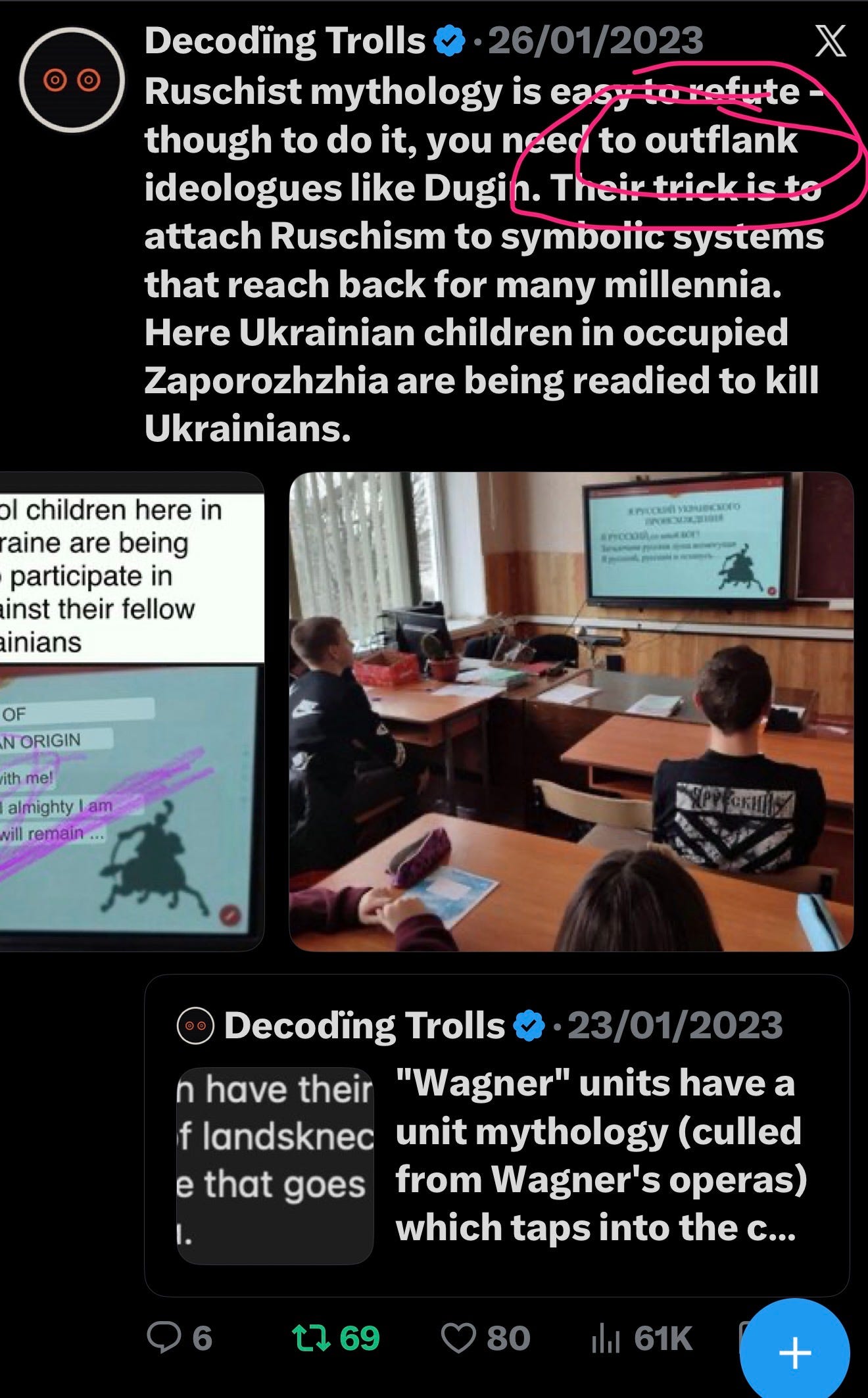
Then I will start another new series: Outflank Dugin. Don’t Rebut. Outflanking enemies in the information war - the battle to free our minds from manipulative Disinfolklore-borne brain-washing memes. That is one of the main tactics I deploy. It’s why, for example, I go as far back and deeply into the past 6,000 years of Indo-European culture as possible. When arch manipulators like Modi, Putler, Donald or Dugin (or even local characters in our own lives deploy mysticism and superstition to gain power, one way to understand what they’re doing and to defeat them is: Outflank. Don’t Rebut. This new series gives everyone the tools to do this.
1. The Word That Wasn’t There
I am talking about a word that was not there in the context of Russia-occupied Ukraine. I would like us also to think about the word that was never there while Muscovy was occupying most of Europe after 1945. It is the same phenomenon. Many people did not see it in the context of Russia-occupied Luhansk. They also did not see it in the context of that massive military occupation of Czechoslovakia, Poland and all the rest of it between 1945 and 1990. And I include myself in that, until relatively recently.
For eight years, the most important word about Russia’s war in Luhansk was missing from almost everyone’s mouth. The word is occupation. It was missing from occupiers and Ukrainians alike. This episode teaches us to read the silence. The thing that is not said is sometimes the operation.
Here is a strange way to catch a disinformation operation. Do not listen for the loudest word. Listen for the word that should be there and is not.

The setting is Luhansk, in eastern Ukraine, from 2014 to 2018. These are the years before the full-scale invasion. Russia has taken a chunk of the region and stood up a fake country there. It is the so-called Luhansk Folk’s Republic, the LFR. I spent time on the contact line at the Stanytsia Luhanska bridge, doing monitoring work for the OSCE. That is the European security body that oversaw the so-called ceasefire. I read thousands of items of propaganda during those years. The thing I want us to notice is what nobody was saying.
Listen to the occupier’s own outlet, the Lugansk Information Centre, in February 2017. The LFR, it reports, “demands”. Demands. It demands “coexistence with central authorities, Kiev, as it calls it, on a contractual basis. This means the power to conclude contracts.” Read that again. Notice the word that is not in it. Two parties. A contract. Coexistence. This is the vocabulary of one state talking to another. It is not the vocabulary of an occupier and the people under its boot.
Or here is the same outlet in 2016, on the LFR’s so-called border guards. They patrol 274 kilometres of the so-called border with Russia. A border. A state has borders. A fake republic is dressing itself every single day in the costume of a country. That is the operation’s foundational move. It works by what it leaves out. Say republic. Say border. Say minister, parliament, ten thousand times. Never once say occupation. And the missing word starts to feel like it was never true.
Now here is the part that should stop us. The other side left the word out too. Look at how Ukraine’s own news agency, Ukrinform, described the fighting in January 2018. “Events in the anti-terrorist operation, the ATO, zone.” The ATO, the anti-terrorist operation, was the official Ukrainian name for the war for years. For all the years I was in Ukraine. Think about what that name quietly does. It frames a foreign invasion and occupation as a counter-terrorism problem. It becomes something a country handles inside its own borders, against criminals. It is a true description of a real fight. But it is not the sentence. The sentence is: a foreign army is occupying our land. The word still is not there.
You can watch the word arrive in slow motion. In 2017, the phrase “temporarily occupied territories” starts creeping into the Ukrainian wires. In 2018, Ukraine renames the war from the ATO to the JFO, the Joint Forces Operation. Still an operation. Still not repelling an occupier. If you measured across the whole archive of ten thousand propaganda items, the occupier’s outlets called it an occupation almost never. Under four per cent. And the Ukrainian side climbs from about three per cent at the start to a third by 2018. The word everyone now uses without thinking was, at the time, the word almost no one reached for.
I will give you the cleanest measurement I have. It is myself. I studied international law at Cambridge. I did monitoring work on that very contact line. And I did not call them occupiers. Not in my own head, until the tanks rolled in 2022. I was inside the frame they built. That is not a confession. It is data. If the frame can hold a stranger who has read law and stood at the bridge, it is a very good frame.
In my framework, I would call this Disinfolklore. It is folklore-like storytelling built to capture you rather than shelter you. Usually we hunt it by the characters it deploys. The Nazi bogeyman. The merciful sovereign. The saintly grandmother at the checkpoint. Those are loud. This one is silent. The archetype here is not even a character at all. It is a shape with a hole in the middle. Like a shell hole in a fairy-tale kindergarten, of the kind Victoria Amelina wrote about.
So let me give us the tool, because it is a small one and we can carry it everywhere. Call it reading the absence. When we meet any account of a contested thing, a war, a firing, a closed factory, a vanished neighbour, let us not only weigh the words that are present. Ask the quieter question. What word would honest description put here, and is it missing? Who benefits from its absence? A border instead of a front line? An operation instead of an invasion? A republic instead of a seizure?
Here is what seeing it gives us. It is the only reason any of this matters. Once you can hear the missing word, you cannot unhear it. The silence stops being neutral. It starts pointing, at every turn, on every side, to the thing someone needed you not to name. The frame only works while the word stays gone. The moment you supply it yourself, the operation is over. It took us collectively eight years and a full-scale invasion to say occupation out loud. We do not have to wait that long next time. We can learn to hear the hole in the sentence and put the word back ourselves.
I think about the reporting this week on Venezuela, and the occupation by the United States of Venezuela.
2. The Republic of Liturgy
This piece is about how a fake state’s ordinary rituals made occupation feel like the weather. A parade. A foreign minister. A children’s hospital transfer. And it is about what naming the liturgy hands back to us.
Here is a small thing that could stop us. In the spring of 2017, an outlet called the Lugansk Information Centre put out a notice that the OSCE would be coming to a parade. The Lugansk Information Centre is the in-house news agency of Russia’s fake republic in eastern Ukraine. The OSCE is the Organization for Security and Co-operation in Europe. In those years it ran an unarmed special monitoring mission along the front line. The observers were people like me, whose whole job was to watch and report neutrally. Here is what the fake republic’s spokesperson, Lieutenant Colonel Andrey Marochko, said about them on the 10th of April 2017. “They said that they will monitor the event.”
The event was a Victory Day parade. It is the most sacred date in the Soviet calendar, the 9th of May. It was staged in occupied Luhansk by an entity that does not exist in international law. And the monitors allegedly agreed to come and watch. I want us to see how ordinary that is. It is not dramatic. It is not a battle. A parade, with observers RSVPing. That is the whole trick of this episode.
This is about archetypal Disinfolklore. It is disinformation that works the way folklore works, by archetype and repetition rather than by argument. An archetype is just a familiar character, or a familiar shape, that a story slots into without us noticing. The one we are reading today I call the fake-state liturgy. Liturgy means the ritual you repeat. The parade. The holiday. The ministry doing its dull rounds. The tell, the thing that gives it away, is not the lie. The tell is the boredom. The fake state performs competent, tender, normal government.
Watch it perform diplomacy. In February 2017, the same outlet quoted the republic’s acting foreign minister, Natalia Nikonorova, talking to the Russian news agency TASS. In her words, she spoke of “coexistence with central authorities, Kiev, as they call it, on a contractual basis.” A foreign minister of a thing that is not a country, conducting foreign affairs on the record, in the register of any chancellery in Europe. You read it and your eyes slide right past it, because it sounds exactly like statecraft.
Watch it perform care, which is the most disarming face of all. An LFR-controlled newspaper in occupied Stakhanov reported, in April 2016, that the LFR Ministry of Health had transferred sick children for treatment. Stakhanov is not the town’s name. Kadiivka is its proper name. Now, those children are probably real, and we should want sick children to be treated. But notice the sentence is doing two things at once. It is moving children, and it is conferring existence. A Ministry of Health did this. Repeat that phrase enough. Ministry of Health. Ministry of Interior. Department of War. State TV and Radio Broadcasting Company, with its own Director General. A town quietly renamed from Krasnodon to Sorokyne. And the republic stops being a claim you could agree with. It becomes the water you swim in. In the context of America, a republic stops being a republic and becomes a monarchy.
That is what liturgy does. Not one ritual. The whole repeated calendar. The parade. The press briefing. The hospital transfer. The school graduation. So statehood is not asserted. It is simply assumed, every single day, in the grammar of ordinary news.
Podcast | Metanoia or the Reboot?

This is the last episode of my mini-series on Larysa Yakubova’s The Beast from the Abyss.
Here is the measure of how well it worked. This is what makes it evidence and not just a story I am telling you. I went through this whole archive, 2014 to 2018. The occupiers’ own outlets almost never reached for the word occupation to describe what they were doing. Somewhere between zero and four times in a hundred. Even the Ukrainian side only climbed from about three in a hundred at the start to about a third in 2018.
So what does seeing this hand back to us? Just this, and it is plain, not very grand. Once we can name the liturgy as liturgy, the spell loosens. The parade is a parade staged by an occupier. The Ministry of Health is an occupier moving children. Forcible transfer. Genocide. And it is conferring itself a name in the same breath. You get the word back. You say occupation on the first day, not the thousandth.
The opposite of Disinfolklore is the work of seeing clearly and naming truly. We call it Infolklore. It does not need a counter-parade or a louder anthem. It needs only this. When the fake ministry issues its next dull, competent, tender little notice, we notice the boredom and we say what it actually is. That is a thing any one of us can do from anywhere today. The water only stays invisible while no one names it.
3. One Drum, Many Hands
The fake Luhansk Folk’s Republic banged one siege drum. You are besieged. The republic protects you. It banged that drum across every outlet at once. You only see the coordination, and get your agency back, when you line the outlets up side by side.
Here is a small experiment we can run with our own eyes. Take a single news headline. Then go looking for it on a second outlet, and a third, and a fourth. Watch the same words come back on the same day in the same shape. Not similar words. The same drum, struck by many hands.
Let me show you the drum first, because it is wonderfully boring. On the 8th of March 2017, the Lugansk Information Centre published this. The Lugansk Information Centre is Luginfo for short, the press service of Russia’s fake Luhansk Folk’s Republic. It published: “Kiev forces violate ceasefire 11 times over 24 hours. Kiev forces shelled LPR people’s militia positions 11 times over 24 hours, the republic’s defence authorities said.” That is the whole story. A number, a direction, and a reassuring little phrase. The republic’s defence authorities.
Now here is the thing. That is not one story. That is a metronome. The week before it was 18 times. Another week 13. Another 11 again. Same headline frame, same source. Just like Donald’s on-off Iran war until the land invasion. The republic’s defence authorities said. A different number dropped in like a date on a calendar. You are not being told what happened on the contact line. You are being told, over and over, in a rhythm. You are besieged. And the republic shields you.
This is an old, deep archetype. The scholar Georges Dumézil was a Frenchman who spent his life mapping the older stories our cultures tell. He noticed that societies keep a special place for the protector, the one who holds the wall while you sleep. It is one of the most loved figures we have. We want a shield. That wanting is exactly the handle a disinformation operation grabs. Disinfolklore is the word I use here. It means folklore-shaped lies that move because they ride an archetype we already trust. It does not invent the besieged feeling. It supplies a shield, and asks us to love the hand that holds it.

But watch what the shield is defending. In June 2016, an outlet calling itself the LFR Ministry of State Security ran the arrest of a Ukrainian journalist, Olga Svorak. The charge, word for word: “the criminal case was opened due to espionage activities to the detriment of LFR’s security.” The security of a thing that is not a country. A made-up republic, with a made-up ministry, jailing a real journalist for endangering the safety of the fiction. The shield is real enough to put someone in a cell.
Think about these so-called elections, too. Consider the idea of elections in Russia. There have never been free and fair elections in Russia. Not in 150 years. Never. Not once. Yet the more times that word is used, the more it works on us. It is a sacred word in most of our cultures, thank God. Its function is to persuade us, in little tiny increments, that there is such a thing as an election that matters in Russia. And in the context of the LFR, the thing the shield defends does not exist.
The drum keeps a beat. By May 2018, the same spokesperson, Lieutenant Colonel Marochko, on the same outlet, says a Ukrainian unit has arrived. In his words, “their main task is to mine lands along the contact line, carry out provocative shelling, carry out terror acts in neighbouring villages.” Terror acts in your villages, from them. The shield needs a sword on the other side of the wall. So one is supplied every week, on schedule.
Here is what you cannot see from inside any single one of these stories. You only see it when you line the outlets up side by side. Luginfo. The Ministry of Interior. The Ministry of State Security. Or whichever talking heads are on CNN. The coordination is invisible at the level of the story. Each looks like a local report. It is glaring at the level of the pattern. That is the tell. When a worry arrives everywhere at once, in the same shape, on the same day, the worry was not gathered. It was issued.
The same shield can be turned two ways. A genuine warning says: there is shelling, take cover. It wears the very same clothes as the manufactured siege. You cannot tell them apart by how protective they feel. Both feel protective. That is the point. You tell them apart by what the shield is actually defending, and what it asks of you. A real warning hands you agency. Here is the danger. Here is the door. The manufactured one hands you a custodian. Stop looking. The republic has it. Love the hand. One opens your eyes. The other closes them and calls it safety.
So this operation worked. It worked so completely that for years almost nobody reached for the plain word occupation until 2022. Not even the careful watchers. The siege drum had done its work. It kept everyone looking at the wall and never at who built it. This is why lining up the outlets is not a clever trick. It is how you get your agency back. I note that ground.news does that. It lines up the outlets and gives us an opportunity to adjudicate between how they represent the news. The drum only governs you while you hear it one beat at a time. Put all the hands in front of you at once. It stops being a siege you are trapped inside. It becomes a thing someone made, on a schedule, for a reason. And a thing made can be set down.
So next time a single worry reaches us from four directions at once, wearing four different faces, do the boring experiment. Put them side by side. There is the speculation about getting rid of the Ukrainian defence minister. There is that guy, Christopher Miller, who spent years chasing mythical Nazis in Ukraine while not mentioning Russia’s Nazis. He is promoting all of this stuff about Fedorov at the moment. There is that guy, Rob Lee, who keeps popping up on my timeline. I thought he was in good faith at the beginning of the war. Yet everything he reports, 99 times out of 100, reflects badly on Ukraine. I do not know whether he is in good faith or not, whether he is doing it on purpose. Or whether he is just psychologically incapable of the self-awareness to understand what he is doing, and the negative vibes he promotes, all in the guise of being a truth-teller.
So the next time a single worry reaches you from four directions at once, wearing four different faces, do the boring experiment. Put them side by side. Find the metronome. That is the operation showing you its hand. The moment you can see the hand, the drum is just a drum.
So that is that. I will come back to those next week. They are quite short and pithy.
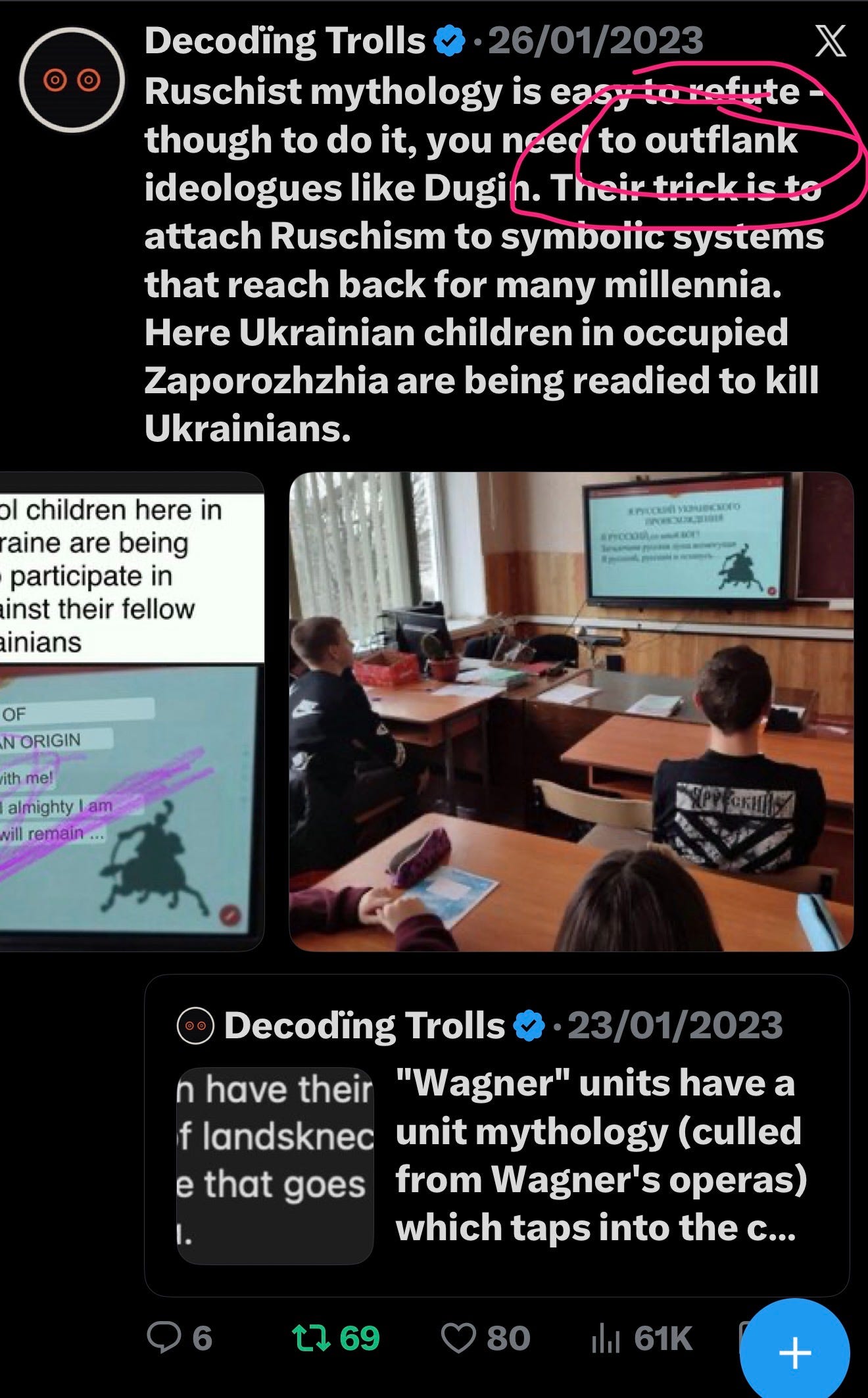
Outflanking Dugin — Don’t Rebut
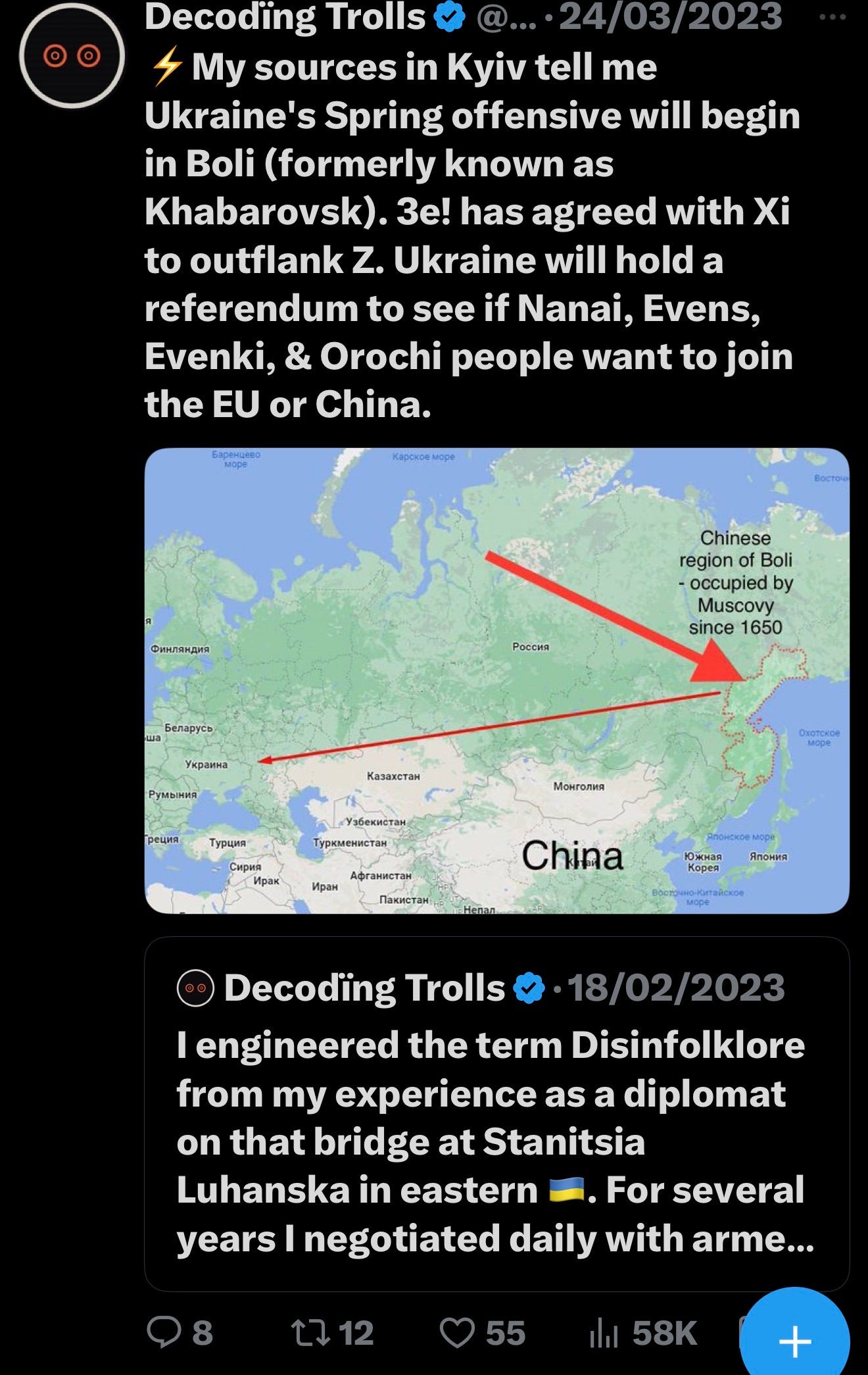
The next thing I wanted to start is something I have been working on for a very long time. It all came out of a tweet I wrote in 2023. The tweet was about outflanking Dugin, not rebutting him. This is one of the keys to the entire method itself, which I have spoken about before. You outflank. You do not rebut. You do not show the picture of the quite fetching French-Russian propagandist when you are trying to criticise her. By showing the picture, you promote her. And just because you wrap that promotion of her picture with a critique, you are keeping the energy of the troll going. So you outflank. You do not rebut.
So this is called Outflanking Dugin: Don’t Rebut. It is a short book about a long apparatus.
Two words in that sentence carry the weight of this book. They will recur on every page. So let me define them before we begin.
The Rashist apparatus is what I will call the apparatus. It is the Russian state’s genocide-justification machine. It is the security services’ built network of operators, channels, archetype-handlers and metaphysical scriptwriters. Its function is to dress repeated genocidal enterprises in respectability, and to industrially export that respectability across borders. The apparatus has been running at industrial scale since at least 2014. That is when Russia’s folklore-archetyped “little green men” and “polite people” began their brutal, genocidal military occupation of parts of Ukraine. The apparatus has done, and continues to do, substantial damage to many countries. By writing this book I hope to help us get our eye in to all the apparatus’s operators, not just to Dugin. Its named senior operators include the man this book is named for, Alexander Dugin. But the apparatus is the whole machine, not any single operator inside it. I will use the word apparatus in this technical sense throughout.
Disinfolklore is the analytical name I gave, on the 15th of February 2023, to the narrative form the apparatus runs on. Disinfolklore is folklore-like archetypes weaponised against rational cognition, democratic alliances, and the integrity of the audience’s mental continuums. The word is a portmanteau. Disinformation married to folklore. The marriage matters. The apparatus’s product is not merely lies, the lies of the surface. Beneath the untruths, the apparatus is reaching for six-thousand-year-old narrative structures. The bridge troll. The wise counsellor. The mother and the maiden. The trickster. The apparatus deploys these archetypes to do cognitive work that ordinary disinformation cannot execute on our mind-screens.
This book takes the reader inside that mechanism. It supplies the instrument with which to counter it. The instrument is a method I call Disinfolklore Analysis. This book proposes a particular way of using it. Not by rebutting the apparatus’s outputs, which transmits them, but by outflanking them, which dispossesses them. The method is twelve tools in a six-element ethical code. It is built from comparative mythology, cognitive psychology, Buddhist ethics, international law, and my seven years of frontline observation in Donbas. Some of that time was spent in Russia-occupied Ukraine between 2015 and 2018, as a diplomat. That was just as the apparatus had begun to brainwash Ukrainians, using propaganda at a scale, intensity and sophistication more powerful than any used before on any community.
The reader does not need any prior acquaintance with my earlier work to follow this book. Every technical term is introduced from zero, in plain English, with concrete examples, the first time it appears. Every M-N cryptotype. Every meme. Every archetype. Every ancient story. The opening artefact does most of the work the book has to do. Stick with me through chapter one. After that, the apparatus collapses on its own.
Chapter One — The Wise Counsellor Archetype: A Manufactured Philosopher
In January 2026, the man whom the Western press has long described as Russia’s primary philosopher sat down and wrote about a children’s puppet. The puppet’s name was Cheburashka. He is small, brown, round-eyed, with two ears the size of his face. He was conceived by a Soviet children’s writer, Eduard Uspensky, in a story published in 1965. He was animated for television in 1969. Across the former Soviet space, in Russian-speaking households from Kaliningrad to Vladivostok, from Mariupol to Minsk to Yerevan, three generations of children have grown up with him. He is, by any sensible measure, a beloved character. He is shy. He is gentle. He is a friend.
In January 2026, the Russian state’s senior philosopher wrote about him. Its primary philosopher. Its most named. Its Tucker-Carlson-interviewed. Its most-translated-into-English. This man chose to publish, on his Telegram channel and his social-media accounts, the following account of who Cheburashka really is.
Cheburashka is not an innocent creature. He is a toxic mutant. A demon of the moon. His true name is Shirdbar Shemot Shirtatan, the demon in the name of Satan. Cheburashka destroys the traditional identity of the Russian child. He is not a bear. He is not a hare. He is a ruthless cosmopolitan. He has no parents. He has no nationality. He might be Jewish. He is a symbol of liberal post-humanism, sent to destroy the Russian archetype.
The author of those sentences then continued, in the same artefact. He claimed that the image of Cheburashka was created on the basis of “ancient pentacles, reproducing the symbolic features of the moon demon, Shabart Ashamat Shirtatana.”
But that demon does not exist. The pentacles are imaginary. Invented. The name is created. It is dressed in pseudo-Semitic phonology to look like a recovered ancient demonological etymology. The whole thing is fabricated. The demon. The pentacles. The etymology.
That artefact deserves a moment before we do anything else with it. Three generations of Soviet and post-Soviet children loved that character. He is the country’s Mickey Mouse. The country’s Pingu. The country’s Paddington. He was the mascot of the Russian Olympic team at four Olympic Games. A 2023 live-action film of him sold nine million tickets at the Russian box office and earned its creators around five billion roubles. He is gentle. He is small. He has big ears. He is not very bright. He is precisely the kind of figure a culture invents when it wants to teach children that you are loved even if you are not strong.
This is no fringe figure. Tucker Carlson flew to Moscow in February 2024 to interview him as the most famous political philosopher in Russia. Carlson’s promotional copy called him so dangerous that the Ukrainian government tried to murder him, and so dangerous that Amazon will not sell his books. Steve Bannon has translated him. J. D. Vance’s intellectual circle has cited him. His 1997 book, Foundations of Geopolitics, is taught at the Rashist Academy of the General Staff. And this man, in 2026, sat down at his desk and wrote that Cheburashka is a Hebrew-named moon demon, that he might be Jewish, that he has been sent to destroy the Russian archetype.
If you want a single piece of paper that ends the question of whether Alexander Dugin is a serious philosopher, this is it. I am not going to spend much time in this book rebutting Alexander Dugin. I am going to spend the book outflanking him. By the end, we will have a method for doing so to anyone like him.
There is a single word in that artefact that matters before we do anything else with it. The word is in the closing line. He is sent to destroy the Russian archetype. It is the line itself that matters. Not the demonology. Not the pseudo-Hebrew etymology. Not the anti-Semitism. The line is: I am here to destroy a Russian archetype and replace it with the right one. The clue to the right one is in the rch sound in archetype itself. That is the apparatus’s project, stated by its own senior operator, in his own keyboard-typed words. It is the most important admission in the artefact. Most readers slide past it because they reach for the anti-Semitism.
An archetype, in the sense this book uses the word, is a recognisable narrative role with a deep structural history. It is a cognitive figure the human mind already knows, because it has been carried by stories, songs, rituals and language for thousands of years. Archetypes live in our minds like tuning forks. They are silent until a stimulus at the right frequency strikes them. Then they ring on their own. The bridge troll. The wise old counsellor. The mother and the maiden. The wicked stepmother. The heroic soldier. The sovereign mother. The trickster. These are not stereotypes, which are flat external caricatures one imposes on a real group. They are narrative roles that anyone can be cast into. A person. A country. An institution. A children’s puppet. And the casting is what the apparatus does for a living.
Once an archetype has been activated in the mind, it determines which facts the mind is able to see. Fact-checking does not fix this. The archetypes live deep inside stories much older than any facts. Platform moderation does not counter it. Archetypes do not need platforms to pass between minds. Media literacy does not neutralise an archetype. It entrenches it. The archetype is not a medium. Archetypes are structures immanent in consciousness. The apparatus’s work is at that structural level. This is why it cannot be undone by surface refutation.
Dugin’s last line reads: Cheburashka is sent to destroy the Russian archetype. There is, in his sentence, an existing archetype called Russia. It is a narrative role the word Russia already carries in the audience’s mind. Dugin is announcing the apparatus’s meta-project. It is to destroy the existing archetype of Cheburashka, so that a new one can take its place. The new one is the one the apparatus is installing. It is the apparatus’s preferred Rch archetype. Right. Reich. It is from the same set of words. It is a Russia that is, in the apparatus’s own preferred vocabulary, Tradition with a capital T. A catacomb against the modern world. A civilisational core standing against the demon of the moon and its presumed-Jewish cosmopolitan footmen.
We will return to this. The rex sound. The consonant skeleton in archetype. Monarch. Oligarch. Patriarch. Reich. Right. Writ. It is a powerful cryptotype across the Indo-European language family, and I will come back to it in chapter ten. For now, hear it ringing in archetype. And indeed in Donald’s arch, his triumphal arch.
Dugin’s own work is precisely to redefine the content of the archetype of Russia. Donald’s own work is to redefine the content of the archetype of a republic, a constitutional republic, by installing an arch on the ceremonial axis of that republic. The apparatus’s whole undertaking is, at its deepest structural layer, an archetype-replacement project. Dugin’s specific function in the apparatus is to write the metaphysical material that supplies the new content.
Cheburashka is the test artefact. He is a beloved figure whose existing archetypal content is innocent child, gentle, friend. His new content, in Dugin’s keyboard-typed instruction, is toxic, mutant, rootless, cosmopolitan, possibly Jewish, post-humanist, saboteur of the Rashist child’s innocence and potential. The replacement of the right content of the archetype is happening in front of the reader. The artefact demonstrates the meta-project on the page by performing it on Cheburashka.
This book is the field manual for noticing the replacement of the Reich element in archetypes, as it is implemented in the information space. It is a handbook for those of us who refuse to be co-opted, through our subconscious, into the apparatus’s many murderous projects.
Here is the spine of the book in one sentence. I will not repeat it every two thousand words. It will simply operate underneath everything else. Dugin is an artificial creation of the Rashist security services, an archetype of a “philosopher” and “wise counsellor.” There is a temptation, especially for well-trained academic readers, and we will get to that next.


