



It’s a reflecting pool. So we’re talking about accusation in a mirror which is Donald’s main tactic as well (just as we were talking about before) using an arch in the ceremonial axis of the Republic to install, archly, an archetype of right (which is in fact the opposite of right, an insurrection). So the structure of these - the magnetism of the - words reveal everything really.
I marvel and find it astonishing that we can be going through this complete saga over the reflecting pool. If you described it to anyone even a year ago they would not believe you. 10 years ago they would not believe you. That this is going on is a marvel to be sure.
We the people are installed inside this disinfolklore galaxy where the script and the stage is right there. The words reveal it, every sentence. Without these revealing words - Monarch, arch, ballroom,… the archetype could not be installed. The monarch installing the monarch with all this gold, visiting Versailles and all of this stuff. This is kind of what I was talking about before, which Surkov talks about. Part of the act, part of the stage play is to reveal it and in there is the supreme act of manipulation.
I happen to believe from my work on Dugin and on Surkov and on Donald that the the playing of the monarch archetype is part of the stage play. In order to pull the wool over everyone’s eyes over what is actually happening, which is more closer, not to a monarchy, but an oikarchy. Where you have the directors and a whole group of oligarchs rinsing the Muni out of our Community, rinsing the Mana, the energy, the money out of our community. The clothes it is wearing are the clothes of Donald playing the monarch. And the reflecting pool, the triumphal arch, these are all parts of this stage play. It fits this same pattern, the symbolism of knocking down the east wing and installing a ballroom, a monarchical ballroom.
Underneath it is the Mafia state. Concealed by waffle about the czar and Donald’s tweets about wanting to be a monarch. The phrase, “you couldn’t make it up,” doesn’t apply because it is disinfolklore. It is made up. The disinfolklore galaxy is a purposefully created instrument. It’s a disinfolklore galaxy made up of these ingredients, which are so obvious. They’re obvious on the level of linguistics, language and symbolism to the simplest minds. Because everyone - the simplest minds- read fairy tales with ballrooms, mirrors, arches, inner/outer realm switching. Yet the archetypes are being installed in every story about the reflecting pool and these arrests and they have these real world impacts which are changing people’s lives… We fight on.
Poland and Ukraine: The Shape of the Strategy
The shape of what is happening now between Poland and Ukraine fits exactly the pattern Vladislav Surkov himself talks about. I spoke about this before in the context of Ukrainian historian, Tetiana Boryak’s work.
Podcast | How Russia's Mental War Against Us Will Persist After Ukraine's Victory

In 2021 Ilnitsky, adviser to the Minister of Defense of the Russian Federation (2015-2024) stated that the purpose of Russia’s “mental wars” is to destroy self-awareness, change the mental, civilizational basis of the enemy’s society (I’m indebted to Tetiana Boryak of Vilnius University and to InformNapalm for drawing my attention to these quotes by Ilnitsky in https://informnapalm.org/ua/format-c/)
The Ruschists’ strategy is to take archetypes of national consciousness, invest new meanings into them, and create divisions in society using this tactic.
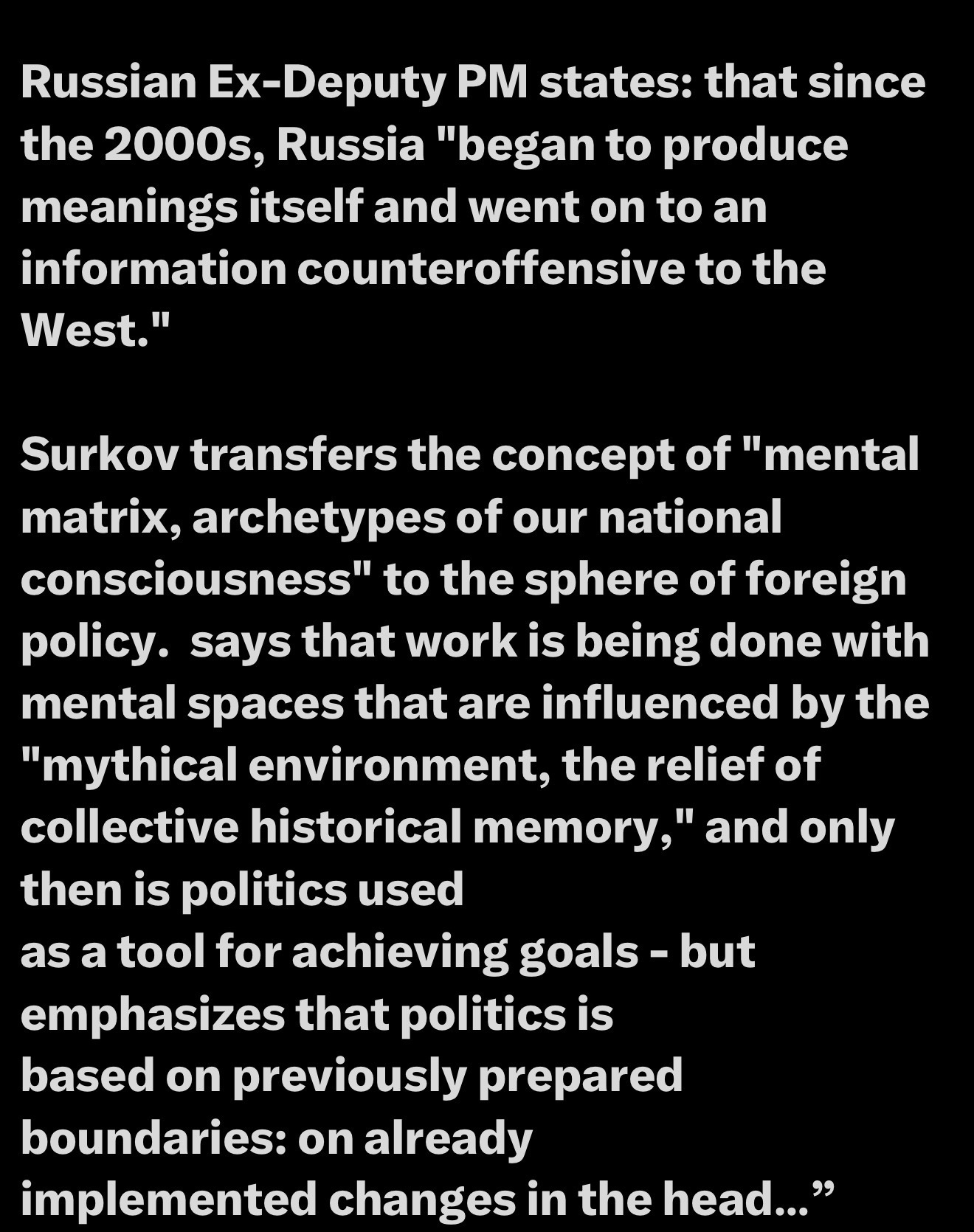
MAGA; Brexit; what we saw with Law and Justice in Poland after it was elected, initially in the wake of Russia’s carpet-bombing of Syria from September 2015; the Fidesz Party in Hungary; entities in Ireland, and all over the place. It’s devilishly difficult to spot, because it’s wrapped, always, in every jurisdiction, in patriotic sentiment. And by its very definition, this strategy — and it is a strategy rather than a tactic, because it’s one of the main means Russia uses, again, in Surkov’s own words, because the Russians can’t help themselves articulating this, which is part of the thrill and part of their creation of power — is to wrap itself in patriotic clothes, in whatever’s to hand.
They just don’t care whether you’re in Poland, with this history between Ukraine and Poland; in Ireland, between Britain and Ireland; or MAGA, Make America Great Again, between liberals and conservatives. They’ll just take this division everywhere. The shape of this — as indeed the shape of the truck protesters in Poland that we all remember, and all the rest of it — has this same shape of the Russian strategy. That’s how I see it.
We did have this miracle where Duda, the former Polish president who presented President Zelensky with the award, continued the government policy that had been established under Solidarity when they took over in the early 90s: the two-track policy of defending Poland’s patriotic and national interests publicly, but in private doing everything they could to promote and give Ukraine opportunities to anchor itself in the minds of the German leadership and the great powers as an independent state. We all remember Bush’s Chicken Kyiv speech as a marker in the ground — that it wasn’t inevitable that people would accept the inevitability of Ukraine becoming a sovereign and independent state.
Podcast | In Defence of "Ancient Ukraine"

We say ancient Greece and ancient Egypt without a flicker, and we call a Bronze Age culture in Kazakhstan the first Aryans — every one of them a modern name thrown back over a people who never bore it. The homeland of the whole Indo-European family is the Dnipro Valley. So, by the rule we already use for everyone else, there is an ancient Ukraine. To withhold the name is not scholarly caution. It is a double standard. And there is a war behind it.
So we’re lucky we have someone as sophisticated as Sikorski, who, as I’ve mentioned, understood — he was in the Maidan in February 2014, negotiating a truce between the demonstrators and Yanukovych’s government, which thankfully failed when Yanukovych fled, with Manafort there. We’re lucky we have him there, and Donald Tusk, and hopefully everything will die down.
The Golem and the Grand Inquisitor
I was going to continue with Larysa Yakubova’s The Beast from the Abyss. Last week I had just told you about how she was describing the use of this arcane, esoteric Ruschist so-called philosopher who was resurrected by the mafia regime in Russia in the 1990s. So the title of this is The Golem and the Grand Inquisitor.
I’m Decoding Trolls. I write mostly on Twitter as Disinfolklore, Decoding Trolls, but also on disinfolklore.eu, decodingtrolls.net, powerofmana.net, and disinfolklore.net, where you can subscribe. The title of the book Larysa Yakubova wrote is Rashism: The Beast from the Abyss. She’s a member of the National Academy of Sciences in Ukraine, and this book was published by them in 2023.
Now go past the title to the doctrine, where Yakubova stops being a critic and becomes a coroner. What did the Ruschist apparatus actually buy when it bought Ilyin? Not subtlety. Strip the prose, and you find one idea worn smooth by handling: the absolute, sacralised, all-powerful state, to which the human being owes everything and may demand nothing. Yakubova has a figure for this — again, her argument. She reads Ilyin as the apologist of the golem: the worshipper of the man-made monster, the giant of clay animated to serve its makers that instead devours them. And she reads the moral posture beneath it as that of the grand inquisitor: the one who takes freedom away for people’s own salvation, certain they are happier without the burden of choosing, and who will burn them to keep them safe.
The Brothers Karamazov and the Third Rome
This week I wrote a post about the fraternal brotherliness of the Soviet archetype, which was used to shoehorn Ukraine and Belarus into a union with the Soviet Union, and was made manifest even in families, where it was all about brotherhood — and this is just an archetype. I referenced The Brothers Karamazov, where, for some of us who have read it — I’m assuming not everyone here has — there are basically three brothers, like three folkloric brothers. One of the brothers, Ivan Karamazov, received some of his education in the West and comes back to Russia and finds it really difficult to reconcile his Western ideas with his Eastern ones, with the ideology of the deep folk. They have a brother, the saintly Alyosha, who is the representation of Russia’s Third Rome troll — its idea of itself as the Third Rome, as some sort of really spiritual, ascetic state, which obviously most of us today would find laughable. Ivan wants to disabuse Alyosha of his saintliness and of his belief in the good.
So Ivan tells him this story, which is the Grand Inquisitor episode, which some of us actually might have read. I read it as a postgrad at Georgetown, as part of my intellectual history. In it, basically, a Jesus figure comes back, and he’s gathering all his followers, and eventually he is arrested; and just before he is executed, he meets and has this conversation with the Grand Inquisitor, who is, in effect, Pontius Pilate. So that’s the literary reference here — in which the Grand Inquisitor says: well, what did you think was going to happen? Did you think we were going to welcome you with flowers? Look what you’re doing out there. The people love you. But you’re promising them an idealism that just doesn’t work in this world. And you were told not to come back to us. And now you’ve come back, and the inevitable will happen. And this will always happen when you and your idealism come back to us.
So that, as an archetype inside the Ruschist consciousness, as voiced by Dostoevsky in such great art, is still immanent in the monarchist, in the czarist approach to governance and their idea of themselves. This is one of the reasons I decided to feature Larysa Yakubova’s book, because it’s so brilliant and everyone should be reading it. They shouldn’t be reading people like Mark Galeotti, or all of these Russian journalists who go to Moscow for 10 years and then write a book — escape from Moscow, and how Putin hates them, and all of that nonsense. They should be reading Ukrainians, as all of us spend time doing, because Ukrainians were part of Russia — as we understood the Soviet Union to be — until 1991, and they understand what makes Russia tick on a really deep archetypal level.
If you want to understand what to do about Russia, and what Russia is, Larysa Yakubova is the person to read — not these people in RAND, or former central bankers working for think tanks in the US. Because Yakubova understands, like me and my insights about Disinfolklore, that if you really want to mine how a people think, and how a people can be manipulated, and how the Russians are manipulating us, you need to look at the archetypes — not least because they’re driving what they do, but also because they give an insight into all of our minds, this substrate that, as far as I’m aware, not very many people have looked into before. I love Larysa Yakubova’s work because she was doing this around the same time I was, when she published this book after I had conceived of Disinfolklore.
The Grand Inquisitor and the “Mythical Deal”
So that trope we often come across — oh, Putler, the Russian people have decided to exchange prosperity for freedom, and this was a deal they made — that’s a little story. It’s a fairy tale, and we hear it from pro-Ukrainians as well, because there’s no consent to this. It’s not a democracy. Immanent in that fairy tale is Disinfolklore itself. Even when people are trying to say, oh, today there are all the petrol queues, and therefore the Ruschists believe this mythical deal they made with the Russians — they never made this deal, because there’s never been a democratic election in the history of Russia where they could have made it. It was never on the table. But there’s an idea that there’s a deal, and that takes on the patina of truth, and it’s promoted, and then it’s taken on board into the minds of Russia experts who decide to try and explain this to us.
So Larysa Yakubova is getting right underneath, undermining these immanences — these archetypal myths that are governing all our experts, many that we see on Twitter. The archetype of the grand inquisitor — the one who takes freedom away for people’s own salvation, certain they’re happier without the burden of choosing, and who will burn them to keep them safe. It’s so clear whenever anyone is talking about this mythical deal that supposedly happened after the 2009 elections: immanent in that is this archetypal identity of the grand inquisitor. Not invented by Dostoevsky and The Brothers Karamazov, but written out because that was what was going on around then. They were the stories the servants told him about the Tsar, and it was a reflection, which he just happened to record in writing. I don’t attribute genius to him for being a stenographer, but it is a recording of this archetypal identity immanent in the Russian mind that we still see on our timelines — every time a Russia expert tells us about this mythical deal that was made with Putler: you stay out of politics. There are a few iterations of it, but it’s the same mana, the same energy in it.
The Trap Inside the Flattery: Outflank, Don’t Rebut
Here is what the Ruschist apparatus wants us to think. This is profound. This is a serious diagnosis of the chaos of liberty, the loneliness of the modern soul, the need for order in a strong hand. Disagree if you like, but engage with it as philosophy, meet it on its own terrain. And I’m making fun of this, because I was one of those people. I sat in the seminar room at Georgetown and we talked about the Grand Inquisitor as a piece of great art — which indeed it is. But we also meet it in the trenches and the meat assaults, and this is what it leads to.
Register the energy. It’s the pull towards debate — the flattering invitation to treat the doctrine as a worthy opponent and argue Ilyin footnote for footnote. And here’s the trap inside the flattery. The moment you agree to argue him on his own terms, you have conceded the only thing that mattered: that he is a thinker with a position, rather than an apparatus with a job. Name the archetype — the same one, in a deeper layer of costume: the captured philosopher in his theological disguise, the absolute state dressed as sacred, and the inquisitor dressed as shepherd.
Here I do the move this whole miniseries is built on, which is: outflank, don’t rebut. That is one of my main strategies throughout all of my work — which Wendy will have noticed I did with her question about Poland, because I don’t want to in any way fan the flames of the fire. So I kind of outflanked it. I appreciated the question, and one day we will live in freedom and I’ll be able to answer that question without any risk of fanning the fires. But now is not that time. I do not stand inside Ilyin’s cathedral and argue the architecture.
And everything I’m saying here stands for Dugin as well. This guy Ilyin stands behind Dugin. Dugin is the modern face for this pastiche he produces, and the costume he wears — the actor, an actor as a philosopher. I do not stand inside Ilyin’s cathedral and argue the architecture. I name what the building is for. The golem worship and the inquisitor’s mercy are not a philosophy of order. They are a permission structure for a security state — a way of telling the men with the truncheons that their truncheons are holy.
Outflanking Dugin: The Ancient Ukraine Discovery
And what you said, James, I really appreciated — about my “In Defence of Ancient Ukraine.” I wrote this on Twitter, which is where a lot of my first ideas appear, in 2023, in the context of Dugin. I said: our strategy for Dugin must be to outflank him, which means understanding the true history of Indo-European society, and the true history of the linguistics, and of this space. And it was in the course of educating myself to outflank him — and all of that nonsense we hear from Putler and Ilyin and the rest of them about the history of the Russias — that I discovered this most amazing thing ever: that not only is Ukraine entitled to parity of esteem alongside all other states, like Israel, like Germany, like Ireland and the United States, but that, given that it is actually — linguistically and genetically, as demonstrated by the latest peer-reviewed science published in the premier journals of human culture, and Nature — the origin of our entire culture and religion and mode of thinking, and the structures of our thoughts and ideas, then if we’re going to give esteem to Rome and to Greece, once we discover, as I did to my amazement (and that’s why I proselytise it), that these are daughter cultures from ancient Ukraine, then we should stay modest in society.
I wrote, and I believe, that someone like Dugin — possibly, or some of the people around him — do understand this, and this is one of the reasons why they’re annihilating Ukraine. And if you argue with them on their nonsense terms — like Cheburashka, this darling cartoon character that Dugin has now declared his sole goal is to undermine, the archetype (again, he uses the term archetype; Dugin uses the term archetype), that Cheburashka is there to undermine the archetype of Russian identity — then we can have this very scholarly debate about a cartoon character. And I can try to prove to you that actually Cheburashka isn’t Jewish, he’s not a moon demon, his name isn’t etymologised into a fake pseudo-Semitic etymology, which is what Dugin argues. The Cheburashka: I outflank him.

My Power of Mana project looks at why the MN sound — in mana, and in energy, and in immanent, and in meaning, and in all of this key Indo-European governance vocabulary, monarch — and tries to understand what’s going on there. I believe it comes from the moon, Meh₁not, which was bespoken by the first Indo-Europeans. The point is, I can argue that through kosher, PACA, gold-standard linguistics, published by Oxford University Press.
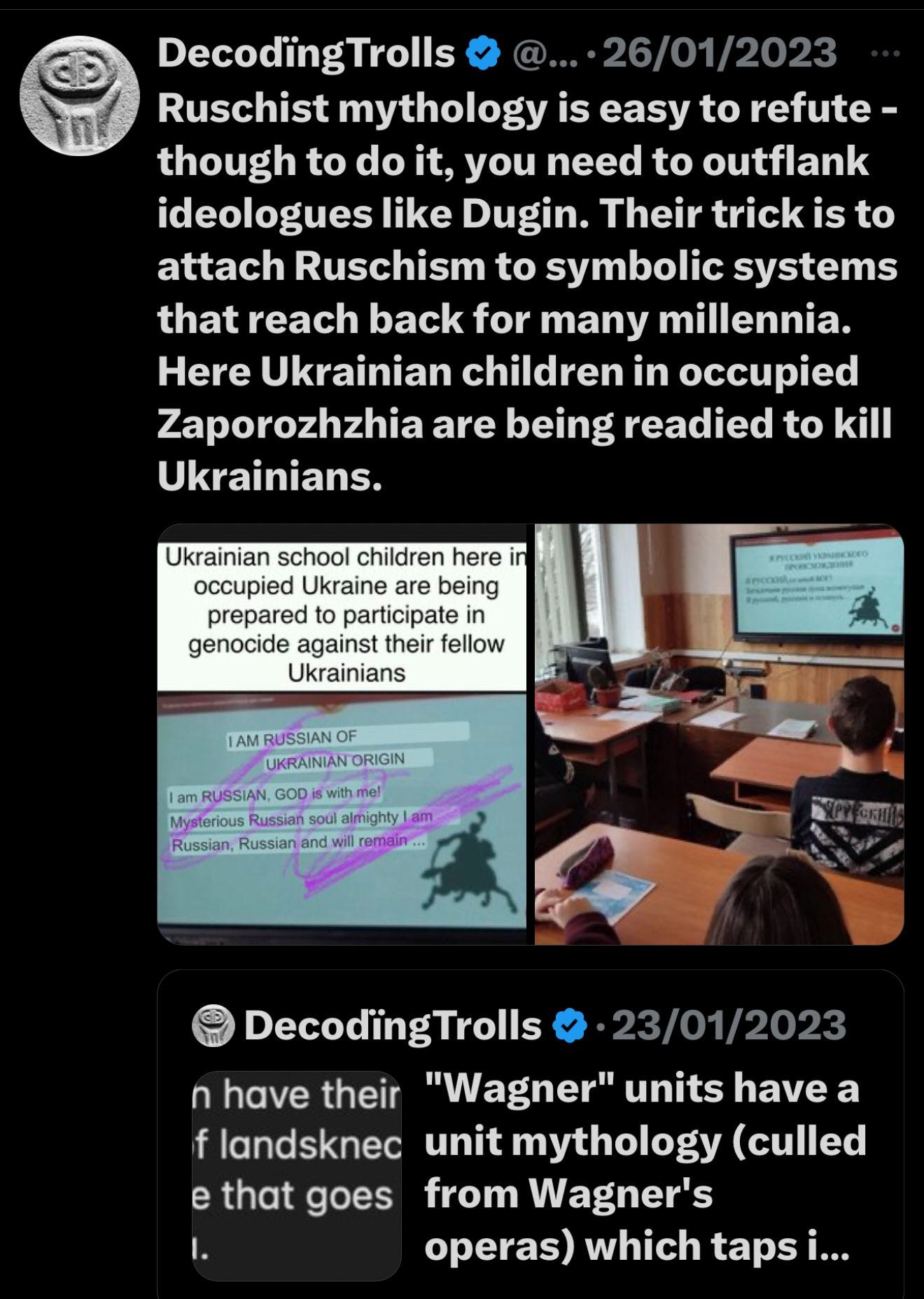
I’ve got all the citations that Meh₁not was the word for moon that the ancient Ukrainians used. And when we see this guy Lunin, for instance — this fake FSB-operation walk-in that we’ve seen this week — yet again, they’re appealing to the moon, which is the fundamental substrate you use, and that the Russians appeal to, when you’re trying to justify ancientness. And for the Russians, it’s like a reflex. That’s how you outflank them.

I mean, it’s quite involved, and you have to spend a lot of time. But if you start arguing over whether Cheburashka really is a moon demon or not, you won’t get anywhere, because you’re falling for the troll and you’re getting involved in their language. The same applies to Ilyin and this troll about the grand inquisitor.
So I proof this. The golem worship — the worship of this monster — and the grand inquisitor, who keeps us enslaved but it’s better than being free: it’s a permission structure for a security state. That’s its immanence, that’s its mana, that’s its energy — a way of telling the men with the truncheon that their truncheons are holy. Proof it against the Code of Positive Trolls. Is it generous? No — its first premise is that you owe your existence to a machine that owes you nothing. Does it deepen understanding or flatten it? It flattens the human being into raw material for the state’s glory. So this is Disinfolklore. And the counter is to refuse the cathedral entirely. Do not become the philosopher’s sparring partner. Name his function — he is an actor, a justificatory function for the security state — and walk out the side door. The function was never to think, which is what philosophers do. It was to make the golem, the monster, respectable.
The Quote Book Method
Now the operating mechanism — the part of Yakubova’s reading I most want to carry out, because once we see it, we will see it everywhere, in every thoughtful defence of every atrocity for the rest of our lives. How does the Ruschist apparatus actually use this captured philosopher? Not by making us read him. Almost no one reads Ilyin. He’s unreadable, and the Ruschist apparatus is counting on that. It uses him as a quote book. It takes the whole contradictory, century-dead body of a man’s writing and renders it down into a curated quotation bank — a few dozen burnished lines snatched from their unreadable pages and dropped into speeches and textbooks. Remember, Putler himself oversaw the removal of Ilyin’s body from a grave in Switzerland, where he spent most of his life in exile, and his reburial in Russia.
The quotes are dropped into speeches and textbooks exactly where a blessing is required. Yakubova’s point — her argument, not her words — is that nothing distorts reality quite like a quotation torn from its context. The quote arrives wearing the dead man’s authority and none of his hesitations: the philosopher with everything inconvenient sanded off. Here is what the Ruschist apparatus wants you to think: but these are his own words, you can look them up, so how can it be propaganda? It’s a primary source.
Register the energy. It’s the smug confidence of the person holding a citation — the feeling that a quotation is a kind of proof, that the footnote ends the argument. That feeling is the exploit. The Ruschist apparatus has learned that a fragment in quotation marks bypasses our judgment the way a uniform bypasses a checkpoint: you wave it through because it is quoted. Name the archetype: the captured philosopher, reduced to his most weaponised state — no longer even a man, just a dispenser of pre-loaded blessings, like an ATM, a vending machine of gravitas.
And here is the contemporary instance, the one the apparatus runs now, the way it ran Ilyin in the last century: Dugin. Alexander Dugin is Ilyin’s living successor in the wise counsellor’s role — the bearded sage produced for export, handed to credulous Western interviewers as Putin’s philosopher, Putin’s brain, the deep Russian mind you simply must engage with. Same archetype, same function, same quote-book method. He’s not the source of the Kremlin’s appetite. He’s the costume the appetite wears to the lecture hall — an artificial creation, an actor in the role of a thinker, with the beard and the robes to add credibility to the role he’s playing. His only job is to give murderous enterprises a patina of respectability, and to make you feel unsophisticated for noticing.
Proof it against the Code of Positive Trolls. Is it true? The quote-book method is a lie at the level of form, before you reach the content: it presents a curated fragment as a whole, an apparatus output as a man’s mind. Is it generous? No. It’s engineered to make atrocity feel like the conclusion of a syllogism. So this is Disinfolklore, and here is the only counter that works. Read the whole, never the curated fragment. Name the function, not the credential. When a beautiful, terrible quotation arrives to bless a war, do not look it up to check if it’s real — of course it’s real. Ask instead: who assembled this quote book, and for what purpose? The fragment is real; the frame is the lie.
Three Keys, One Lock
So step back. The three moves are one move. The state digs up a thinker and crowns him, so reverence does the disarming. It buys his most absolutist doctrine and dresses it as sacred, so you are flattered into debating it instead of naming it. It grinds his heritage into a quote book, so a fragment in quotation marks can wave any cruelty through the checkpoints of our troll radar. Reverence, debate, citation: three keys, one lock — and the lock is our respect for thought.
So here’s the single thing to carry out of this. The most dangerous archetype is always the respectable one. Philosopher disarmed scrutiny, exactly as Brother did in episode one, and for the same reason: both arrive as friends of something you love — kin in the one case, thinking in the other. Both are the apparatus. Larysa Yakubova named the whole monster with three words I can give you verbatim, because they are her title and they are exact: the Beast from the Abyss. The philosopher is one of the faces the beast wears to the surface — the calmest, the most credentialed, the one who does not roar. See the robe, look under it for the function; and where the curated quotation arrives to make the killing sound profound, read the whole, and name what the fragment was assembled to bless.
The Mirror: Accusation in a Mirror
In the next part I’ll look through the Kremlin’s eyes. Now I want to teach us to catch a thief who has already convinced the room. That’s the claim, stated up front the way I try to state these things. The single most powerful move in the whole combat-propaganda playbook is not a lie about the future or a smear about the past. It’s a mirror. The apparatus commits the crime, and then, loudly, first, before the dust has settled, accuses its victim of exactly that crime. And paired with it is a second device, quieter and even cleverer, that exists for one purpose: to make sure the true accusation can never be spoken at all.
Larysa Yakubova’s whole book is an answer to a question that sounds almost too simple. How did the West miss this? How did serious people — diplomats, scholars, editors — watch the beast form year after year and not see it? Her answer is the spine of this part. The West, she argues, spent more than a century learning Russia and Ukraine from books written to one centre’s specification. It read the region in translation, and the translation was the centre. It was the Kremlin. In her foreword she puts it with a historian’s bluntness: by looking at Ukraine through the eyes of the Kremlin, the West missed the birth of its ontological enemy. Sit with that phrase — missed the birth. The thing was being born in plain sight, and the West did not see the labour, because it had been handed a map on which that corner was simply blank.
My anchor here is Tool 2, the troll radars — the mental gatekeeping that works in both directions, which you can find on disinfolklore.eu in the 12 tools. The incoming radar that screens what enters your mind, and the outgoing radar that governs what we ourselves send out. The specific failure Yakubova diagnoses is a troll-radar failure: recalibrated over generations to the enemy’s own frame, so that it could no longer register the threat sitting in front of it. We proof every move against the Code of Positive Trolls — is it generous? is it true? is it patient? — and we name the archetype, because once you can see it operating you can’t unsee it, and recognition halves the mana.
Here’s the move in its purest form — and James’s question about reflexive control, which sparked that series of five or six programmes, looked at this as well, so you see how immanent it is in my work. The Russian apparatus carries out an atrocity. Then, before any forensic examiner has reached the site, it points at the people it has just attacked and says: they did this, they did it to us, we’re the ones who suffer here, we’re going to get blamed for this. We have a public name for this, and it’s the oldest move there is: accusation in a mirror. You perform the violation, then you hand the violation to your victim. You hold up a mirror so that the world sees your face on their body.
Yakubova folds this into a larger argument about what she calls anti-truth: a propaganda mode that does not merely bend the facts but inverts them, so that the aggressor occupies the chair of the wronged. I’m paraphrasing her there — those are my words for her idea, not a quotation — but the mechanism she describes is the one I’ve been tracking through all of these shows for over a year now, and indeed all of my work since I worked out accusation in the early part of the full-scale invasion, having spent years thinking about what this provocation logic was all about: the soldiers on the bridge saying, oh, it’s a provocation, that side’s provoking us.
So here’s what the Ruschist apparatus wants us to think: we are the genuine victims, the defender is the aggressor, the blood on the ground is what they spilled, and look how they slander us by saying otherwise. Register the energy, the feeling before the thought. The energy of the mirror is wounded innocence — a great power performing the small, trembling posture of the abused. And the dangerous thing is that the posture is contagious. You start to extend it your sympathy, that injury owed, before you’ve checked who injured whom. That sympathy is the costume. Name the archetype underneath it, and the voltage drops. This is the merciless sovereign performing the grief of the very people he targets: the documented author of the harm, wrapping himself in the mourning cloth of the harmed, so that the next blow can be dressed as self-defence.
Proof it against the Code of Positive Trolls. Is it true? The mirror cannot survive the question, because its entire architecture is the swapping of true position — the doer named as the done-to. Is it generous? No. It spends the suffering of real victims as currency to purchase the next attack. Is it patient? No. It must move first, must accuse before the evidence is in, precisely because the evidence, given time, would convict it. So this is Disinfolklore, and it is the Ruschist apparatus’s single cleverest defence, because a mirror does not argue with you — it just shows you a face, and trusts you not to ask whose it is.
The counter is the decolonial troll radar Yakubova is really arguing for: name the crime in your own tongue, in Ukrainian, on the evidence you can stand on. The question the apparatus needs you never to ask is not “can you disprove their version of this one incident?” It’s the older, sturdier one: who has been doing this as a pattern for years now?
The Preemptive Troll: Russophobia
The second move is the more elegant of the two, because it does its work before we even open our mouths. Suppose the mirror is not enough. Suppose someone does manage to gather the evidence, stand on solid ground, and prepare to name the crime plainly. The Ruschist apparatus has one more device, and it’s aimed not at the accusation, but at the accuser’s nerve. It is the single word: Russophobia. The instant you reach to name a Russian crime, the device fires, and it reframes your naming as bigotry.
I’m paraphrasing Yakubova’s reading here, in my own words. She treats this device as one of the Ruschist apparatus’s load-bearing instruments — the thing that has long preempted honest Western description of what the state was doing. This is exactly a troll-radar problem, and I want to be precise about which radar. Our incoming radar screens what others send at us. But we also run an outgoing radar, the gatekeeper that governs what we ourselves transmit. And that’s what I was trying to use in my answer to your question, Wendy, about Poland — I was trying to proof my answer against my outgoing troll radar, and not fan the flames. And I understand you weren’t asking me to fan flames; you were just asking me a very interesting question, and something I’ve written about as well. But anyway — the internal check that asks: am I being fair? am I being decent? is this beneath me? That outgoing radar is the better angel of an honest mind. And Russophobia is engineered to reach past everything else and corrupt that gate specifically.
It does not try to win the argument. It makes the act of arguing feel like prejudice, so that our own conscience, our own decency, jams our own signal before it ever leaves us. The apparatus turns our scruples into a bodyguard. Here is what the apparatus wants us to think: to name what Russia does, to name the manner of what Russia does, to gather all the patterns and name them, to label them, to designate them — to name what Russia does is to hate Russians. A fair-minded person, a person who is not a bigot, holds their tongue. Our discomfort is our conscience telling us to stop.
Register the energy. It’s self-doubt wearing the mask of fairness — that hesitation a good person feels at the edge of a hard word, hijacked and pointed back at them. Name the archetype: this is the reverse victim, the perpetrator who preloads the charge of bigotry so that any future naming detonates it instead. BLM, woke — same trick.
There is a real lineage here, and I attribute it carefully — not to Yakubova. The US State Department’s Global Engagement Center, in its January 2024 report, traced the term Russophobia’s modern career back through Soviet usage to a 19th-century pedigree, and to a dissident-turned-nationalist, whose name I won’t try to pronounce, whose own work carried open anti-Semitism. I mention it only to say that this is not a neutral word the Ruschists happened to overuse. It is, by documented descent, a manufactured shield. It’s an anti-Semitic trope. It was used against Russian citizens who happened also to be Jewish, to say that anything they said in criticism, or in trying to improve things, was an act of Russophobia. And what that instantly did — which is what the entire Russian state and constitutional architecture did — was to reduce Russian citizens who happened to be Jewish to having a different nationality, which is textbook anti-Semitic: to allocate to Jews some loyalty to a state which is not their own. In fact, they are just as Russian as any other Russian, in any definition we would accept in any other country. By branding them Russophobes, they were at once removed from the Russian society of which they formed a constituent part, and scapegoated. And then that Russophobic meme is used against any of us who label what Russia’s crimes are.
So let’s proof it against the Code of Positive Trolls. Is it true? No. It answers no factual claim. It’s just “you’re Russophobic.” It changes the subject from the crime to the motive of the one naming it. Is it generous? It’s the opposite of generous. It weaponises the listener’s own decency against the truth. Is it patient? It’s pure preemption. It fires before we speak, which is urgency turned inward. So this is Disinfolklore: the preemptive troll, the device built so that the accusation can never be made.
The counter is the hardest discipline on the troll radar, and it’s the one his whole book performs: do not let the word confiscate the word. When you have done the work, when you can source the crime, you name it as a crime, by its name, in your own language. And you do not surrender that naming to a label designed to make you flinch. Refusing to flinch is not bigotry. It’s the outgoing troll radar working exactly as it should: passing the true signal, declining the manufactured shame.
The Kremlin’s Eyes: The Outer-Realm Monster as Frame
There’s a place in Yakubova’s argument where she arrives that I’m not going to soften, because this whole series on her book has been climbing towards it. When the West sees a region only through the eyes of the Kremlin, it does not simply make an academic error. It surrenders the ground on which the crime could be named at all. And that surrender is what let the Ruschist apparatus grow unseen, until it was strong enough to put the world before a stark choice.
Larysa Yakubova frames that choice in existential terms — and again, I give it as my paraphrase of her, not as her quotation in Ukrainian. The beast forces a decision between subjecthood — peoples and nations with the standing to speak, to name, to be authors of their own story — and totalitarianism, in which one centre dictates the frame and everyone else reads from the script it wrote. There is no comfortable middle. To keep borrowing the Kremlin’s eyes is slowly to choose the second.
Here is what the Ruschist apparatus wants us to think: there’s no neutral ground to stand on, so you might as well stand on ours; our frame is just the way things are; resisting it is eccentricity. Some of us will remember that guy who was the first governor of fake Novorossiya, saying: if you don’t want to be ruled by us, we’ll kill you, we’ll kill millions of you; if we have to kill five million of you, we’ll kill five million of you. That’s this imperialist, extremist viewpoint.
And register the energy in that, because it’s subtle, and it is fatigue — the weariness that says: who am I to insist on my own words against the established account? Name the archetype. This is the outer-realm monster in its largest form. The mirror and the preemptive troll were tactics; this is a dramatising frame that wants to be mistaken for the horizon itself, so that stepping outside it feels not like courage but like madness. They serve a world in which only one centre, the centre Moscow, gets to say what is true.
Proof it against the Code. Is it true? No. It presents a manufactured frame as a natural order, which is the foundational lie beneath the other two. Is it generous? No. It asks every other people on earth to surrender their own tongue. Is it patient? It has been patient for a century, which is its most frightening quality — but patience in service of an inversion is not the patience the Code of Positive Trolls means. It’s a long con. So this is Disinfolklore at the largest scale — such a large scale that so many people can’t even conceive of Disinfolklore at this scale.
And the counter is the one I’ve been building to: the decolonial troll radar in full. Refuse to see through the Kremlin’s eyes. Take our own eyes back. Name the crime in our own language. Don’t let one word, Russophobia, confiscate another. Choose subjecthood — yours, ours, and every targeted people’s — over the frame that wants to be the only frame. That refusal is not a small act of editing. In Yakubova’s telling, it’s the whole fight.
The mirror and the preemptive troll — i.e. Russophobia — are the two cleverest defences Disinfolklore owns. They are clever for the same reason: neither of them argues with you. The mirror shows you a face and trusts you not to ask whose it is. Russophobia reaches past the argument entirely, so our own decency does the silencing for free. Both of them win by getting inside our gatekeeping, recalibrating our troll radars to the enemy’s frame, so that the threat reads as the victim and the honest word reads as the bigotry. Which is why the counter is not a better argument. It’s a better radar. The troll radar that refuses the frame is the whole answer. We do not adapt our seeing to the Kremlin’s specification. We keep our own eyes. We name the crime in our own tongue — which all of us do on Volya Radio. We can do it on Volya Radio. We can do it on Twitter. Amazing. And we do not let a manufactured word confiscate a true one. That is what Yakubova means when she says the West, looking through borrowed eyes, missed the birth. The eyes of the battlefield: take them back, and the beast loses its best cover.
Closing
Next time, in the final episode, I’ll talk about the final part of her book, which answers the question: is there light at the end of the tunnel? And at the risk of ruining it for you — yes, there is light at the end of the tunnel. But I think you wouldn’t be listening to Volya Radio if you didn’t believe there was a light at the end of the tunnel. So I’ll leave it at that for tonight. That went really quickly for me; I hope it went quickly for you. Out.
Next episode:
Podcast | Metanoia or the Reboot?

This is the last episode of my mini-series on Larysa Yakubova’s The Beast from the Abyss.
Podcast | In Defence of "Ancient Ukraine"
We say ancient Greece and ancient Egypt without a flicker, and we call a Bronze Age culture in Kazakhstan the first Aryans — every one of them a modern name thrown back over a people who never bore it. The homeland of the whole Indo-European family is the Dnipro Valley. So, by the rule we already use for everyone else, there is an ancient Ukraine. To withhold the name is not scholarly caution. It is a double standard. And there is a war behind it.


