


We say ancient Greece and ancient Egypt without a flicker, and we call a Bronze Age culture in Kazakhstan the first Aryans — every one of them a modern name thrown back over a people who never bore it. The homeland of the whole Indo-European family is the Dnipro Valley. So, by the rule we already use for everyone else, there is an ancient Ukraine. To withhold the name is not scholarly caution. It is a double standard. And there is a war behind it.
Say ancient Greece, and nothing in you objects. Say ancient Egypt, ancient Rome, ancient China — all of them slide past without a snag. Now say ancient Ukraine, and for a great many people, something catches: a small resistance, a raised eyebrow, sometimes a flat correction. “But Ukraine is a modern country.” That catch — not the linguistics, not the archaeology, just the catch itself — is what this is about. Because of all the things worth defending about this work, the plainest is the right to use two ordinary words.
Part of what people feel here is simply correct. Modern Ukraine is a modern state. Its present borders, its flag, its seat at the United Nations are 20th-century phenomena. The herders who lived in the Dnipro Valley 5,500 years ago did not call themselves Ukrainians. They did not know the word, and could not have pointed to a country on a map that did not exist. All of that is true. But notice that every word of it is just as true of ancient Egypt.
The people who raised the pyramids did not call themselves Egyptians. That is a Greek word, Aigyptos, laid on them long after. And the people who live in Egypt today are, for the most part, Arabic-speaking Muslims, whose language and faith and much of their ancestry arrived more than a thousand years after the last pharaoh — about as discontinuous from the pyramid builders as a population on its own soil can be. By that same standard, ancient Egypt should be an outrage. But it troubles nobody. It troubles no one because everyone already understands, without being told, what an anachronistic name is for. Ancient Egypt does not claim that the modern nation descends in an unbroken line from the pharaohs. It names the ancient people of that land using the land’s modern moniker, because the land’s modern moniker is the handle we have.
Ancient Britain does the same. The modern English are largely descendants of Anglo-Saxon incomers, not the people who raised Stonehenge, nor the Celts — the Pretani tribe — who, after being eradicated by the Romans, then the Germanics, and then the Normans, survive as a rump in Brittany in France and in Cymru, which is Wales, in the west of the country. No one accuses a book on ancient Britain of bad faith. Ancient Greece names the Hellenes, who never called themselves Greeks at all; Graeci is a Roman’s word for them. Every single one of these is a modern label thrown backward over a people who never wore it.
Naming a People by a Country They Would Reach a Thousand Years Later
In fact, we go much further than naming the ancient people of a land by that land’s modern name. We routinely name an ancient people by the modern name of a different land — one their descendants would reach only a thousand years later. Consider the Sintashta culture, dug out of the steppe of what is now Kazakhstan.
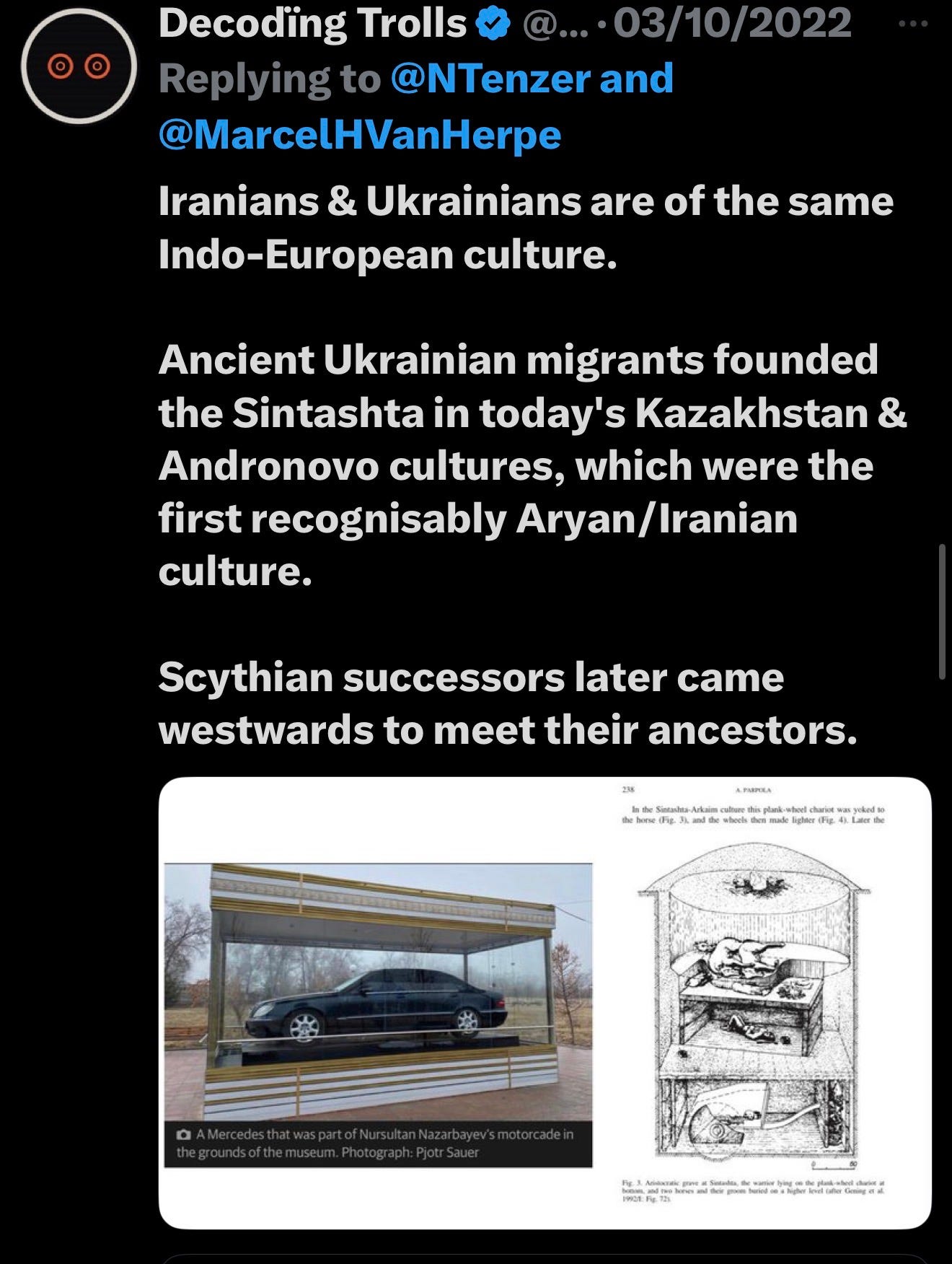
When the Sintashta graves were discovered about 20 or 30 years ago, deep inside them were the exact copy of burial customs and funereal feasts that had been written down in the Rig Veda in India around 1100 BCE. Archaeologists and experts had assumed that these burial practices and funereal ceremonies, written down in the Rig Veda from around 1200 to 1100 BCE, had been invented. And then we find, thousands of kilometres away, the exact facsimile of them from 2000 BCE.
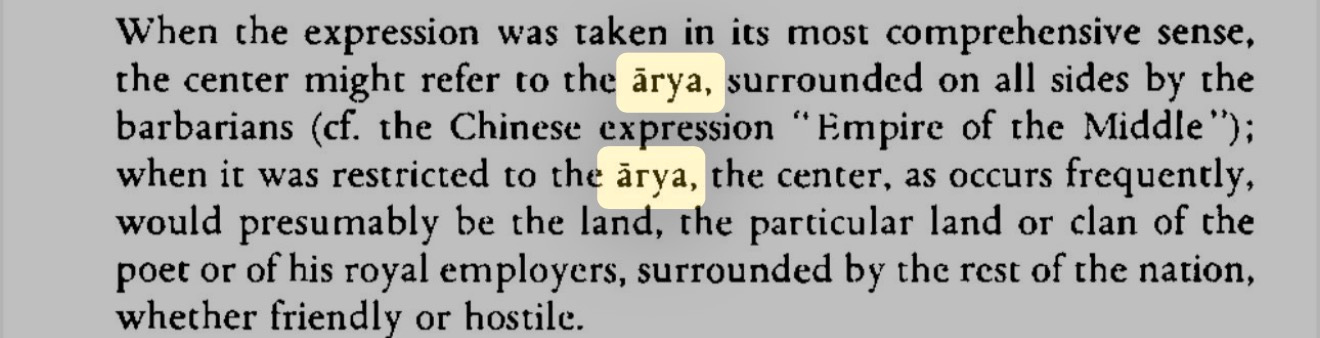
Every account you will read calls these people the first Aryans, or Indo-Iranians, and the names are borrowed wholesale from India and Iran — lands the Sintashta themselves never saw. Remember, 2000 BCE; but their customs do not appear in India, or we have no evidence of them appearing in India, for another 900 years. Iran and Aryan as identities did not exist in their time. They arose, as I have noted elsewhere, from a religious reform by Zoroaster that came along long after the Sintashta culture had risen and passed. Zarathustra — Zoroaster — is about 1400 BCE, so about 500 years between the Sintashta and when the Zoroastrian reforms came in and the whole idea of the Arya, meaning the centre of a community, arose.

From the Sintashta’s own standpoint, there was no Iran, no India, no Veda; it was 2000 BCE, no Zoroaster — only the grass and the chariot and the horse. But we call them Aryans anyway, reading the rich later record of their descendants — the Vedic hymns, the Zoroastrian fire — back into a preliterate people who would have found every one of those words meaningless. It is, in my own phrase for it, anachronistic yet defensible. And it is defensible: the back-propagation is sound because the descent is real. We have the archaeogenetic evidence of it. We have the archaeological evidence of it. And we now have the textual evidence.
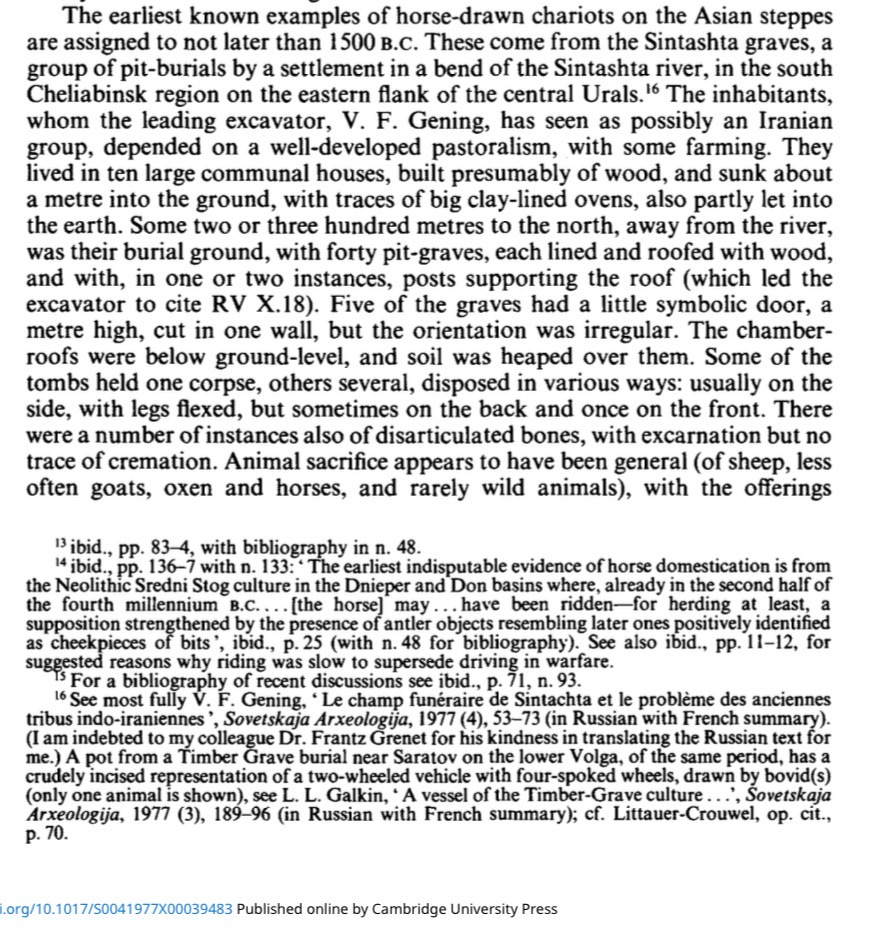
“The first Aryans” for the Sintashta is the loose kind: it names the people of one place by the later name of a country their great-great-great-grandchildren’s grandchildren would build somewhere else. We accept the loose kind without a murmur. Ancient Ukraine only ever asks for the tight kind — the easier, safer, more literal move. If we grant the harder courtesy to the steppe of Kazakhstan while refusing the easier one to the steppe of Ukraine, that is not a principle. It’s a preference dressed as a principle. If the naming rule is the same for everyone, why does ancient Ukraine alone catch the throat?
The Catch Is a Lag, Not a Position
The reason is not about Ukraine at all. It’s about us, and what we happen to have read. We grant the back-propagated name confidence, evidently, wherever a dense later record makes the deep past feel anchored. Egypt has its monuments and its hieroglyphs; Greece its Homer; Rome its libraries; India and Iran their scriptures. The Dnipro homeland left no writing, and the knowledge that it is the homeland is genuinely recent. It arrived in force only with the archaeogenetics revolution after 2015, when the reading of ancient DNA — together with the linguistics, the archaeology, the comparative mythology, and the isotopes, the strontium locked in ancient teeth that tells us where a person grew up — converged on a single answer.
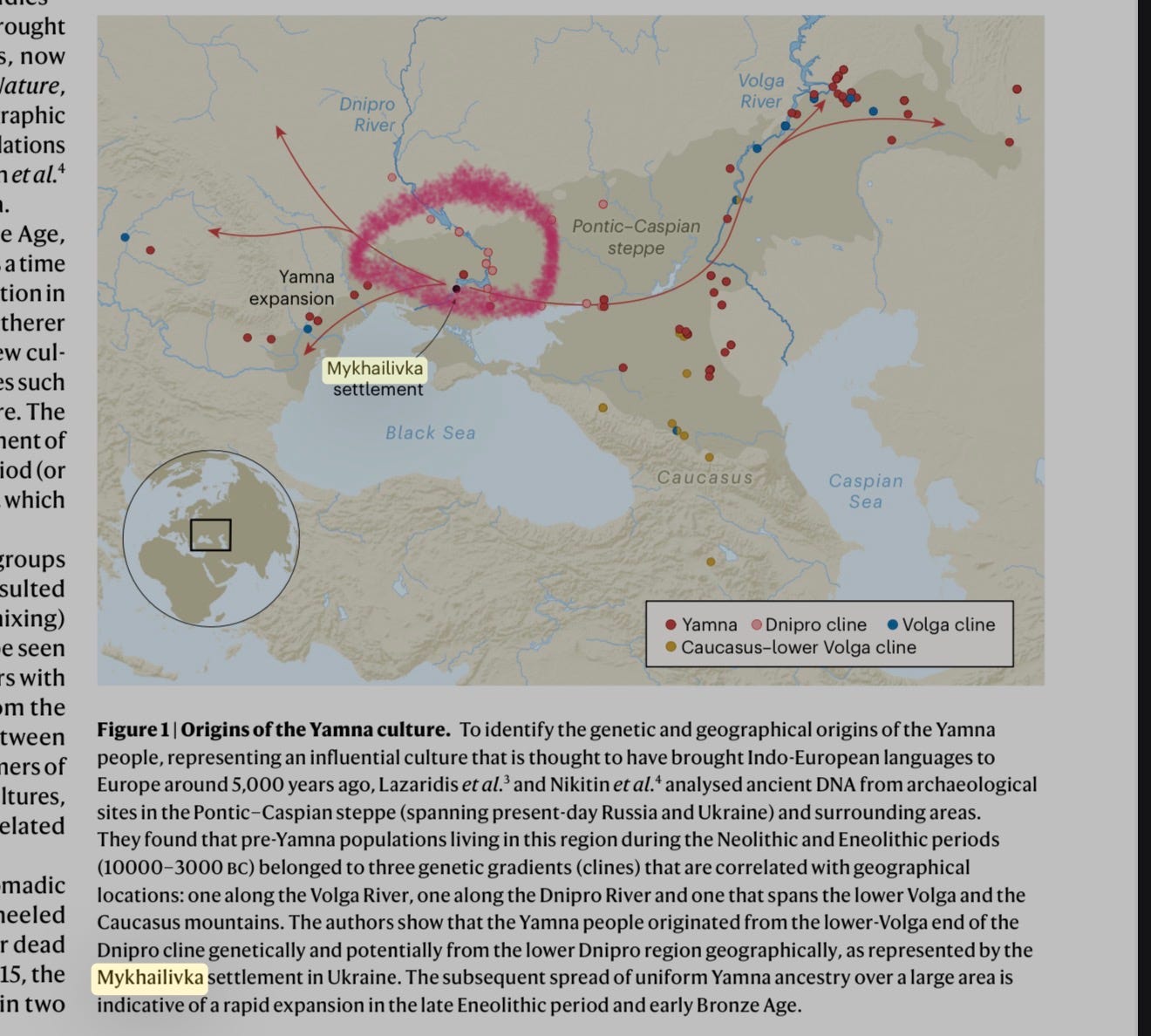
So the hesitation over ancient Ukraine is not a considered position. It’s a lag. The moniker has not yet caught up with the evidence. Most of us still carry the mental map we were handed in school. That map is out of date, and the correction is not a fringe claim. Multidisciplinary scholars have known since 2015 that all Indo-European language, religion, and culture — all living Indo-European languages, from Ireland to India — go back to the Yamnaya of the Dnipro Valley around 3600 BCE: the herders of Mykhailivka, from whom the ancient DNA now traces every living branch of the family.
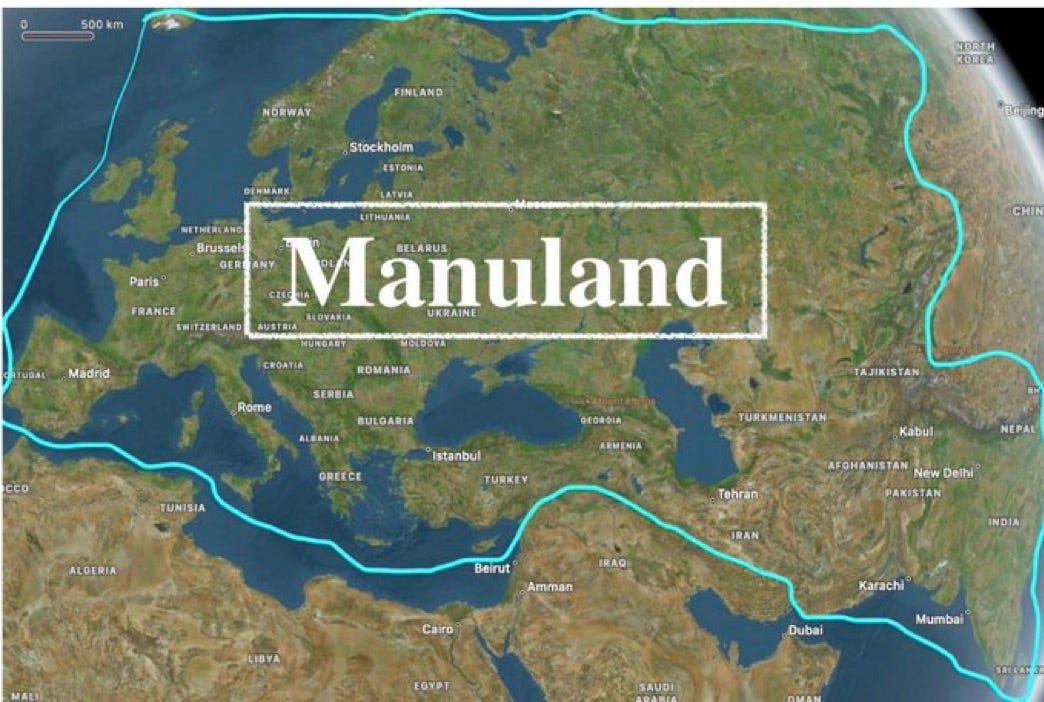
And I note — two days ago the Russians destroyed a Russian colonial-era mansion which I visited in a village near Mykolaiv, on the right bank of the Dnipro. Some of you might have seen the pictures of it. Another war crime by Russia. But anyway. I’m with the linguist Don Ringe, author of the definitive study on the origins of the Germanic languages, including English, on the location. In 2006 he wrote that it was the rivers and valleys of Ukraine that made the most sense; and then in the new edition, 2017, he said the evidence strongly points there. Nikitin et al.’s Nature paper, which I’ve spoken about before, from the 5th of February 2025, establishes beyond all reasonable doubt that the Yamnaya, and Mykhailivka village on the right bank of the Dnipro, was the centre of the Yamnaya community from whom all living Indo-European languages emanate.
Steinmeier, the Nebra Sky Disc, and “Southern Russia”
So what kept the answer from being heard for so long was not the absence of evidence. Some of you might remember, around the beginning of the war, I tweeted a lot about Steinmeier, who is currently German president. On my way back from Ukraine — I left Ukraine on the 29th of January 2022 with my cat, and we drove over the border into Poland, anticipating the invasion — I visited an amazing place called Halle in Germany, because I wanted to see the Nebra Sky Disc there. They have this most amazing museum in Halle, which I stopped in on my way back from Ukraine, and the exhibition catalogue had an introduction by Steinmeier.
The exhibition I’d gone to see was about the Corded Ware culture from this part of Germany. And Steinmeier — who had spent eight years trying to troll Ukraine into accepting the Steinmeier formula, which was allowing Russia’s so-called elections in Donetsk and Luhansk in exchange for a later promise to give Ukraine back control of its borders — Steinmeier, who clearly had engaged with Ukraine, like myself, a lot, was still referring to this area of Ukraine as southern Russia in this catalogue.
That gives you an idea of what I now call the data-resistant archetype of the Potemkin State: that they could not refer to the homeland as just steppe ancestry, or Pontic-Caspian steppe, or southern Russia. They couldn’t see it as being Ukraine — as having just the same status as ancient Greece, or any of these other cultures I mentioned.
Ukraine Is Not One More Culture — It Is the Source
Here’s the part the catch hides, because it stops people at the threshold. Ukraine is not one more ancient culture among many asking to join the club. It’s the source. Greece, Rome, the Germanic North, the Celtic West, the Indo-Iranian East — the papers in all of my work in Finding Manuland trace them one by one, based on PACA, peer-reviewed, gold-standard archaeogenetic, isotopic, archaeological, and linguistic evidence. And every one is a daughter, a branch carried downstream from the same upper Dnipro River. Much of what we love best about ancient Greece and Rome and Germany and Ireland was forged first on the Dnipro.
I say this without taking anything from these daughter cultures. They are the glory of what the family became out in the wide world. The recentering is not a demotion of them. It’s a recognition that they share a cradle, and that the cradle has a place on the map.
So set the practice we already keep against the one case we balk at. We grant ancient Egypt to a land whose modern people are largely discontinuous from its ancient ones. We grant the first Aryans to a Kazakh culture, by the name of a country far away and centuries late. We say ancient Germany, though the first unified German state dates only to 1870 — I’ve spoken before about Herder’s call in 1873, or 1875, or 1876, one of those dates; Herder, who said “where is our Shakespeare? We must unite the Germanic tribes, and to do this we need a collective culture, something to rally around, like England has Shakespeare.” That began the folklore-collecting movement that Goethe and the Grimm brothers and eventually Wagner used to create a sense of a German identity. We say ancient France, though France is younger than the United States. We even have the Belgians reaching back to a pre-Christian chieftain, Brennus, whom I’ve spoken about before, and to the Menapii, to furnish a 19th-century nation with a deep past.
We project backwards all the time. As I’ve put it, affording parity of esteem among all the great cultures that have achieved statehood requires an equitable allocation of anachronistic and teleological names. Was Bismarck German? Was Napoleon French? Of course we say so, and of course we should. But they weren’t, when they lived. There was no Germany before 1870, for most of Bismarck’s life. There was no France for Napoleon — there were the Franks, the Germanic aristocracy who had taken over France. And the only culture from which we withhold the courtesy is the one with the best claim of all: the source. There’s no principle that grants the name to every daughter and denies it to the mother. There’s only the catch.
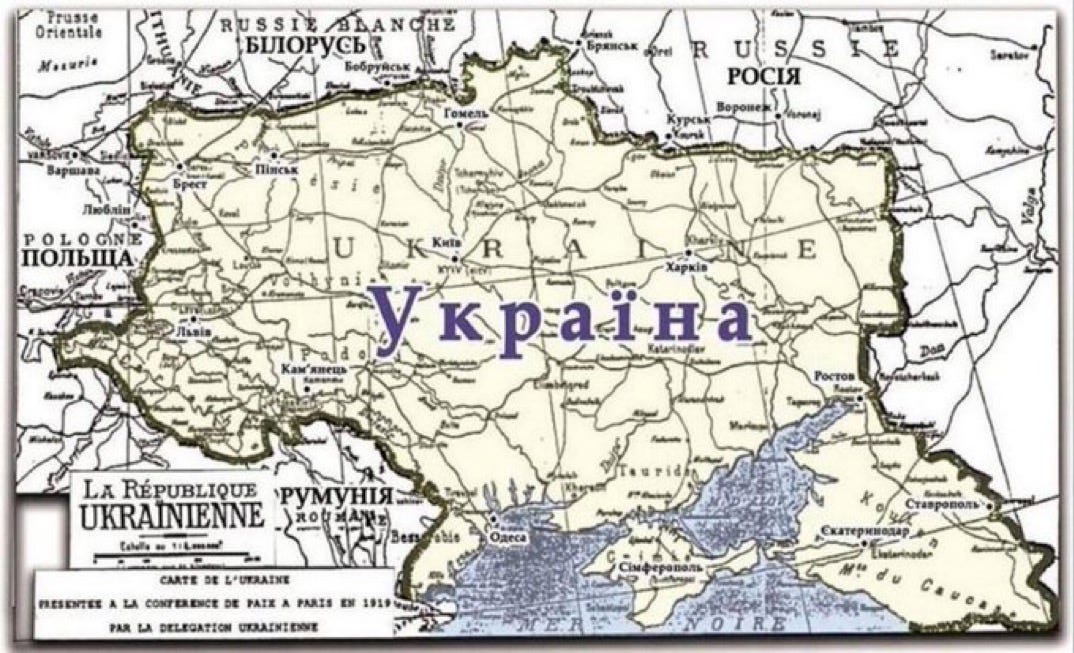
There is, in fact, a continuity case for Ukraine too — the branch that never left the homeland, treated in its own paper, which I’ve written. “Ancient Ukrainian” is a territorial name, like “ancient Egyptian.” It names the ancient people of this ground, and that alone is enough. With Egypt, Greece, and the Aryans laid side by side, a real question is left standing. If the rule is the same for everyone, and the evidence for Ukraine is in fact the strongest of all, then why does the resistance fall on this one word, ancient? The rule is enforced in exactly one direction. Ancient Egypt passes without a word. Ancient Ukraine alone catches. That asymmetry is the tell, and naming it is where all my work begins.
The Data-Resistant Archetype and the Potemkin State
In my study of Disinfolklore, I call a certain kind of mental model a data-resistant archetype: an idea planted so deep that it no longer updates on the evidence. Such an archetype digests and processes all the data about it, and the output is always the same. It is, in plain terms, impervious to truth. There is a specific archetype at work on Ukraine, the one I call the Potemkin State. It is the picture of Ukraine as hollow, fake, accidental — a country without real depth or history.
That picture, crucially, is double. The Potemkin State is both the actual brittle thing across the border, and the mental state — the thing propaganda installs in our own brains. So when a thoughtful, decent person accepts ancient Egypt without a blink and bristles at ancient Ukraine, they’re not reasoning. They’re reporting the archetype. The catch is the archetype speaking. Most of the people who feel the catch are not ill-willed. They have simply inherited a map, and the map was drawn in part by an interested hand. For a century or more, the deep past of this region has been narrated through a Russian and Soviet lens that had every reason to keep Ukraine shallow: to file the homeland as southern Russia, to treat the Ukrainian nation as an emerging thing, a province, a recent administrative line. The catch you feel at “ancient Ukraine” was, to a real degree, put there.
Why the Deep Past Is a Field the War Is Fought On
If this were only a quarrel about nomenclature, it would not be worth your time or mine. It is worth it because the shallow picture of Ukraine and the killing of Ukrainians are the same picture, doing two jobs. The Russian state does not merely dislike Ukraine. It denies, as a matter of doctrine, that Ukraine is a real state and that Ukrainians are a real people. “Ukraine, never a real state; Ukrainians, not a real people” — that is the propaganda’s own words.
That denial is not rhetoric idling. It’s the legal and psychological precondition of the crime. I trained as a lawyer, and the point is not subtle. When a state announces that another nation has no right to exist, and then kills that nation’s people in a war to denationalise them, it has supplied both halves of genocide: the intent and the act. Denial of the existence of a protected group is, in the language of the United Nations, a specific indicator of genocide. Denationalising a country is genocide. The erasure of Ukraine’s past and the erasure of Ukraine’s present are one motion. And the premise is false on its own terms anyway, because Ukraine signed the United Nations Charter as a founding member, and that is the only test international law recognises. It has been a state all along — longer than many other states.
So the deep past is not a sideshow to the war. It is one of the fields the war is fought on. To insist, gently and accurately, that there is an ancient Ukraine — that the people of this land were not latecomers to the human story but stood near its Indo-European beginning — is to take back a piece of the ground that Russia’s lie depends on.
Re-archetyping: Use the Words
The picture in our heads is not fixed, and that is the hopeful part. An archetype can be replaced. The work I call re-archetyping — the conscious effort to disrupt, alter, and reconstruct our existing mental models — has a task here: to catch our monikers up with where the scholarship has already arrived, and to do it across the whole university at once: in archaeology and linguistics, in archaeogenetics and isotopic analysis, in the study of religion and comparative myth, in how the deep past of Europe is taught to our children.
It is happening. The historian Timothy Snyder has moved, since the beginning of the war, the start of his history of Ukraine back from the first Greek colonies on its coast around 700 BCE to the Yamnaya era, two and a half thousand years before that, from whom the first Greeks emanated. The Economist has lent its voice to decolonising what we still call prehistory. The data-resistant archetype, as I keep insisting, is not invincible, and it is our work to defeat it. The smallest, most available act of re-archetyping is the one anyone can perform today, at no cost: use the words. Every time we say ancient Ukraine, and mean by it exactly what we mean by ancient Greece or ancient Egypt — the deep past of a real land and a real people — we recenter the map a little, and we repopulate the world.
This is what my paper on the Turkic takeover of Anatolia does to the idea of the Semitic-first ideology, which undermines a lot of our history — rather than seeing the interactions, over two millennia, between the Indo-Europeans in northern Mesopotamia particularly, but also in Turkey, where the first Indo-European writing, from 2000 BCE, at precisely the same time the Sintashta were there, appeared in Kanesh, in an Assyrian trading colony. The Amarna Letters from ancient Egypt, from 1400 BCE, show in textual evidence — so this is 300 years before the Rig Veda was standardised and written down — Indo-European monarchs ruling Canaan, four centuries before the Hebrew Bible, before King David and King Solomon. So the routes reach back past the Near East to the Dnipro, and the old reflex that civilisation began in the Fertile Crescent gives way. That’s work which has come out in the last few weeks.
Whether the lagging name is Indo-Germanic, or southern Russia, or simply the awkward silence when ancient Ukraine is mentioned, our work should be one work: to bring the moniker up to date. I’m quite deliberately introducing the term ancient Ukrainians, and ancient Ukraine, into our civilisation — not as a slogan, not to take a thing from anyone, but because it is true, by the same standard that makes ancient Greek and ancient Egyptian and the first Aryans true. Ancient Ukraine: the cradle of a family that reaches from Ireland to India, standing at last on the ground where it has always been. So that’s what I have to say about that.
The Salted Ground
I was then going to move on to a couple more archetypal analyses. I wanted to talk about the salted ground. One week, around the same bridge where all of this began for me, three small things landed together. A volunteer battalion commander accused the regular Ukrainian army of something. A big social media channel sneered that, while tanks roll through Luhansk, my old employer, the OSCE, is off attending a bridge opening repaired by the hard-working people of Luhansk with the help of God. This is all in the media, in the Luhansk Corpus, which I collected between 2015 and 2018.
No victims were named, no date, no incident you could check — just a place, a real place, a place I knew, being smeared lightly from several directions at once. You could feel it: a low, diffuse unease settling on the name of the town, Stanytsia Luhanska. Something’s wrong there, from the perspective of the Russian propaganda media. Something otherworldly. And your instinct, as a propaganda analyst, is to plant a flag and call it a deployment. This method makes you stop.
I tested it against the pattern of the bridge troll, the gatekeeper who extorts the crossing — and it doesn’t fit. Nobody’s been denied passage. I tested it against the bogeyman, the nameless looming enemy, and it almost fits; but the piece that makes a bogeyman dangerous, the protector who arrives to save you from it, simply isn’t there yet. So the verdict is: not yet. This is not a mature piece of Disinfolklore. It’s what I call salted ground — a place being seasoned with disrepute now, so that a real operation can detonate on pre-poisoned soil later. A detection method that cried propaganda at this stage would be useless. It would burn its credibility before the real strike came. The discipline to say not yet, but watch this ground, is not the method failing. It’s the method working.
The Innocent Apparatus
The militia chief in occupied Luhansk, by contrast, explains in another news item that some Ukrainian soldiers died near Shchastia — which means “happiness,” and it’s a city the Russians destroyed in the first months of the first full-scale invasion. More precisely, it was Prigozhin’s men who destroyed it. But this is long before then, and it’s a town I used to go through almost every day when I worked in Stanytsia. The militia chief in the occupied territory says the Ukrainian soldiers died because they were rigging a bridge to blow, and something went wrong with the vehicle carrying the ammunition — it exploded early. In the very next breath, “our positions,” he alleged, “came under mortar fire from Kiev five times in a day.”
There’s a flatness to the charge here. He’s almost bored. They did it to themselves; we’re the ones being shelled. It doesn’t reach for your fury, and that weakness is itself a tell. In this method, when the emotional charge is faint, you’re usually looking at raw material, not a finished weapon. I run it through the test I built for manufactured wounds — the move where an aggressor invents or self-inflicts an injury and then points at it. Two threads are there: the speaker plainly benefits from the framing, and his side is structurally never at fault. The enemy’s dead are always self-inflicted; the shelling is always one way. But the core of a true manufactured-wound operation — being the documented cause of the wound you’re crying about — isn’t on the page. So no archetype convicts. What I name here is the innocent apparatus: not a finished story, but a posture being preset. “We are never the ones at fault.” Lay that foundation now, and the later strike inherits the innocence.
The Forecast Phantom
Now the one I would build a lot around, because it’s the purest little machine there is — and the Disinfolklore method still won’t formally convict it. That tension is the most honest thing I can show you.
In April 2016, the militia headquarters announced that Ukrainian forces are preparing provocations using OSCE symbols to discredit the mission. Two cars with OSCE insignia were stopped near Smile village. The militia does not exclude the possibility that they could be used to stage something on the territory of the Folk’s Republic. Read that again, and hear what’s not in it. Nothing happened. No so-called provocation occurred. The only actual fact — two cars drove off — is in the same report, exactly as the OSCE said: our cars were in the car park. The menace lives entirely in the future tense: preparing, could be used, does not exclude the possibility.
That is the device. A threat asserted in the future tense can never be falsified in the present, because it hasn’t happened yet; and when it doesn’t happen, that just proves how dangerous the preparations were. Its target is precise: it pre-discredits the neutral witness before that witness can report anything inconvenient. I stood behind that insignia. This is the story that was built to make you not believe me before I opened my mouth. I call this the forecast phantom. By the strict rules of the Disinfolklore method, it is four-fifths of a bogeyman, missing only the rescuer. So I do not formally convict it, and I will not bend the rule to make the number prettier. But the pattern is named, and a named pattern is the defused one. That is the whole craft.
The Mirror Wound
This one I have to handle with care, because at the centre of it is a real child who was really hurt, and nothing I’m about to say takes that away. In December 2015, while I was living in Russia-occupied Luhansk, the so-called Luhansk Folk’s Republic’s Ministry of Emergency Situations — and, just as an aside, every time Mockers reads “Ministry of Emergency Situations,” my eyes go up, and I know her eyebrows are raised as well; just the idea that a modern state would have to have a Ministry for Emergency Situations tells you all you really need to know about Russia, and then, when it establishes its fake occupying republics, it ensures they too have Ministries for Emergency Situations, but that’s an aside — they put out a notice saying a 15-year-old near Teplychne stepped on an anti-personnel mine and was seriously injured. And then the notice adds this: despite the fact that in 1980 the UN adopted a convention prohibiting the use of mines against a civilian population, and that in modern wars mines are rarely used.
Feel what that does to you. A maimed child — remember the mother and the maiden archetype — a maimed child, the enemy’s mine, the enemy (which is Ukraine in this story) breaking the very law written to protect children. The pull is protective fury: the deepest, fastest charge there is, the one that fires before thought. And that is exactly why I do not trust the feeling. I make myself apply the rule, not the fury.
Here the method does something I want you to notice, because we confront this all the time — whether it’s about Starobilsk, or in Palestine, or in the school massacre by Donald in Minab. The strong instinct is to call this the mother and the maiden, the violated innocent. The rule says no, though. The text names a physical injury and nothing more — no act done to a child, as a child, in the way the archetype requires. The feeling says fire. The discipline says no. It was a mine; it was an anti-personnel mine. The discipline wins.
But then the deeper test fires. Who is telling me this? The same apparatus whose own mines, elsewhere in this very archive, kill civilians it then blames for infiltrating despite the signs. It lays mines, it cries about the enemy’s mines, and it reaches for the children’s convention to harvest your indignation. That move has a name: the mirror wound. You attribute to the adversary precisely the harm your own side also does, then you quote the protective law to bank the outrage. The child’s wound is real. The operation is the mirror. Hold both of those at once.
The Witness, Not the Weapon: Where the Method Says No
I want to end this little mini-series on the one where the method says no most importantly of all, because this is where a lesser instrument would do the most damage. In December 2015, in central Luhansk, the occupation’s police — its Berkut — arrest a handful of young people for burning a Russist flag and chanting what they call nationalist slogans: 20-year-old Natalia, 19-year-old Yevhen, 17-year-old Artem, a schoolboy, arrested in an occupied city for the identity they would not hide.
Now, every surface signal here is screaming at the recogniser: children, arrest, identity, loyalty. That is the exact silhouette of the changeling — the disloyal-by-identity operation. A crude detector, or an analyst hungry for a hit, fires here instantly and feels clever. The Disinfolklore Analytical Method refuses to. And the reason is the whole reason this matters. This text is not a weapon aimed at you. It is a Ukrainian outlet bearing witness to a real act of repression. The story isn’t running an operation on the reader. It’s reporting one being run on those three young people. The mana is faint precisely because nothing has been done to you. Something is being done to them, and you are being told about it.
So the verdict is: this isn’t Disinfolklore. And here is what that verdict does and does not mean. It does not exonerate the apparatus. Criminalising a teenager for his flag is grim and real, and the apparatus’s conduct is changeling to its core. What the method refuses to do is flatten true witness report into a propaganda artefact, just because its surface is seductive. A method that cannot tell the weapon from the witness is not a method. It is the confirmation bias it claims to cure. The discipline to say this one is testimony, leave it standing, is the most important move there is. The Disinfolklore instrument knows what to say — and that’s why I was compelled to invent the name Disinfolklore, to cover instances like this.
The Closed Factory
I’ve got one more story, which I’ll tell you. It’s a very quick one. In every Soviet-era industrial town in Russia-occupied Luhansk, it tells you the same story when you arrive. Before the war, we had a factory. The factory’s now closed. Kiev destroyed it. In my corpus of 10,000 propaganda items, 165 carry this blame-swap formula. It’s the single most effective economic Disinfolklore item I have catalogued, because it meets the listener at the site of their greatest pain. Unemployment is real; idle factories are real; collapsed pensions and lost skilled work are real. Russia’s Disinfolkloreists do not need to invent the wound. They only need to re-label the wound’s cause.
Let me read you the canonical example. 17th of February 2017: LPR and DPR heads Plotnitsky and Zakharchenko expressed concern over the condition of industrial infrastructure facilities located in Kiev-controlled parts of Donbas, and demand that Kiev let the republics’ observers carry out inspections. Notice the grammar. The pretenders position themselves, with no discernible irony, as the conservators of Ukrainian industrial heritage. This is the closed factory archetype in full regalia. The logic: step one, the factory is closed — true, the war closed it. Step two, Russia and its proxies did not close it, Kiev closed it — false, the front line closed it. Step three, Russia’s rule would restore the factory — undeliverable, but emotionally activating.
The Stakhanov Carriage Works, the Lysychansk Oil Refinery, the Severodonetsk Azot chemical plant, the Alchevsk Metallurgical Combine — my corpus is full of them, each one in the occupier’s mouth. The promise is emotionally adjacent to true historical memory, and this is common to all of the nostalgia, far-right, Russia-inspired parties across the whole of Europe — and indeed MAGA. The Soviet Union did keep these factories open. The men who ran them for 40 years, their fathers ran them. The bread on the table came from the factory. The sense of dignity, of skill, of identity — all of it was rooted through the factory gate. When the factory closed, something deeper than a payroll died.
Russian Disinfolklore taps this grief with surgical precision. The closed factory archetype does not need the promise of the Soviet Union back. It only needs to whisper: we remember, Kiev forgets. And here is the cruelty. The archetype was deployed by actors who have no ability to reopen the factory. The occupation strips the machinery, exports what can be exported, lets the rest rust, and promotes a puppet mayor to make New Year’s announcements about the resumption of work of the city-forming Alchevsk metallurgical plant — a resumption that, by the actual measurement of production, never arrives.
The counter is to name the shells. Every closed factory in Donbas has a date, coordinates, a shell fragment, a casualty report, and reports about how the Russians are taking away all of the contents and selling them for scrap. Many of the shells that arrived were fired by Russian-backed positions. My corpus holds the entries and the evidence. Name the shell that cracked the wall. Name the brigade that lost electricity. Name the pensioner who never got paid because a Russian-supplied munition hit the administrative building. Grief for the closing factory is legitimate. Its direction is in question.
The Wise Counsellor’s Poison: The Captured Philosopher
A couple of weeks ago I started Larysa Yakubova’s The Beast from the Abyss, so I’m just going to start one of those — the penultimate episode of that — and then I won’t go beyond another seven minutes, I promise. This is the wise counsellor’s poison episode, the fourth in this miniseries.
I want to begin tonight with the most flattering trick in the whole arsenal, because it is the one that works on the cleverest people — the ones who think they are too clever to be worked over. You have spent the last three episodes learning to distrust the bully and the brother. Now I’m going to ask you to distrust the man who reads: the grey beard, the shelf of difficult books, the one who does not shout, who sighs. The one who, when the tanks roll, does not cheer them — he explains them, gives the killing a reason, a lineage, a melancholy grandeur. He is the wise counsellor, and he is, I will argue, the single most dangerous figure Larysa Yakubova names in her whole book, The Beast from the Abyss — more dangerous than the soldier or the propagandist, because they announce themselves, and the wise counsellor does not.
Here is the claim up front. The philosopher is not the source of the doctrine. The philosopher is the apparatus speaking, in a robe and a beard borrowed to disarm your scrutiny. Tonight’s anchor is Tool 1, archetypal literacy, turned on the most respectable archetype there is: the philosopher. Philosopher disarms in exactly the same way brother disarmed us. In episode one, if you remember, we talked about the fraternal-brotherhood troll that the Russists used to justify their murder of Ukrainians. Brother switched off your defences by invoking love. Philosopher switches them off by invoking thought. Both are costumes worn over the same machine.
The Man They Dug Up and Called the Pushkin of Philosophy
Yakubova built this whole investigation to crack one costume in particular — the one Moscow has been polishing for 20 years. Let’s open it. In 2005, the Russian state did something a confident culture never needs to do. It went looking for a dead philosopher, and it found Ivan Ilyin — an émigré ideologue who died in Switzerland in 1954, a man of white fascism, a monarchist of the most revanchist kind — and brought his bones, literally brought his bones, home to Moscow with honours. Putler himself has stood at Ilyin’s grave. Russian university rectors have called Ilyin, with a straight face, the Pushkin of philosophy. His texts get pressed into the hands of governors and FSB officers. A dead man was exhumed and installed as the official mind of a living state.
Here is what the apparatus wants you to think. Russia is not a brute. Russia is a civilisation. It has a philosopher — a deep, suffering, orthodox thinker who saw the truth about the West a century ago. When Russia acts, it acts not from appetite, but from thought. And here, here is the thinker to prove it.
Register the mana first, that feeling before the argument. It is reverence — the small, automatic genuflection an educated person makes towards the word philosopher. You feel yourself slowing down, lowering your voice, preparing to consider. That hush is the weapon. A state that can make you reverent has already made you a little bit obedient.
Now name the archetype under the robe. This is the captured philosopher: the credentialed thinker whose actual function is not to think but to bless — to lay a patina of respectability over an enterprise that, stripped of the robe, is simply murder organised at scale. Yakubova does the stripping herself — a member of the Ukrainian National Academy of Sciences, no less — with a single devastating question, which I give you as her argument, not her words. She asks, in effect, whether a revanchist, monarchist, fascist apologist can be the conscience of anything. That is Tool 1 in its purest form: refuse the credential, look at the function.
Proof it against the Code of Positive Trolls. Is it true? Is it generous? Does it open the mind or close it? The Ilyin operation fails on the first question alone. It’s just not true. It’s a manufactured genealogy. So this is Disinfolklore, and of the most ambitious kind, because it does not target your fear or your grief. It targets your respect for thinking itself, and it turns it into a leash.
Next week, God willing, I’ll continue this and talk about how Yakubova treats the Golem and the Grand Inquisitor, who of course is that great grand character in The Brothers Karamazov. So that is it for this week. Wonderful. Thank you so much for being there. Out.
Podcast | The Lie as Binding Agent, the Pickup Artist, Their God Is War, and the Vanished Koshchei

I am going to continue today the series on The Beast from the Abyss, this brilliant book by a renowned Ukrainian historian. Last week, you may remember, I got to her chapter on the deep folk — which is the moniker that the Russist former deputy prime minister of Russia, Vladislav Surkov, used. He used this term, deep folk, to describe, highly ironically, the Russians, and Larysa is basically parsing this troll into its parts and making a play on the words.


